What it shows
This family is for the Sun, which the simulator does not draw. Never look at the Sun through any instrument without a certified filter over the front of it.
What it is for, goal by goal
Every score with the sentence behind it, highest first.
- Sun5/5 ExcellentProminences standing off the edge, filaments across the disc, and a Sun that changes by the hour. The instrument is the filter: its etalon and blocking filter are built in, and nothing else is needed. Every time: certified filter over the front · finder capped · never an eyepiece filter · an adult with children · never without the filter.
- Travel4/5 GoodOne tube on a photo tripod. Solar observers take these on holiday.
- With a child3/5 FairProminences hold a child's attention like nothing at night does, but the tuning is an adult's job and the price is a real commitment.
- Photo3/5 FairSolar imaging with a phone at the eyepiece is surprisingly good, and a dedicated camera turns it into a genuine speciality.
Not for this
- Moon & planets0/5 NoNever. The etalon passes one wavelength of sunlight and blocks everything else, including the Moon.
- Deep sky0/5 NoNever.
- Learn the sky0/5 NoThere is one object, and the instrument cannot see any other.
Not scored: Serious photo.
What it does well
- Prominences, filaments, plages and flares — the living Sun, not the flat disc white light shows
- Changes visibly over an afternoon, which nothing else in the sky does
- Small, light, and the target is up in daytime
What it costs you
- It shows the Sun. It shows nothing else, ever, at any price — there is no night-time use
- Tune-able etalons are a skill, and the view on a mistuned one is a disappointing red disc
- A 40 mm costs what a 250 mm Dobsonian costs. Be certain the Sun is what you want before this is what you buy
The Sun, safely
The Sun with this family
The instrument is the filter: its etalon and blocking filter are built in, and nothing else is needed.
Prominences standing off the edge, filaments across the disc, and a Sun that changes by the hour.
Every time
- A certified solar filter over the FRONT of the instrument, fastened so it cannot slip or blow off.
- Cap or remove the finder. It is a second telescope, and it has no filter.
- Never a filter at the eyepiece end: the concentrated sunlight there can crack it in an instant.
- With children, an adult is there every time.
- Never look, or point, without the filter on. Check it before each use; a scratched or torn filter goes in the bin.
Sources for the Sun
- American Astronomical Society — How to View a Solar Eclipse Safely — filters on optics go on the front; eclipse glasses never with optics; children supervised
- American Astronomical Society — Solar Filters for Optics — eyepiece filters are dangerous; the finder capped, removed or filtered; the filter attached securely
- American Astronomical Society — About the ISO 12312-2 Standard — EN ISO 12312-2:2015 covers naked-eye viewers only; no international standard covers filters on telescopes, binoculars or lenses
- Société astronomique de France — Guide des observations solaires — a filter at the front, never one screwed into the eyepiece, the finder capped
- NASA — Keep Your Eclipse Glasses to See the Sun's ‘Freckles’ — a large enough sunspot shows through eclipse glasses
- AAVSO — Le Guide d'Observation Solaire de l'AAVSO, v1.1 (2017), p. 6 — archived copy — “Les ouvertures plus grandes que 100 à 125 mm sont généralement limitées par les effets de turbulence atmosphérique”; 50 to 80 mm is enough to count sunspots
Next to it
Smaller
Nothing smaller in this family.
Bigger
Small telescope with a front-mounted white-light solar filter- +25 mm
- +0.5 kg
- −€1,000 at entry level
The models
Each price is the cheapest one observed, with its date. Links marked paid link earn us a commission and cost you nothing extra; the list is ordered by price, then by name — never by what pays. How this site is funded
| Model | Aperture | Focal length | Weight | Eyepieces supplied | Cheapest observed | Buy |
|---|---|---|---|---|---|---|
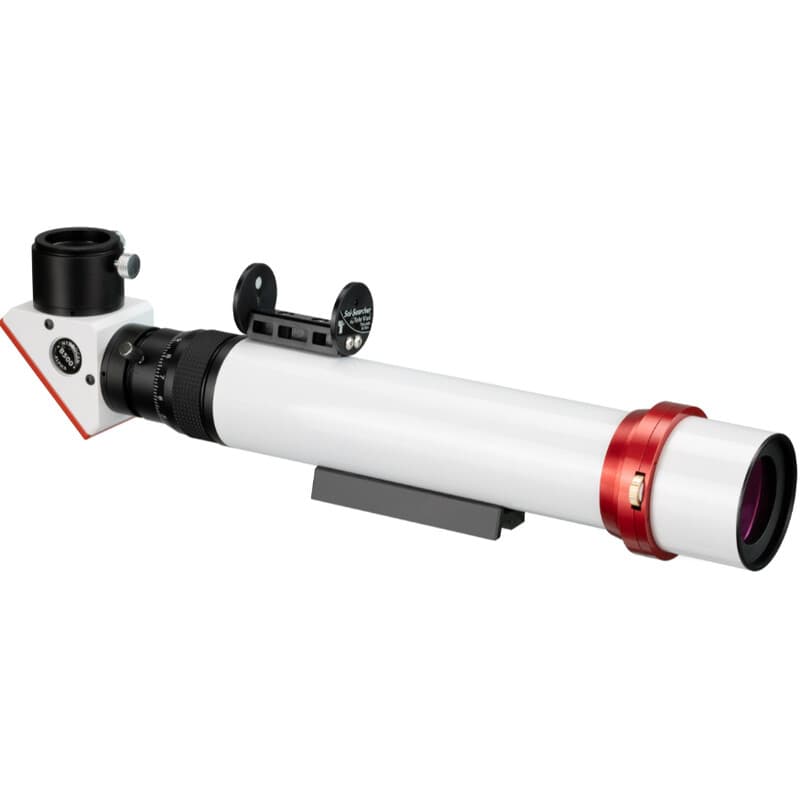 Lunt Solar Systems LS40THa B500 Lunt Solar Systems LS40THa B500 | 40 mm | 400 mm | 1.2 kg | — | €990seen 7 Oct 2026 at Astroshop | At Astroshoppaid link4 other sellers
|
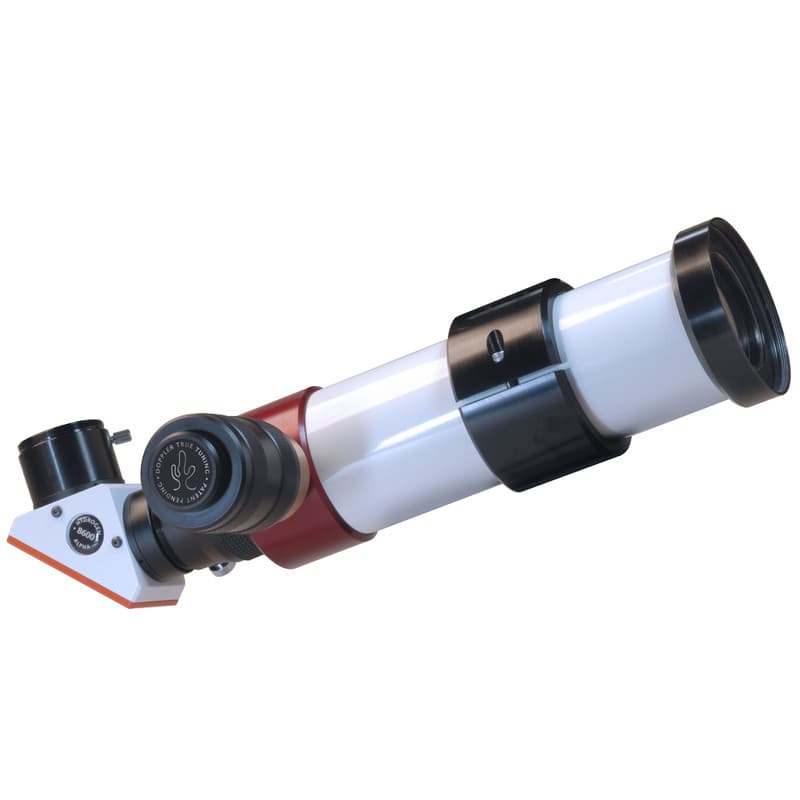 Lunt Solar Systems LS50THa B600 PT Lunt Solar Systems LS50THa B600 PT | 50 mm | 350 mm | 1.4 kg | — | €1,390seen 7 Oct 2026 at Astroshop | At Astroshoppaid link4 other sellers
|
Questions people ask
Hydrogen-alpha or white light?
White light shows the surface: spots, granulation. Hydrogen-alpha shows the Sun's atmosphere: prominences at the limb, filaments on the disc, flares — a Sun that changes by the hour. For about ten times the price. Every time: certified filter over the front · finder capped · never an eyepiece filter · an adult with children · never without the filter.
Can I use it at night?
Never. The filter passes one wavelength of sunlight only; the Moon and stars are invisible through it. Every time: certified filter over the front · finder capped · never an eyepiece filter · an adult with children · never without the filter.
Isn't 40 mm too small?
For the Sun, light is plentiful; the filter does most of the work. Aperture limits fine detail (2.9″ at 40 mm by Dawes' limit), which is enough for prominences and filaments. Bigger costs a great deal more. Every time: certified filter over the front · finder capped · never an eyepiece filter · an adult with children · never without the filter.
Read next