What it shows
There is no eyepiece to look through: this family puts an image on a screen, built from minutes of stacked exposures. What that image shows depends on exposure time and processing, not on a view the simulator could draw honestly.
What it is for, goal by goal
Every score with the sentence behind it, highest first.
- Photo5/5 ExcellentThe standard recommendation, and the one most people wish they had taken before buying a mount.
- Travel4/5 GoodPacks into a camera bag.
- Serious photo2/5 WeakA stepping stone. Serious deep-sky work needs a proper equatorial mount and guiding.
- Sun2/5 WeakPhotographs of the whole disc and its spot groups, taken through the lens. Nothing to look through. The cell has to hold each model's own outside diameter, so it depends on the model: from €45 for the smallest (30 mm) to €69 for the largest (70 mm). Each model's page names its own. Every time: certified filter over the front · finder capped · never an eyepiece filter · an adult with children · never without the filter · measure first.
Not scored: Moon & planets, Deep sky, Learn the sky, With a child.
What it does well
- A fifth of the price of an imaging telescope setup, and it teaches the same skills
- Wide-field targets — the Milky Way, Orion whole, Andromeda in context — that no telescope can frame
- Short focal lengths forgive tracking error, so results come quickly
What it costs you
- Assumes you already own a camera
- Small targets stay small. Galaxies other than Andromeda are not really available
- Still needs polar alignment, and still needs dark skies for the faint stuff
The Sun, safely
The Sun with this family
The cell has to hold each model's own outside diameter, so it depends on the model: from €45 for the smallest (30 mm) to €69 for the largest (70 mm). Each model's page names its own.
Photographs of the whole disc and its spot groups, taken through the lens. Nothing to look through.
- 30 mm: outside diameter not sourced — once measured, one of: euro EMC SF100 1B (48–61 mm), Omegon Helievo 60 (44–68 mm), euro EMC SF100 (57–71 mm), Omegon Helievo 72 (64–88 mm) (€45–€55).
- 70 mm: outside diameter not sourced — once measured, one of: euro EMC SF100 (57–71 mm), Omegon Helievo 72 (64–88 mm), Omegon Helievo 92 (84–108 mm), Omegon Helievo 112 (104–128 mm) (€50–€69).
The listing names no standard; no international standard exists for filters on telescopes, binoculars or lenses (AAS).
Counted against this family: €55, the filter for its smallest model — its cheapest route, where its price band starts.
Every time
- A certified solar filter over the FRONT of the instrument, fastened so it cannot slip or blow off.
- Cap or remove the finder. It is a second telescope, and it has no filter.
- Never a filter at the eyepiece end: the concentrated sunlight there can crack it in an instant.
- With children, an adult is there every time.
- Never look, or point, without the filter on. Check it before each use; a scratched or torn filter goes in the bin.
- Measure before ordering. A cell that sits loose can fall off.
Sources for the Sun
- American Astronomical Society — How to View a Solar Eclipse Safely — filters on optics go on the front; eclipse glasses never with optics; children supervised
- American Astronomical Society — Solar Filters for Optics — eyepiece filters are dangerous; the finder capped, removed or filtered; the filter attached securely
- American Astronomical Society — About the ISO 12312-2 Standard — EN ISO 12312-2:2015 covers naked-eye viewers only; no international standard covers filters on telescopes, binoculars or lenses
- Société astronomique de France — Guide des observations solaires — a filter at the front, never one screwed into the eyepiece, the finder capped
- NASA — Keep Your Eclipse Glasses to See the Sun's ‘Freckles’ — a large enough sunspot shows through eclipse glasses
- AAVSO — Le Guide d'Observation Solaire de l'AAVSO, v1.1 (2017), p. 6 — archived copy — “Les ouvertures plus grandes que 100 à 125 mm sont généralement limitées par les effets de turbulence atmosphérique”; 50 to 80 mm is enough to count sunspots
Next to it
Smaller
Nothing smaller in this family.
Bigger
Smart telescope (30–80 mm, integrated camera)- +5 mm
- −1 kg
- +€150 at entry level
The models
Each price is the cheapest one observed, with its date. Links marked paid link earn us a commission and cost you nothing extra; the list is ordered by price, then by name — never by what pays. How this site is funded
| Model | Aperture | Focal length | Weight | Eyepieces supplied | Cheapest observed | Buy |
|---|---|---|---|---|---|---|
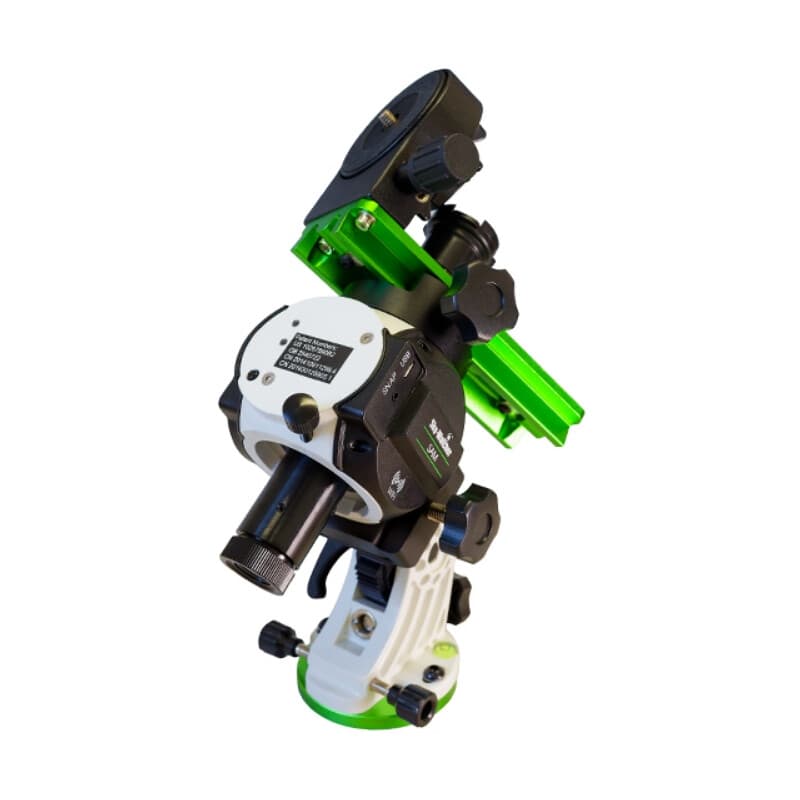 Sky-Watcher Star Adventurer Mini Wi-Fi Astro-Set mount only Sky-Watcher Star Adventurer Mini Wi-Fi Astro-Set mount only | 36 mm | 100 mm | 2 kg | — | €319seen 7 Oct 2026 at Astroshop | At Astroshoppaid link4 other sellers
|
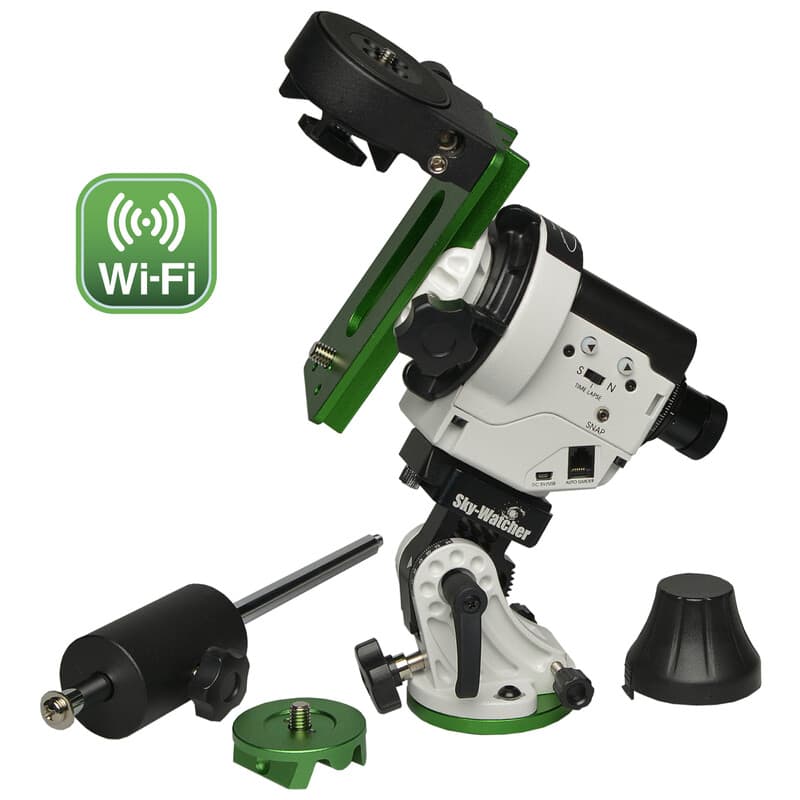 Sky-Watcher Star Adventurer 2i Wi-Fi Photo-Set mount only Sky-Watcher Star Adventurer 2i Wi-Fi Photo-Set mount only | 50 mm | 200 mm | 1.7 kg | — | €435seen 7 Oct 2026 at Astroshop | At Astroshoppaid link4 other sellers
|
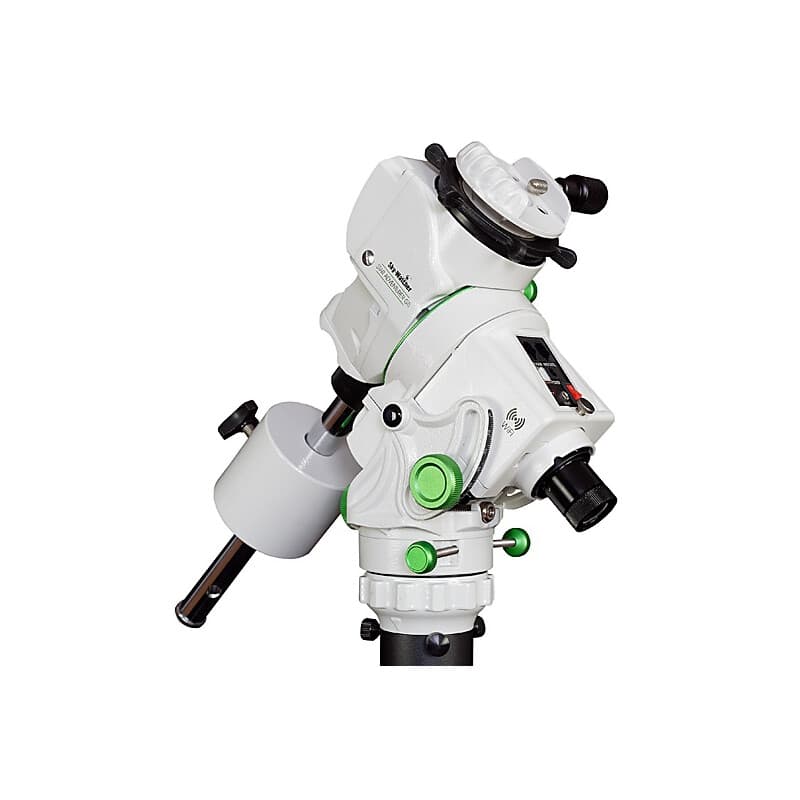 Sky-Watcher Star Adventurer GTi mount only Sky-Watcher Star Adventurer GTi mount only | 50 mm | 200 mm | 4 kg | — | €649seen 7 Oct 2026 at Astroshop | At Astroshoppaid link4 other sellers
|
Questions people ask
Do I need a telescope to start astrophotography?
No — usually the opposite. A tracker, a camera and an ordinary lens photograph the Milky Way, Orion whole or Andromeda in context — framings no telescope allows — and teach the same skills.
Which camera?
Any interchangeable-lens mirrorless or DSLR that allows long manual exposures. A smartphone does not mount usefully. A fast lens between 35 and 135 mm covers most subjects.
Do I need to polar-align?
Yes, every night. At short focal lengths it forgives a lot: at 50 mm a rough alignment holds exposures of a minute or more; at 200 mm it needs far more care. That is a rule of thumb, and it depends on the tracker too.
What about galaxies?
Andromeda, yes, and it makes a fine image. The rest stay tiny at these focal lengths. For them, a proper equatorial mount and a small telescope will one day be needed.
Read next