For the first time, a question that is not about money: for the price of a 200 mm Dobsonian you can buy either a smart telescope that photographs the sky by itself, or that Dobsonian, which shows it to your eye.
The 200 mm Dobsonian the smart telescope costs: Saturn, Jupiter and Orion by eye — Orion grey, because it is grey.
€449seen 7 Oct 2026 at Astroshop
See it at Astroshoppaid link?This link earns the site a commission. Sorted by price, never by what pays.
The cheapest that sufficesThe lowest observed price among these picks that will show the planets and the Moon to the eye better than a smart telescope does.
These are not two levels of the same thing. They are two activities, and this page tries to tell you which one is yours before the box decides.
The short answer
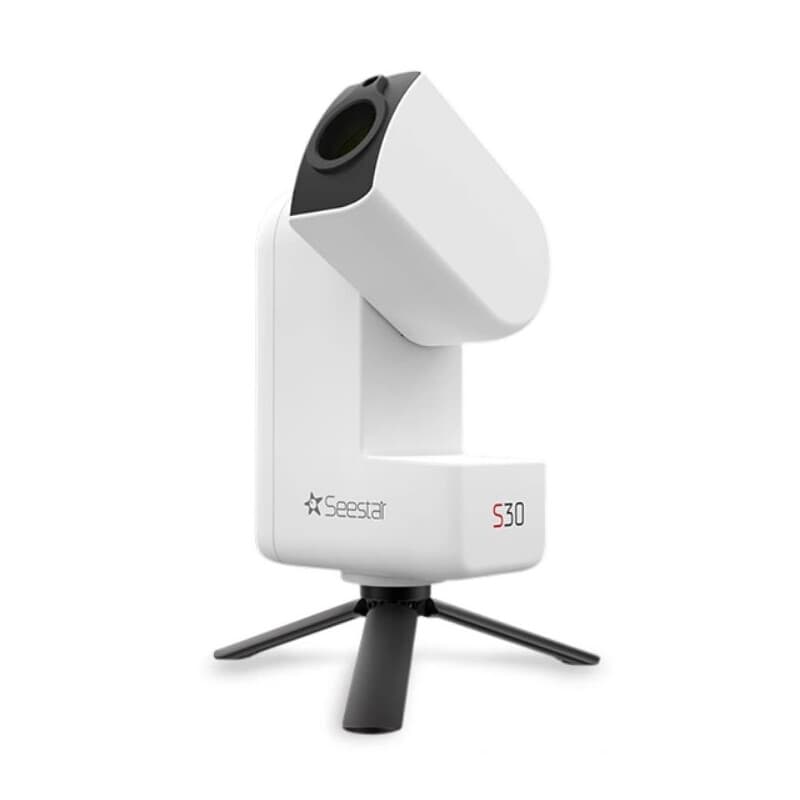
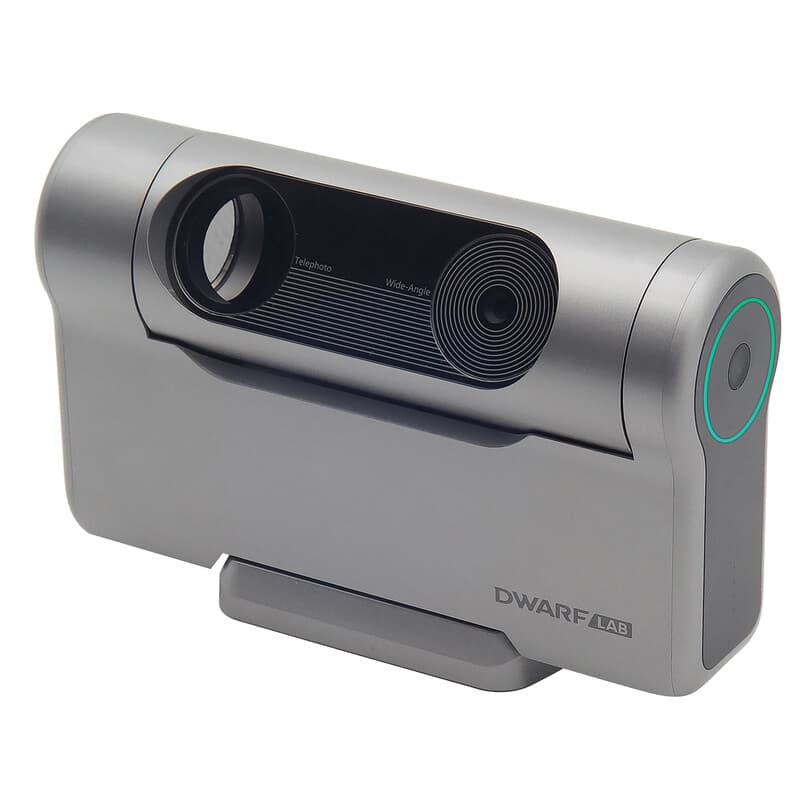
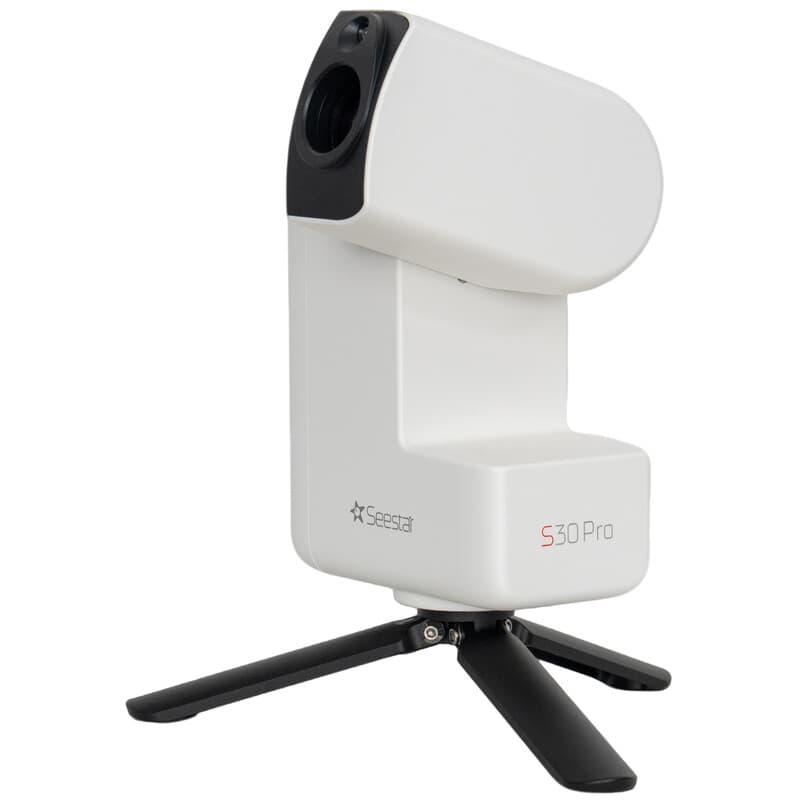
What you want is the image: to keep it, share it, see nebulae in colour from a city balcony. Buy the smart telescope. Seestar S30, S30 Pro or Dwarf 3 — they do this better, more simply and more cheaply than any other form of astrophotography.
What you want is to see: Saturn and its ring, with your own eyes, light that left an hour and a quarter ago. Buy the telescope with an eyepiece. A smart telescope shows nothing to the eye; it has no eyepiece and cannot take one.
You do not know: take the eyepiece telescope, cheaper, and a pair of binoculars. The smart telescope can be bought a year later if the sky has taken hold; the reverse, often, is not bought.
For a child under twelve: the eyepiece. They already have a screen.
At the eyepiece, the Orion Nebula in a 150 mm under a suburban sky is this — a grey shape, a brighter core, four stars in the middle. It is computed, not prettified, and it is genuinely moving for reasons that have nothing to do with colour.
Recognisable150 mm f/7 · 42× · exit pupil 3.6 mm
Detailed200 mm f/7 · 56× · exit pupil 3.6 mm
Orion at the eyepiece, 150 mm and 200 mm, low power, suburban sky. Grey because the eye does not see colour at these light levels. No eyepiece telescope, at any price, shows it pink.
On a Seestar's screen, the same nebula after ten minutes of stacking is pink and blue, with wisps, from the same balcony, under the same sky. That is not cheating: it is what a camera accumulates and the eye does not. But it is a picture of the nebula, produced by software, that you look at on a phone. Many people find it magnificent. Some find it empty. It matters to know which you are before paying.
On the planets and the Moon the relationship reverses. A smart telescope of 30–50 mm aperture shows Saturn as a small ball with a ring, Jupiter as a disc with two blurred belts — less than a 130 mm Newtonian with an eyepiece, for twice the price. If the planets are what draw you, the smart telescope is the wrong buy.
Recognisable50 mm f/7 · 58× · exit pupil 0.9 mm
Detailed150 mm f/7 · 175× · exit pupil 0.9 mm
Jupiter in 50 mm — a Seestar S50's aperture — and in 150 mm, at the eyepiece. The smart telescope does no better than the left circle on planets; its software does not create the detail 50 mm do not gather.
The models
The models, at their observed price
The three French retailers stock. The S30 Pro replaced the discontinued S50.
Saturn, suburban sky (Bortle 6). Computed, not photographed.
One price per model — the cheapest observed offer, with its date — and the button goes to that offer, never to the one that pays. Cards in price order. Links marked paid link earn us a commission and cost you nothing extra. Every seller is listed on the model's page.
Vaonis Hestia, not listed here: a holder for your phone plus an optic; the phone's camera makes the image.
Above €1 500 (Vespera, Unistellar, Celestron Origin): the same idea with more aperture and more software. Not a first purchase.
None of these is named by this site's advisor: it reasons in instrument families, and the smart telescope is a family with its strengths and limits, not a brand. Each price above carries the date it was read; check before buying.
You still need sky. A smart telescope works wonders against light pollution, not against clouds, nor against a balcony facing a wall. Check what you can see of the sky before buying either.
Battery and cold. Three to six hours in summer, less in January — and January is when Orion is there.
The pleasure decays differently. At the eyepiece the hundredth Saturn is as good as the first, because it is the air that changes. On screen the hundredth Orion photo looks like the tenth, and many smart telescopes stop there — unless you genuinely enjoy processing images.
Resale. A used 200 mm Dobsonian is worth 70 % of its price in five years. A 2026 smart telescope will be worth what a 2026 phone is worth.
Both together is how many households end up after two years. Few start with both.
What next
If you arrived here hesitating, the question to ask is not 'which is better' but 'what do I want to hold in my hand at the end of the evening: an image, or a memory'. Both are good answers. They do not buy the same thing.
There is no eyepiece and none can be fitted. The image is on the phone's screen, produced by the camera and the stacking software.
Does a smart telescope show the planets?Saturn and Jupiter, yes, but small and with little detail: 30–50 mm of aperture gather little light and detail.
A 130 mm Newtonian with an eyepiece, at half the price, does better on the planets and the Moon.
Seestar S30 or S30 Pro?The S30 is enough to discover the hobby.
The S30 Pro adds a larger sensor, a wider field and a mosaic mode, for considerably more — both prices are on this page, dated. If you do not yet know whether this hobby is for you, the S30.
Seestar S30 or Dwarf 3?Very close in results.
The Seestar has the more mature app and the better distribution in Europe; the Dwarf 3 is more compact. At similar prices the app decides; both are good first smart telescopes.
Does a smart telescope work in a city?That is its best argument: stacking and filters largely compensate for light pollution on nebulae and galaxies.
It still needs a patch of clear sky and cloudless nights.
Photo credits
These thumbnails are built from real photographs, scaled and darkened by the same arithmetic as the large view.
The Hercules Cluster: Wikimedia Commons, Messier_13.jpg, CC BY-SA
The Orion Nebula: NASA, ESA, M. Robberto (heic0601a), CC BY 4.0
Method and changes
What this page rests on and when it changed, computed from the catalogue — no date below is typed by hand. There is no price history yet, so this log says what was read and when, never whether it went up or down.
6 prices read at Astroshop
Text revised
First published
One price per model: the cheapest observed offer, with its date. Models are ordered by that price, never by what a link pays. How we choose.