Sky-Watcher Heritage 130P FlexTube
A short Newtonian on a small rocker box that sits on a table, a wall or a crate. The best value in astronomy at the moment, and the answer to more first-telescope questions than anything else here.
€197seen 19 Nov 2026 at Astroshop
Price alert
Our price readings have been paused since 24 Oct 2026. Alerts will resume as soon as readings do.
One email when the price we observe for the Sky-Watcher Heritage 130P FlexTube falls at least 5% below the lowest we observed in the previous 30 days. At most one a week.
- 130 mmAperture
- f/5.0Focal ratio
- 6.2 kgTypical weight
- 22–260×Useful magnification
Should you buy it?
- Yes if what you mainly want is sharing it with children, the moon and the planets, learn my way around the sky: that is what this family does best.
Computed from its family's per-goal scores and its own numbers — not a rating, not one evening's opinion.
Where to buy
Also search at First Light Optics · Optique Unterlinden · Pierro Astro · Teleskop-Express (searches; neither price nor stock checked)
1 of these 5 links earn us a commission, marked above. Sorted by price, never by what pays. How this site is funded.
Prices are observed on the date shown, never live. Links marked paid link earn us a commission and cost you nothing extra.
Observed price history
Unchanged at Astroshop: €197 at each of the 28 readings from 29 Sept 2026 to 19 Nov 2026.
Only prices actually read on the retailer’s page, one per day at most; a day without a reading is a gap, not a guess.
What it shows, really
These circles are simulations, computed from the aperture, the magnification and the sky — indicative, not exact. A real night also depends on the turbulence, your eyes and your experience. Closer to the truth than the photo on the box; still not a promise.
Under a suburban sky (Bortle 6), through a common 25 mm eyepiece for wide targets and a 10 mm for planets. Every circle is the true field — nothing is enlarged.
Photo credits
These thumbnails are built from real photographs, scaled and darkened by the same arithmetic as the large view.
The numbers
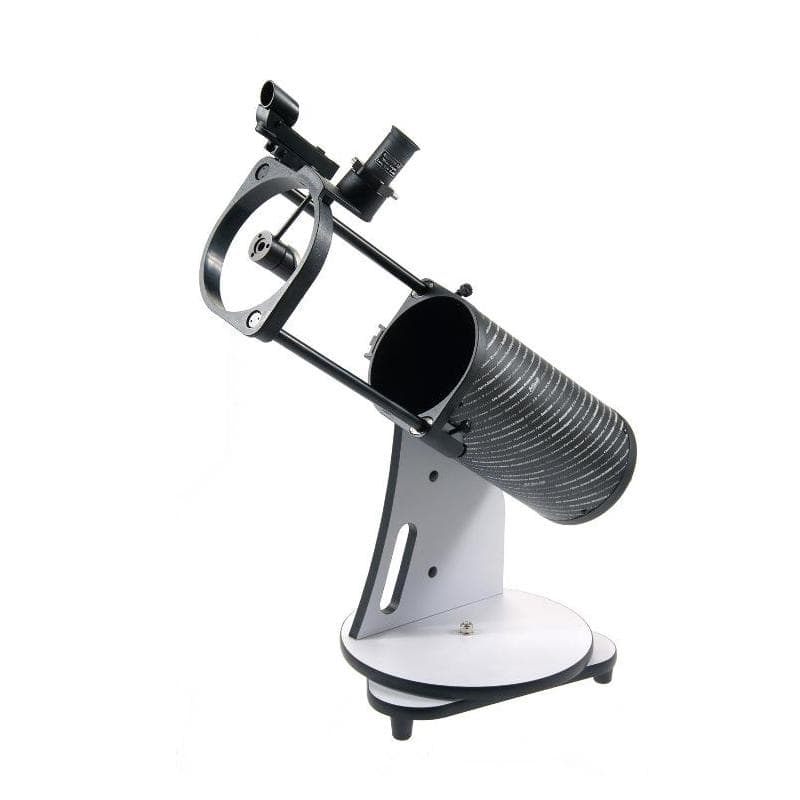 Photo: Astroshop
| Aperture | 130 mm |
|---|---|
| Focal ratio | 650 mm · f/5.0 |
| Mount | Tabletop Dobsonian base, collapsible tube |
| Typical weight | 6.2 kg |
| Eyepieces | 25 mm and 10 mm |
| Collimation | Adjustable at home in five minutes; check it every outing. How to collimate it → |
| Useful magnification | 22× to 260× at 130 mm |
| Resolution (Dawes) | 0.9″ — the tightest double star this aperture can split |
| Faintest star, suburban sky | around magnitude 11.8 |
| Observed price | €197 seen 19 Nov 2026 at Astroshop |
Made for
- Sharing it with children
On a garden table it sits at a child's eye level, and they can move it themselves.
- The Moon and the planets
Sharp on the Moon, and Saturn's rings are unmistakable at 130× on 130 mm (an exit pupil of 1 mm). Jupiter shows two belts and four moons.
- Learn my way around the sky
Fast enough to point that star-hopping stays fun.
- The Sun
In white light: sunspots with their penumbra, faculae near the edge, and granulation on a steady morning. Dawes' limit on the Sun: 0.9″ (116 ÷ 130 mm, arithmetic). Measure the outside diameter first, then one of: Omegon Helievo 132 (124–148 mm), Omegon Helievo 152 (144–168 mm), Omegon Helievo 172 (164–188 mm) (€79–€99). Every time: certified filter over the front · finder capped · never an eyepiece filter · an adult with children · never without the filter · measure first.
The Sun, safely
No solar filter in the box
The Sun with this model
No source we have states the outside diameter of its tube or dew shield. Measure it at the front, then take the cell whose range holds it. For 130 mm of aperture, one of these:
In white light: sunspots with their penumbra, faculae near the edge, and granulation on a steady morning. Dawes' limit on the Sun: 0.9″ (116 ÷ 130 mm, arithmetic).
Past about 100 to 125 mm, daytime air rather than aperture generally sets the limit on the Sun (experience: the AAVSO solar observing guide).
- Omegon Helievo 132 (124–148 mm): holds 124–148 mm, €79 (seen 26 Sept 2026) Astroshoppaid link
- Omegon Helievo 152 (144–168 mm): holds 144–168 mm, €89 (seen 26 Sept 2026) Astroshoppaid link
- Omegon Helievo 172 (164–188 mm): holds 164–188 mm, €99 (seen 26 Sept 2026) Astroshoppaid link
The listing names no standard; no international standard exists for filters on telescopes, binoculars or lenses (AAS).
Every time
- A certified solar filter over the FRONT of the instrument, fastened so it cannot slip or blow off.
- Cap or remove the finder. It is a second telescope, and it has no filter.
- Never a filter at the eyepiece end: the concentrated sunlight there can crack it in an instant.
- With children, an adult is there every time.
- Never look, or point, without the filter on. Check it before each use; a scratched or torn filter goes in the bin.
- Measure before ordering. A cell that sits loose can fall off.
Where these safety rules come from: the sources are listed on the family's page →
The family it belongs to: 130 mm tabletop Dobsonian
What it does well
- Real aperture — several hundred times the light of an unaided eye — at a price that does not need justifying
- Carried outside in one hand, set up in a couple of minutes
- Nothing to align, nothing to power, nothing to fight in the dark
What it costs you
- Needs a table or a wall. On the ground you are lying down
- Needs collimating occasionally — five minutes with a €20 cap
- The supplied eyepieces are usually adequate rather than good
Worth knowing about this model
The most-recommended first telescope of the last decade. The open tube needs a light shield in a garden with a street lamp.
This model against its neighbours
The nearest models of the same family, compared on the catalogue's own numbers. Each price is the one we observed, on the date beside it.
| Model | Aperture | Weight | Observed price |
|---|---|---|---|
| Sky-Watcher Heritage 130P FlexTube this modelTabletop Dobsonian base, collapsible tube · 25 mm and 10 mm | 130 mm | 6.2 kg | €197seen 19 Nov 2026 at Astroshop |
| Bresser Messier 130/650 DobsonTabletop Dobsonian base · 25 mm and 9 mm | 130 mm | 6.6 kg | €219seen 19 Nov 2026 at Astroshop |
| Celestron StarSense Tabletop 130Tabletop Dobsonian base, push-to through the StarSense Explorer phone app · 25 mm and 10 mm | 130 mm | 8.7 kg | €599seen 19 Nov 2026 at Astroshop |
| Celestron StarSense Tabletop 114Tabletop Dobsonian base, push-to through the StarSense Explorer phone app · 17 mm and 10 mm | 114 mm | 7.8 kg | €459seen 19 Nov 2026 at Astroshop |
- With the Bresser Messier 130/650 Dobson, you pay €22 more and keep the same aperture.
- With the Celestron StarSense Tabletop 130, you pay €402 more and keep the same aperture; there is 2.5 kg more to carry.
- With the Celestron StarSense Tabletop 114, you pay €262 more and give up 16 mm of aperture, which collects 1.3 times less light; there is 1.6 kg more to carry.
The rest of the family
Compare it
- Sky-Watcher Heritage 130P FlexTube or Sky-Watcher Heritage 150P FlexTube?
- Sky-Watcher Heritage 130P FlexTube or Sky-Watcher Skyliner 150P Classic?
- Sky-Watcher Heritage 130P FlexTube or Bresser Messier 130/650 Dobson?
- Sky-Watcher Heritage 130P FlexTube or Celestron StarSense Explorer DX 130AZ?
- Sky-Watcher Heritage 100P or Sky-Watcher Heritage 130P FlexTube?
- Sky-Watcher Heritage 130P FlexTube or Celestron StarSense Tabletop 130?
- Sky-Watcher Heritage 130P FlexTube or Sky-Watcher Skymax 127 AZ-GTi?
- Celestron AstroMaster 70AZ or Sky-Watcher Heritage 130P FlexTube?
- Celestron TravelScope 70 or Sky-Watcher Heritage 130P FlexTube?
- Omegon AC 70/700 AZ-2 or Sky-Watcher Heritage 130P FlexTube?
- Sky-Watcher Heritage 130P FlexTube or Omegon Horizon N 130/650 Bellavista?
- Sky-Watcher Heritage 130P FlexTube or Omegon Horizon AC 70/700 Bellavista?
Guides that discuss it
- Which telescope should a beginner buy?
- Which telescope for a child?
- Telescopes under €200: what is worth it
- Seestar, Dwarf or a real telescope?
- Tabletop telescopes: which one, and for whom
- Giving a telescope for Christmas 2026
- Which eyepiece to buy first
- Binoculars for astronomy: which format, which pair
- Why Saturn looks so small in a telescope
- “525×” on the box: why that number lies
- Black Friday 2026: telling whether a telescope discount is real
Other reviews to compare
Read next
- Collimating a Dobsonian or Newtonian, with a laser or a capStars that are never sharp in a Newtonian: five minutes with a laser or a cap, in the right order.Updated 21 Nov 2026
- Buying a second-hand telescopeA Dobsonian at 55–65% of new that has been out ten times: where to find it, what to check, what not to buy used.Updated 30 Aug 2026
- Aligning the finder, in daylightThe commonest cause of a failed first night, fixed in ten minutes, in daylight, on a distant pole.Updated 8 Oct 2026
€197seen 19 Nov 2026 at Astroshop
Where to buy