Not sure yet, or under €150
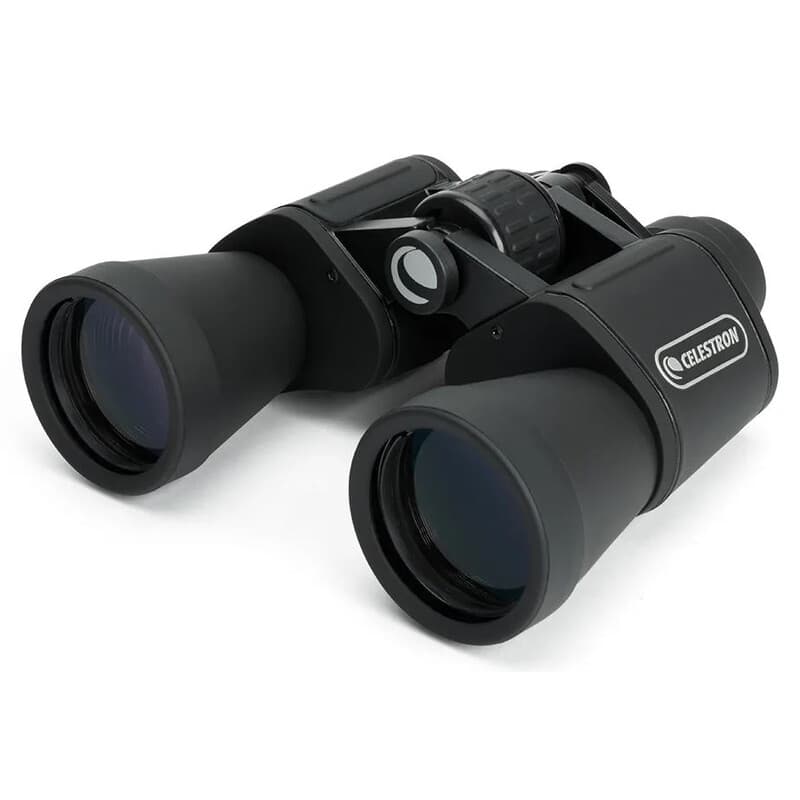
10×50 binoculars
The Moon, the clusters, Andromeda, Jupiter's moons — and the sky learnt, which no telescope at this price does.
€62seen 7 Oct 2026 at Astroshop
See it at Astroshoppaid link?
There is no best telescope. There is the one you will still carry outside in March, under your sky, on your budget.
The class first, then the cheapest observed model in it. Every view is computed: same eyepiece rule, same suburban sky.
Not sure yet, or under €150
The Moon, the clusters, Andromeda, Jupiter's moons — and the sky learnt, which no telescope at this price does.
€62seen 7 Oct 2026 at Astroshop
See it at Astroshoppaid link?
The best first telescope
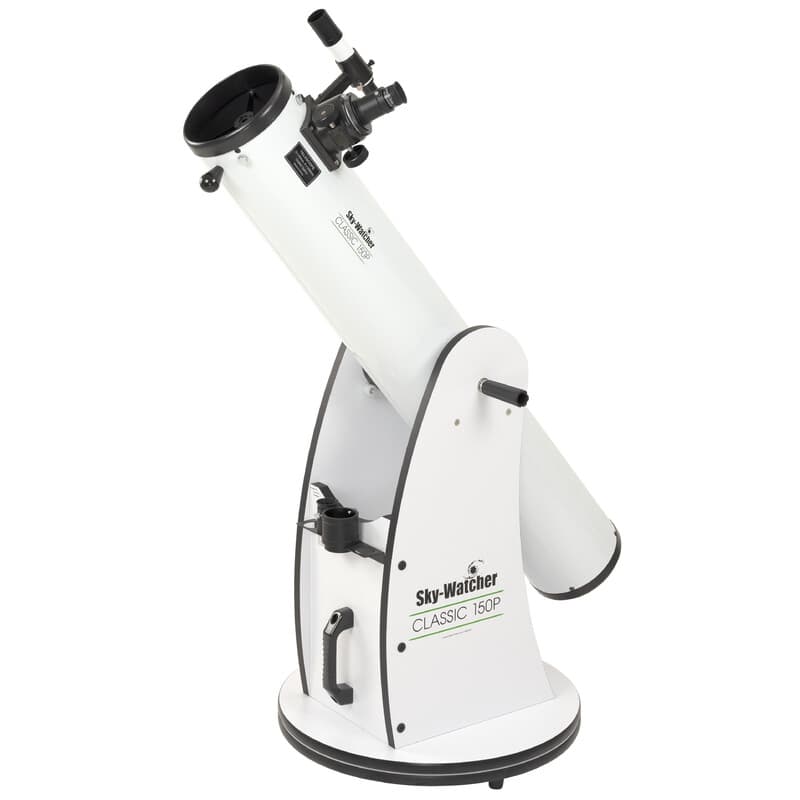
Sky-Watcher Skyliner 150P Classic
The most light per euro ever put in a box, on a base that simply works. You need somewhere to keep it.
€357seen 7 Oct 2026 at Astroshop
See it at Astroshoppaid link?
The cheapest that sufficesThe lowest observed price among these picks that will show a beginner the planets, the clusters and the bright galaxies, with no mount to learn.
Little room, or €200–300
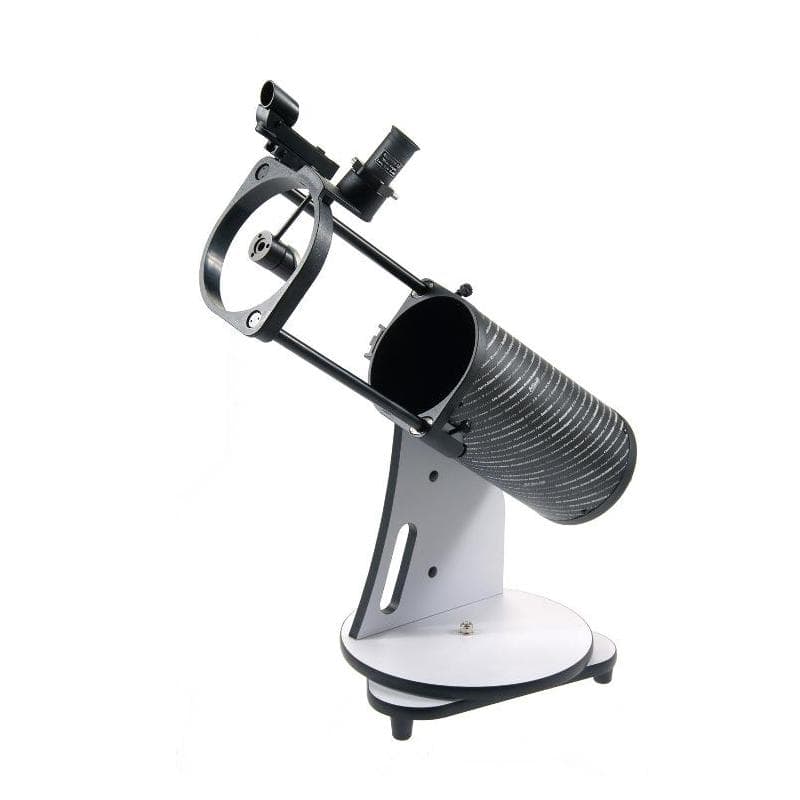
Sky-Watcher Heritage 130P FlexTube
Same family, smaller: it lives in a cupboard and sets up on a garden table.
€197seen 7 Oct 2026 at Astroshop
See it at Astroshoppaid link?
This page gives the short answer first, then the three things the box does not say, then the detail by budget and by situation. Every number here is computed; every opinion is labelled as one.
1. Aperture decides everything; magnification decides nothing. The diameter of the tube — 70 mm, 130 mm, 150 mm — sets how much light gets in and how much detail is possible. Magnification only spreads that light out: the more you magnify, the dimmer and softer the image. '525×' on a 60 mm tube is not an arithmetic lie; it is a physical one. Beyond roughly twice the diameter in millimetres there is nothing more to see.
2. The mount matters as much as the tube. A 130 mm Newtonian on a small equatorial mount (EQ1, EQ2) is a good tube on a tripod that shakes, with motions most owners never learn. The same tube on a Dobsonian base is a different experience. For visual beginners, alt-azimuth and Dobsonian almost always win.
3. Your sky is often the real limit. Under a city sky a 250 mm shows less of a galaxy than a 130 mm in the countryside. The planets and the Moon do not care; nebulae and galaxies do. Before buying diameter, look at what sky you have — this site's simulator accounts for it, which no other French-language tool does.
Under €150. 10×50 binoculars and a planisphere or an app. 60 or 70 mm refractors at that price show the Moon well. Look at the kit: the usual rule gives them 120 to 140× (twice the aperture in millimetres, an exit pupil of 0.5 mm), and this site does not suggest a kit whose eyepieces reach more than twice that number.
€150–300. A 130 mm tabletop Newtonian (130/650). This is the first real telescope: clusters resolved into stars, Jupiter's belts, Saturn's ring clearly detached, Andromeda as a pale oval. It sits on a table or a wall and fits in a cupboard. A 70/700 alt-azimuth refractor is the honest alternative if you mostly want the Moon and planets and never want to adjust anything.
€300–450. The 150/1200 Dobsonian. Most beginners' ceiling should sit here, and that is good news: this instrument shows the Cassini division, the Hercules cluster as an ant-hill of stars, dozens of galaxies under a good sky. It is 1.2 m long and weighs about fifteen kilos; check you have somewhere to keep it and that you will carry it out.
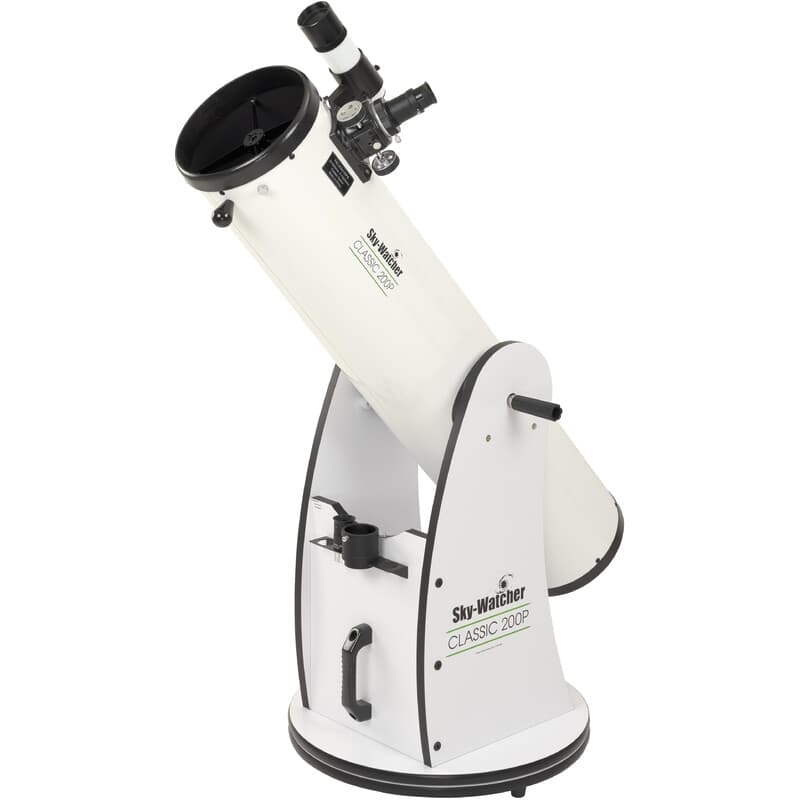
€450–800. A 200/1200 Dobsonian if your sky is decent and your back is sound; a 127 mm Maksutov on a go-to mount if you are in town on a balcony. Above that you are no longer buying a telescope, you are buying a mount for photography — a different hobby with a different budget.
What this site's advisor does that this list cannot: compute a spending ceiling from your sky, your home, your car and who will be looking, before showing you a single product. That ceiling often lands below your budget. That is the point.
One model per rung, at its observed price
From binoculars to the 200 mm Dobsonian: four models, one per paragraph above.
Saturn, suburban sky (Bortle 6). Computed, not photographed.
One price per model — the cheapest observed offer, with its date — and the button goes to that offer, never to the one that pays. Cards in price order. Links marked paid link earn us a commission and cost you nothing extra. Every seller is listed on the model's page.
The family's strengths
The family's limits
€62seen 7 Oct 2026 at Astroshop
 See it at Astroshoppaid link
The family's strengths
The family's limits
€197seen 7 Oct 2026 at Astroshop
 See it at Astroshoppaid link
The typical first telescope, €300–450
150 mm · f/8.0 · 18.0 kg · set up in 8 min
The family's strengths
The family's limits
€357seen 7 Oct 2026 at Astroshop
 See it at Astroshoppaid link
€449seen 7 Oct 2026 at Astroshop
 See it at Astroshoppaid link
ExperienceOpinion, not physics — shared by nearly everyone who has helped a beginner.
The 60–70 mm refractor sold as '525×' or '675×'
The kit reaches more than three times the usual rule (twice the aperture in millimetres): on 70 mm, 525× is an exit pupil of 0.13 mm. The optics may be decent; it is that magnification that is of no use.
The 114 or 130 mm Newtonian on a light equatorial mount (EQ1, EQ2)
A mount to point at the celestial pole and to learn before seeing anything.
The small €50–90 telescope for children
Check the aperture and the focal length: under 50 mm the usual rule tops out at 100× (an exit pupil of 0.5 mm), and a 76 mm gathers more than twice the light ((76 ÷ 50)² ≈ 2.3).
The question is not the child's age but who will set the instrument up. Under ten, that is you — so choose something you will want to carry out: the 130 mm tabletop Newtonian is the right compromise, and it grows with the child. Between ten and fourteen, 10×50 binoculars they can take out alone beat a telescope they cannot set up alone. The 'children's telescopes' in Christmas catalogues are to be avoided at any age.
First night, with any instrument: the Moon, at a quarter rather than full. The shadows along the terminator are the one thing in the sky that looks like the photographs, and it is the right first surprise.
A city sky removes the nebulae and galaxies, not the Moon or the planets. A balcony adds a constraint: a compact instrument, stable on a small tripod, set up in two minutes. The 90–127 mm Maksutov on an alt-azimuth mount (go-to or not) is made for this; so is an 80–90 mm refractor. A 150 mm Dobsonian on a balcony is possible but awkward, and it will not see what it was built for.
What you will see from a Bortle 8 balcony with a 127 mm Mak: the Moon in detail, Saturn and its ring, Jupiter with its moons and belts, Mars as a small disc at opposition, double stars, a few bright clusters. That is a lot. It is not Orion in colour.
The two GoTo Maksutovs, at their observed price
Saturn, suburban sky (Bortle 6). Computed, not photographed.
City balcony, Moon and planets
102–127 mm Maksutov on a GoTo alt-az
102 mm · f/12.7 · 7.5 kg · set up in 12 min
The family's strengths
The family's limits
€629seen 7 Oct 2026 at Astroshop
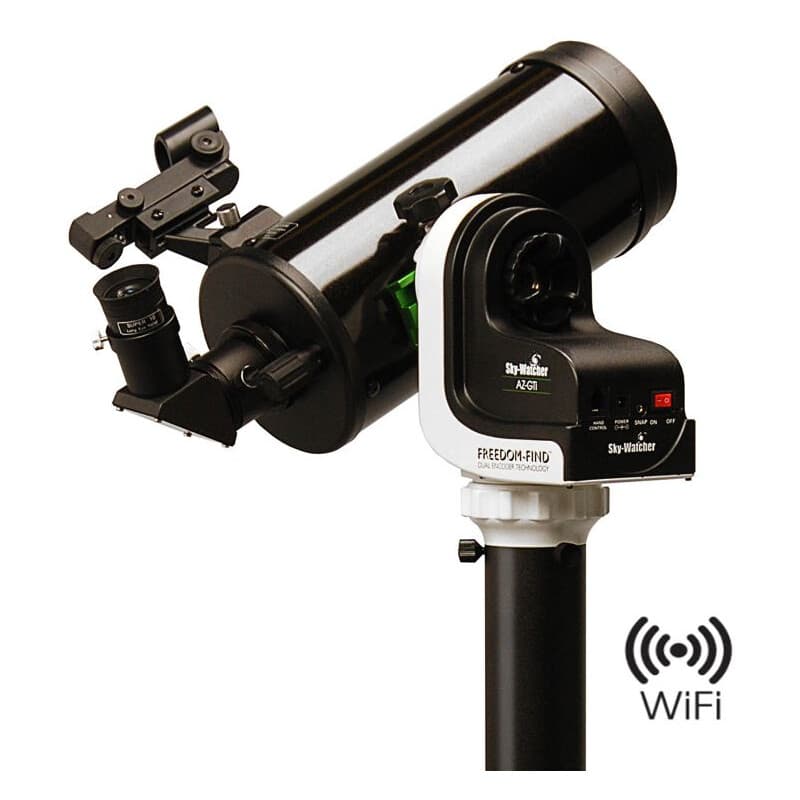 See it at Astroshoppaid link?
City balcony, Moon and planets
102–127 mm Maksutov on a GoTo alt-az
127 mm · f/11.8 · 8.5 kg · set up in 12 min
€709seen 7 Oct 2026 at Astroshop
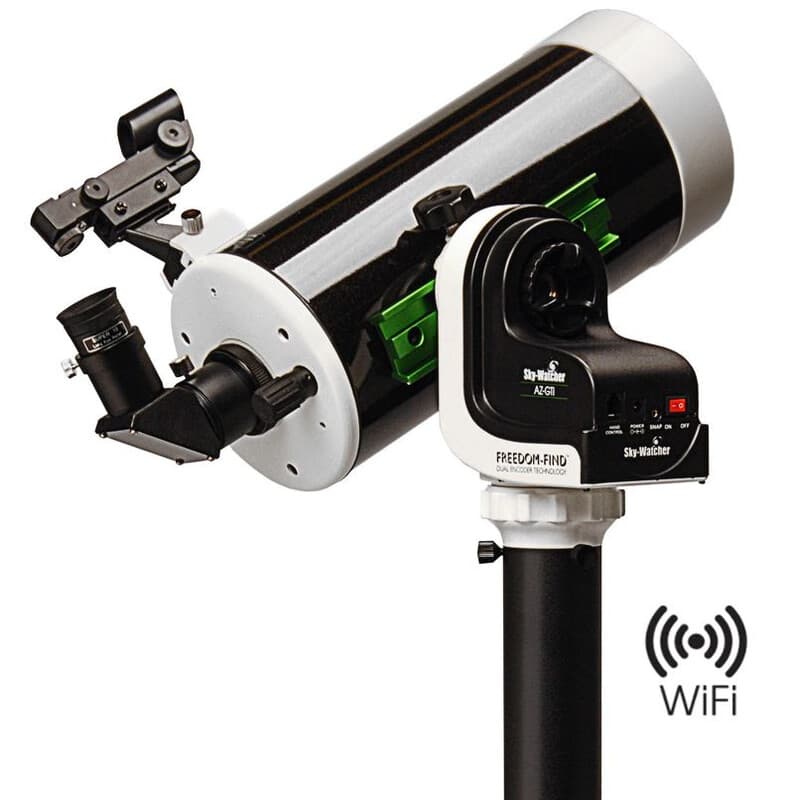 See it at Astroshoppaid link?
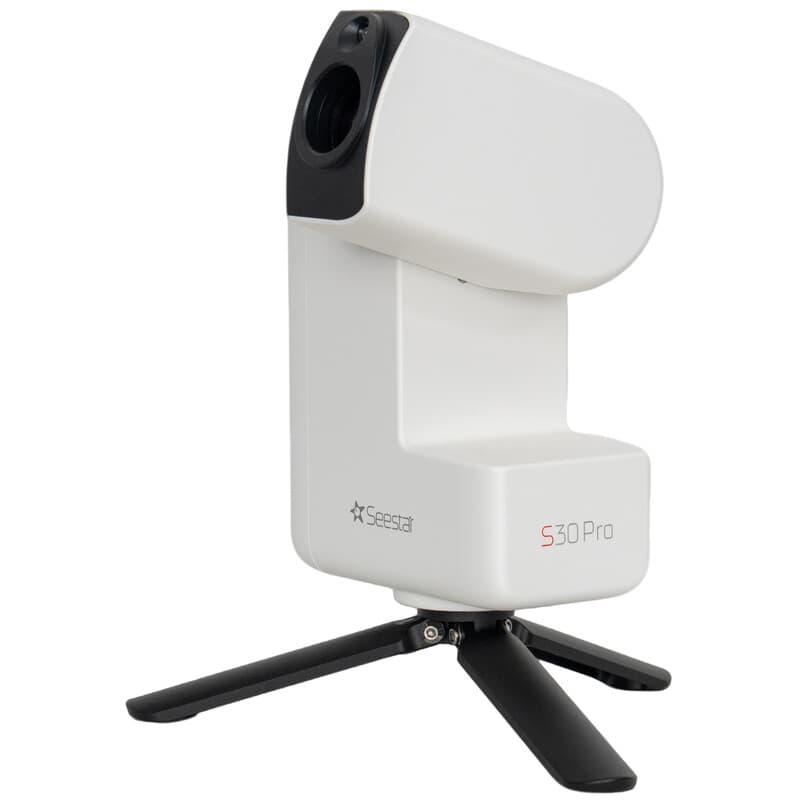
Seestar, Dwarf, Vaonis: a small camera on an automatic mount, driven from a phone, that stacks exposures and produces a colour image of a nebula in a few minutes. It is real, it is impressive, and it is not the same activity. There is no eyepiece: you are not looking at the sky, you are looking at a screen that photographs it. For the planets and the Moon, a 130 mm telescope with an eyepiece shows more.
If what you want is the image — to share it, to keep it — it is a good buy, and simpler than any other form of astrophotography. If what you want is to see, with your own eyes, photons that left before there were people, this is not it. Many households end up with both; few start with both.
The smart telescopes, at their observed price
Saturn, suburban sky (Bortle 6). Computed, not photographed.
The picture rather than the eyepiece
Smart telescope (30–80 mm, integrated camera)
30 mm · f/5.0 · 1.8 kg · set up in 4 min
The family's strengths
The family's limits
No eyepiece: it shows a picture on a phone, not the sky through glass. No view is drawn for it.
€479seen 7 Oct 2026 at Astroshop
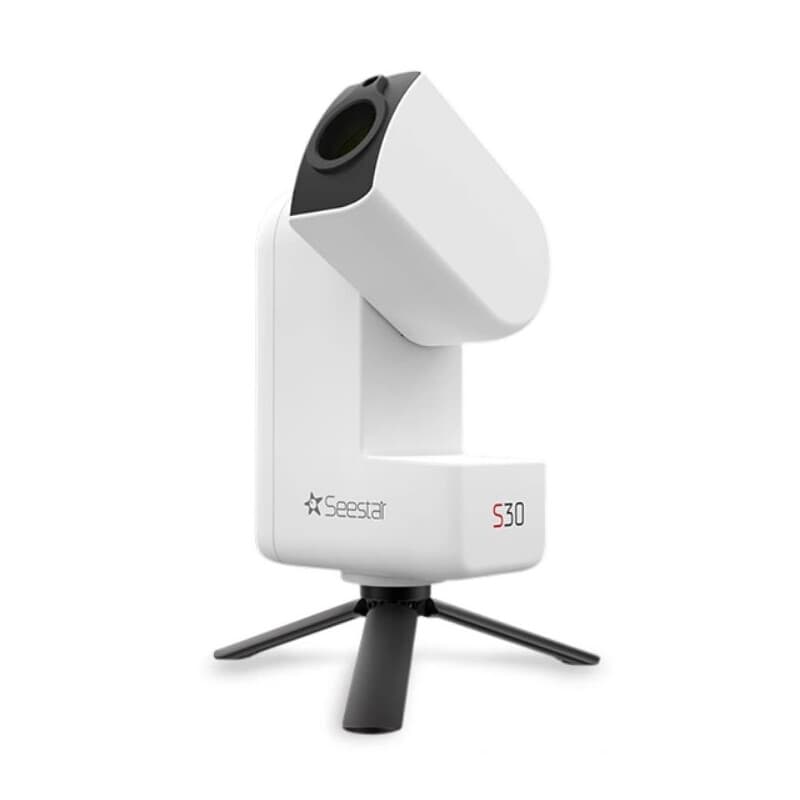 See it at Astroshoppaid link?
The picture rather than the eyepiece
Smart telescope (30–80 mm, integrated camera)
35 mm · f/4.3 · 1.4 kg · set up in 4 min
No eyepiece: it shows a picture on a phone, not the sky through glass. No view is drawn for it.
€529seen 7 Oct 2026 at Astroshop
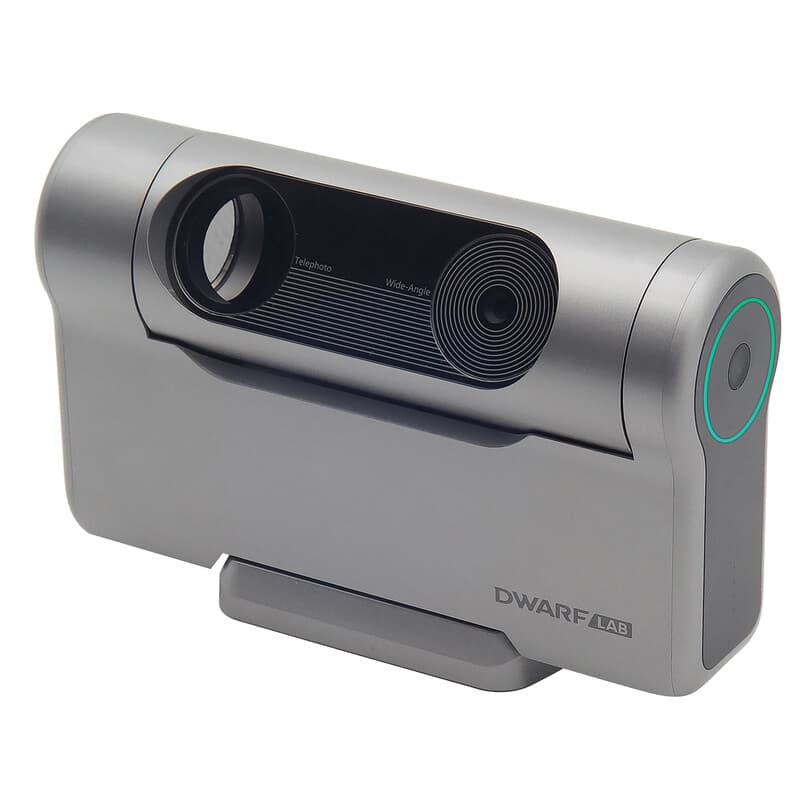 See it at Astroshoppaid link?
The picture, with a wider field
Smart telescope (30–80 mm, integrated camera)
30 mm · f/5.3 · 1.7 kg · set up in 4 min
No eyepiece: it shows a picture on a phone, not the sky through glass. No view is drawn for it.
€699seen 7 Oct 2026 at Astroshop
 See it at Astroshoppaid link?
A good share of good first telescopes are bought second-hand, because a good share of good first telescopes are sold after one winter. A used 150 or 200 mm Dobsonian is often the best deal on the market. Prefer the classifieds on astronomy forums and clubs: sellers there know what they are selling. On general sites, check that the counterweights, eyepieces and finder are present, that the mirror is not pitted, and be wary of the dusty 'never used'.
For the first month, buy nothing else. No Barlow, no filter, no laser collimator. Take the instrument out ten times; on the eleventh night you will know what you are missing, and it will probably be a decent 8–10 mm eyepiece and a chair.
Cheapest first. Each view is the Hercules Cluster through the model, at the same exit pupil, under the same suburban sky.
| Model | Aperture | Weight | Setup | What it shows | Price |
|---|---|---|---|---|---|
| Celestron UpClose G2 10×50For whom: Not sure yet, under €150 | 10×50 | 0.9 kg | 1 min | €627 Oct 2026 · Astroshop | |
| Sky-Watcher Heritage 130P FlexTubeFor whom: Little room, €200–300 | 130 mm · f/5.0 | 6.2 kg | 3 min | €1977 Oct 2026 · Astroshop | |
| Sky-Watcher Skyliner 150P ClassicFor whom: The typical first telescope, €300–450 | 150 mm · f/8.0 | 18.0 kg | 8 min | €3577 Oct 2026 · Astroshop | |
| Sky-Watcher Skyliner 200PFor whom: A decent sky and a strong back | 200 mm · f/6.0 | 25.0 kg | 8 min | €4497 Oct 2026 · Astroshop | |
| ZWO Seestar S30For whom: The picture rather than the eyepiece | 30 mm · f/5.0 | 1.8 kg | 4 min | No eyepiece: a screen | €4797 Oct 2026 · Astroshop |
| DwarfLab Dwarf 3For whom: The picture rather than the eyepiece | 35 mm · f/4.3 | 1.4 kg | 4 min | No eyepiece: a screen | €5297 Oct 2026 · Astroshop |
| Sky-Watcher Skymax 102 AZ-GTiFor whom: City balcony, Moon and planets | 102 mm · f/12.7 | 7.5 kg | 12 min | €6297 Oct 2026 · Astroshop | |
| ZWO Seestar S30 ProFor whom: The picture, with a wider field | 30 mm · f/5.3 | 1.7 kg | 4 min | No eyepiece: a screen | €6997 Oct 2026 · Astroshop |
| Sky-Watcher Skymax 127 AZ-GTiFor whom: City balcony, Moon and planets | 127 mm · f/11.8 | 8.5 kg | 12 min | €7097 Oct 2026 · Astroshop |
Not a 70 mm refractor on a light tripod, and not a Newtonian on an EQ1 equatorial mount.
In a city a 90–127 mm Maksutov is the best choice: the planets do not care about light pollution.
The refractor wins on simplicity and on a balcony. Under €400 the Dobsonian (a Newtonian on a simple base) is the most frequent answer and the right one.
The maximum useful magnification is about twice the diameter in millimetres: 60 mm → 120×, an exit pupil of 0.5 mm. Beyond that the image is dim and blurred.
The human eye barely sees colour at these light levels; nebulae and galaxies appear grey, sometimes faintly green for Orion. The colour images are long exposures. The Moon, the planets and double stars, on the other hand, are coloured.
These thumbnails are built from real photographs, scaled and darkened by the same arithmetic as the large view.
What this page rests on and when it changed, computed from the catalogue — no date below is typed by hand. There is no price history yet, so this log says what was read and when, never whether it went up or down.
One price per model: the cheapest observed offer, with its date. Models are ordered by that price, never by what a link pays. How we choose.
Read next
Written and maintained by the person behind About.