Under €100
10×50 binoculars
No telescope at this price is worth having. 10×50s show the Moon’s seas, the Pleiades and Andromeda, and work in daylight too.
€50seen 19 Nov 2026 at Astroshop
See it at Astroshoppaid link?
A telescope is a present that asks for something back: evenings outside, some cold, some patience. Given to the right person it is one of the best presents there is.
The class first, then the cheapest observed model in it. Every view is computed: same eyepiece rule, same suburban sky.
Under €100
No telescope at this price is worth having. 10×50s show the Moon’s seas, the Pleiades and Andromeda, and work in daylight too.
€50seen 19 Nov 2026 at Astroshop
See it at Astroshoppaid link?
The cheapest that sufficesThe lowest observed price among these picks that will show the Moon and Saturn’s ring on the first night, without the person having to learn any mechanics.
The safe present
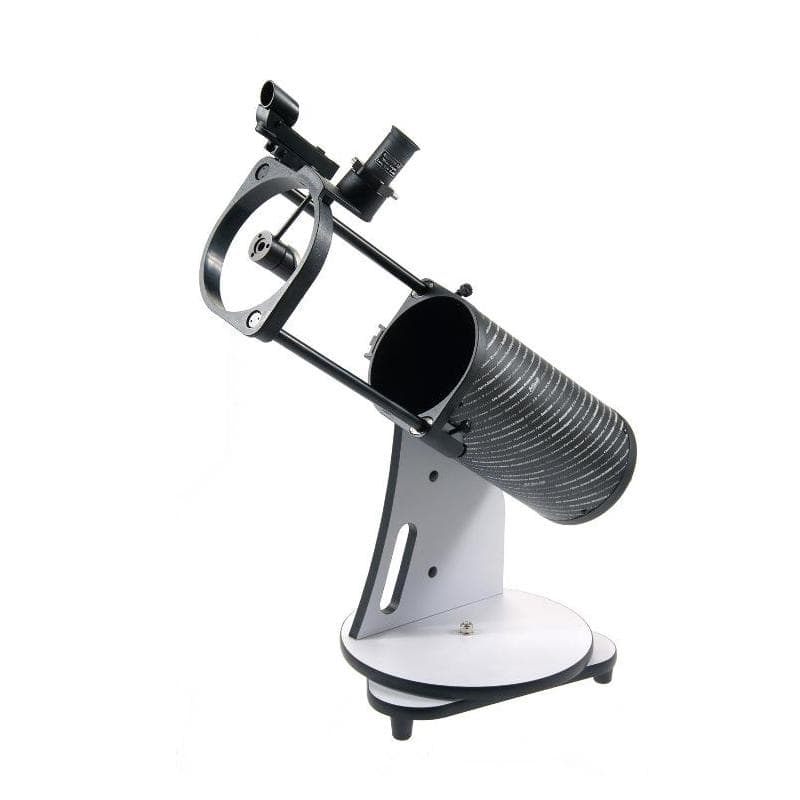
Sky-Watcher Heritage 130P FlexTube
Set on a table, pointed by hand, ready in two minutes. Saturn’s ring on the first night, and still in use in ten years.
€197seen 19 Nov 2026 at Astroshop
See it at Astroshoppaid link?
For a gadget lover
No eyepiece: it shows a picture on a phone, not the sky through glass. No view is drawn for it.
A camera run from a phone: pictures of nebulae on the first night, but on a screen, never in an eyepiece.
€479indicative, seen 30 Aug 2026
Given at random it is in the garage by February. This guide says which one to give to whom, at what price, and when the best present is not a telescope.
The right present depends less on the budget than on the person: who will set it up, where it will be stored, and what they hope to see. Six cases cover almost everything.
This is where the present succeeds or fails. The person will not compare the view with what an astronomer knows about Saturn, but with the picture on the box. A small refractor shows a dot with a ring; a 130 mm shows a ring standing clear of the globe, with its shadow. The difference does not come from magnification; it comes from aperture.
The telescopes in this guide, at observed prices
Sorted by price. Each price is the one observed at the retailer on the date shown; it moves, especially in December.
Saturn, suburban sky (Bortle 6). Computed, not photographed.
One price per model — the cheapest observed offer, with its date — and the button goes to that offer, never to the one that pays. Cards in price order. Links marked paid link earn us a commission and cost you nothing extra. Every seller is listed on the model's page.
The safe present, adult or family
130 mm · f/5.0 · 6.2 kg · set up in 3 min
The family's strengths
The family's limits
€197seen 19 Nov 2026 at Astroshop
 See it at Astroshoppaid link
The safe present, adult or family
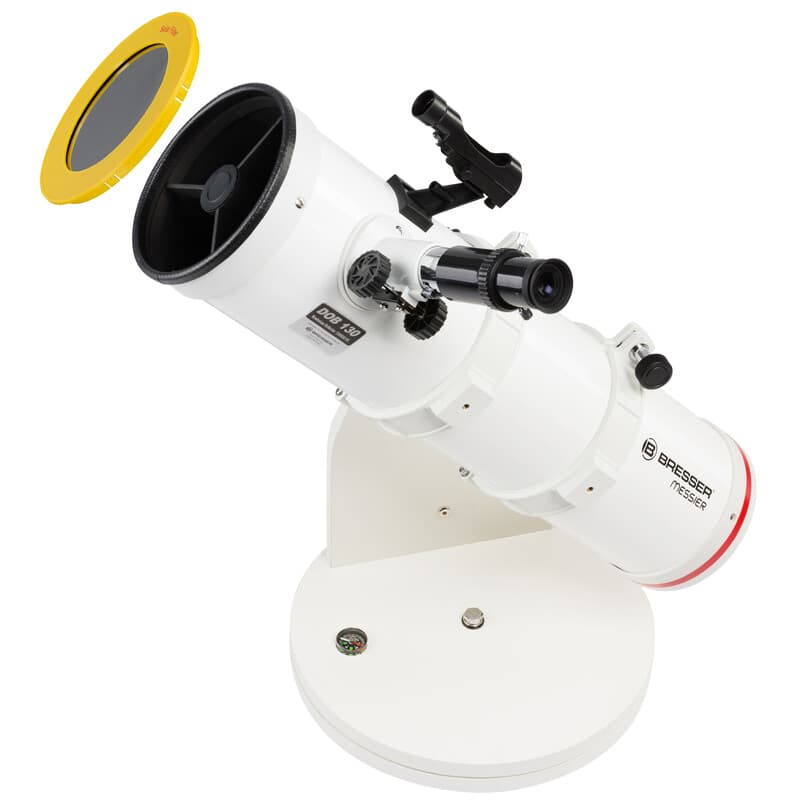
130 mm · f/5.0 · 6.6 kg · set up in 3 min
€219seen 19 Nov 2026 at Astroshop
 See it at Astroshoppaid link
Someone who has already said “I want to observe”
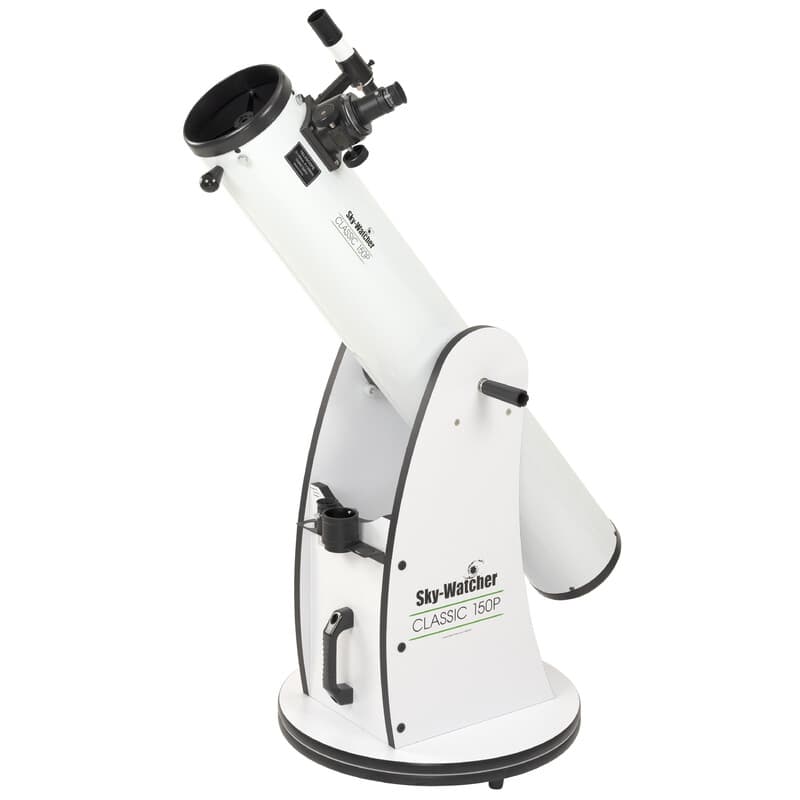
150 mm · f/8.0 · 18.0 kg · set up in 8 min
The family's strengths
The family's limits
€357seen 19 Nov 2026 at Astroshop
 See it at Astroshoppaid link
A parent who wants the telescope to find things itself
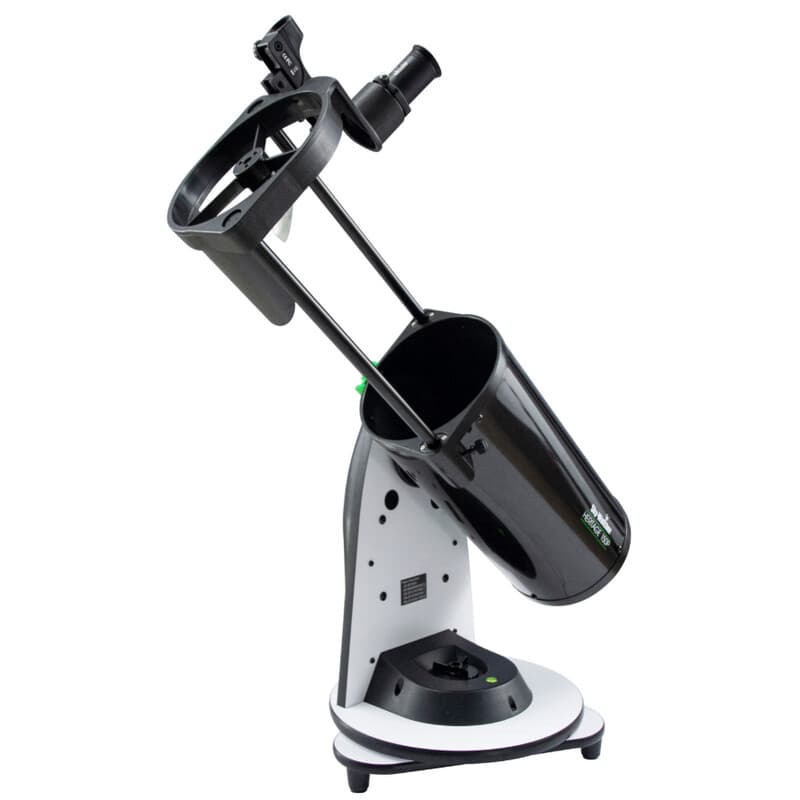
130–150 mm Newtonian on a small GoTo alt-az mount
150 mm · f/5.0 · 9.0 kg · set up in 12 min
The family's strengths
The family's limits
€482seen 19 Nov 2026 at Astroshop
 See it at Astroshoppaid link
ExperienceOpinion, not physics — shared by nearly everyone who has helped a beginner.
The 60–70 mm gift-aisle refractor sold as “525×”
On 60–70 mm of aperture the usual rule allows 120–140× at most (a 0.5 mm exit pupil); beyond that the view is a dim smear. Its tripod shakes at a touch. The person is disappointed once, and the present goes in a cupboard.
A boxed 130 mm on an equatorial mount (EQ1, EQ2)
The same mirror as the 130 tabletop, on a mount that has to be polar-aligned and that no beginner understands on the first night. And it often costs more.
A big 250 or 300 mm Dobsonian as a surprise
Around 25 to 33 kg and a tube of 1.2 m or more: a purchase to decide with the person, knowing where it will live and who will carry it.
A smart telescope for someone who dreams of “seeing it with their own eyes”
It has no eyepiece: everything goes through the phone screen. Wonderful for pictures, disappointing for someone who wanted to put their eye to a telescope.
Astroshop publishes a Christmas gift page for beginners and children. If you buy from Astroshop after following one of our links, we may earn a commission; the page “How this site is funded” has the details. We read its listings on 19 November 2026 and added six of the page’s instruments to our catalogue, all of them Omegon, plus a seventh from the same range that is not on the page. For each one: what the listing says, what the eyepieces and Barlow in the box give, and the model in our catalogue we would look at for about the same money, with the reason.
Omegon Horizon AC 70/700 AZ-Bellavista. A 70 mm f/10 refractor on the AZ-Bellavista alt-az mount and a steel tripod, 4.6 kg per the listing, with a 25 mm and a 10 mm eyepiece, a 2× Barlow, an Amici prism diagonal, a red-dot finder and a phone adapter. The parts in the box run from 28× on 70 mm (an exit pupil of 2.5 mm) to 140× (0.5 mm): the usual rule’s maximum, and nothing past it. At this price we would look first at the Heritage 130P, a cheaper tabletop Newtonian that gathers (130 ÷ 70)², about 3.4 times the light; it needs a table or a wall, where the refractor brings its own tripod. And if it is a 70/700 refractor you want, the Omegon AC 70/700 AZ-2 in our catalogue is another one, for much less.
Omegon Horizon AC 90/650 AZ-Bellavista. The same mount with a 90 mm f/7.2 refractor, a Crayford focuser, a steel tripod of 62 to 100 cm and the same accessories; 5.1 kg per the listing. The 10 mm eyepiece gives 65× on 90 mm, an exit pupil of 1.4 mm; with the Barlow, 130× and 0.7 mm, under the usual rule’s 180×. A short achromat puts a stronger violet fringe around the Moon and the planets than an f/10 one (experience). If you want a 90 mm refractor, we would set it against the Evostar 90/900 AZ-3: the same aperture at f/10, on an AZ-3 mount with slow-motion controls on both axes. If aperture is what counts, the cheaper Heritage 130P gathers (130 ÷ 90)², about 2.1 times the light.
Omegon Horizon N 130/650 AZ-Bellavista. Not on the gift page, but the same range: a 130 mm f/5 Newtonian, parabolic mirror per the listing, on the same mount, 6.8 kg in all. The 10 mm eyepiece gives 65× on 130 mm, an exit pupil of 2 mm; with the Barlow, 130× and 1 mm, half the usual rule’s 260×. The Heritage 130P has the same aperture and focal length for less; the mount is what separates them. The Horizon stands on its own tripod, while the Heritage needs a table, a wall or a crate. If you have nothing like that where you observe, the Horizon makes sense.
The next three are on manual equatorial mounts. Once aimed at the celestial pole, such a mount follows the sky with one knob; before that, you have to learn to polar-align it, and its movements do not match the up-down and left-right of a sky chart. That is the reason for the warning above, under “What not to give”: it is aimed at the mount, not the tube.
Omegon AC 90/1000 EQ-2. A 90 mm f/11 refractor on an EQ-2, with a 25 mm and a 6.3 mm eyepiece, a 2× Barlow, a mirror diagonal and a red-dot finder. The 25 mm gives 40× on 90 mm (an exit pupil of 2.3 mm) and the 6.3 mm 159× (0.57 mm); with the Barlow, 317× and 0.28 mm, well past the 180× that 90 mm can use. The duel sets it against the Evostar 90/900 EQ-2, the same aperture on the same mount for about the same money, whose 10 mm eyepiece and Barlow stop at 180×, the most 90 mm can use (an exit pupil of 0.5 mm). For a first telescope we would rather look at the Heritage 130P: (130 ÷ 90)², about 2.1 times the light, and nothing to polar-align.
Omegon N 150/750 EQ-3. A 150 mm f/5 Newtonian on an EQ-3, with a 25 mm and a 6.5 mm eyepiece, a 2× Barlow, a red-dot finder and a rack-and-pinion focuser. The parts in the box run from 30× on 150 mm (an exit pupil of 5 mm) to 231× (0.65 mm), under the usual rule’s 300×. 150 mm is a lot of aperture for the price. What we would look at instead is the same aperture on a Dobsonian base, pushed by hand to where you look, with no polar alignment: the Skyliner 150P. It costs more, it is longer too (150/1200, 1.2 m) and it weighs 18 kg.
Omegon Advanced 150/750 EQ-320. The same aperture and focal length, with a parabolic mirror and a 2″ Crayford focuser per the listing, on an EQ-320; 17 kg per the listing. It comes with a 25 mm and a 10 mm eyepiece, and the listing names no Barlow: 30× and 75× on 150 mm, exit pupils of 5 and 2 mm. Going higher takes a shorter eyepiece. The duel compares it with the N 150/750 EQ-3, which costs much less. For a beginner we would look at the Skyliner 150P, the same aperture on a Dobsonian base for much less; and if the budget really is this size, the Skyliner 200P: (200 ÷ 150)², about 1.8 times the light on the same kind of base, at 26 kg in all.
Omegon Nightstar 15×70. 70 mm binoculars at 15×, BaK-4 Porro prisms, multi-coated: 70 ÷ 15 gives an exit pupil of 4.7 mm, with a 4.4° field, 18 mm of eye relief and 1.49 kg, and a tripod thread. At that magnification and weight they are used on a photo tripod with an adapter, as the binoculars guide explains. The duel compares them with the Celestron SkyMaster 15×70, the same format, a little dearer, a little lighter (1.36 kg), and supplied with their adapter. For a first hand-held pair, we stay with the 10×50s at the top of this guide.
For someone interested in the sky who has never observed, these are often better presents than a telescope, because they ask for nothing: they work on the first night, with no setting up.
Almost nothing. No Barlow lens, no filters, no eyepiece kit: those are second-month purchases, made once you know what is missing. Three things do make the first night better:
Cheapest first. Each view is the Hercules Cluster through the model, at the same exit pupil, under the same suburban sky.
| Model | Aperture | Weight | Setup | What it shows | Price |
|---|---|---|---|---|---|
| Bresser Hunter 10×50For whom: Under €100, anyone | 10×50 | 0.8 kg | 1 min | €5019 Nov 2026 · Astroshop | |
| Celestron UpClose G2 10×50For whom: Under €100, anyone | 10×50 | 0.8 kg | 1 min | €6219 Nov 2026 · Astroshop | |
| Sky-Watcher Heritage 130P FlexTubeFor whom: The safe present, adult or family | 130 mm · f/5.0 | 6.2 kg | 3 min | €19719 Nov 2026 · Astroshop | |
| Bresser Messier 130/650 DobsonFor whom: The safe present, adult or family | 130 mm · f/5.0 | 6.6 kg | 3 min | €21919 Nov 2026 · Astroshop | |
| Sky-Watcher Skyliner 150P ClassicFor whom: Someone who has already said “I want to observe” | 150 mm · f/8.0 | 18.0 kg | 8 min | €35719 Nov 2026 · Astroshop | |
| ZWO Seestar S30For whom: A photography or gadget lover | 30 mm · f/5.0 | 1.8 kg | 4 min | No eyepiece: a screen | €479indicative, 30 Aug 2026 |
| Sky-Watcher Heritage 150P FlexTube Virtuoso GTiFor whom: A parent who wants the telescope to find things itself | 150 mm · f/5.0 | 9.0 kg | 12 min | €48219 Nov 2026 · Astroshop |
If you are not sure they want it, give 10×50 binoculars and an evening at an astronomy club. The telescope can come the year after.
It sits on a table, points by hand, needs no adjustment, and shows Saturn’s ring and Jupiter’s moons on the first night. The safest telescope present at its price.
Under €100, give 10×50 binoculars instead: no telescope at that price shows as much.
At that price most are 60–70 mm refractors on a shaky tripod, sold with magnifications they cannot deliver. 10×50 binoculars at the same price show more and disappoint less.
Alt-azimuth, no GoTo, no equatorial mount. The kids guide covers the 13-and-up section in detail.
For someone who wants to look through an eyepiece, no: it has none, everything goes through the phone screen.
A sky atlas, an adjustable observing chair, a red torch — or ask them what they are missing.
No Barlow, no filters, no eyepiece kit: those are second-month purchases, made once you know what is missing.
The best-selling models can run short in December. Remember that the 14-day cancellation period for online purchases runs from delivery, not from Christmas.
A struck-through price can also be one nobody paid: our Black Friday guide gives the 30-day rule to check it. Buying in late November has a catch. The 14-day withdrawal period runs from delivery and has usually ended before Christmas, unless the seller extends it. If you wait for December, the best-selling models can run short.
The Moon is full on 24 December, which washes out the craters: it looks far better at first quarter, on 15 January 2027.
These thumbnails are built from real photographs, scaled and darkened by the same arithmetic as the large view.
What this page rests on and when it changed, computed from the catalogue — no date below is typed by hand. This log says what was read and when; whether a price went up or down is on each model’s review page.
One price per model: the cheapest observed offer, with its date. Models are ordered by that price, never by what a link pays. How we choose.
Read next
Written and maintained by the person behind About.