Independent order · dated prices · no cookiesNo seller changes the order · dated prices · no cookies
Our picks
The class first, then the cheapest observed model in it. Every view is computed: same eyepiece rule, same suburban sky.
The cheapest that sufficesThe lowest observed price among these picks that will show the wide sky (the whole Moon, the Pleiades, Andromeda) held in the hand.
This page says which format to choose (10×50, 7×50, 8×42 or 15×70) with the one calculation that separates them: the exit pupil, compared with your own eye's. Then it says what binoculars really show, and which pairs to buy, at their observed prices.
Reading the format: 10×50, 7×50, 8×42, 15×70
Two numbers. The first is the magnification, the second the diameter of each objective lens in millimetres. The second sets how much light comes in; the ratio of the two gives the exit pupil, the width of the beam that leaves the eyepiece and enters your eye.
10×50: 50 mm objectives, magnification 10, exit pupil 50 ÷ 10 = 5 mm.
7×50: 50 mm objectives, magnification 7, exit pupil 50 ÷ 7 = 7.1 mm.
8×42: 42 mm objectives, magnification 8, exit pupil 42 ÷ 8 = 5.25 mm. Light gathered: (42 ÷ 50)² = 0.71, about 70% of a 10×50's.
15×70: 70 mm objectives, magnification 15, exit pupil 70 ÷ 15 = 4.7 mm. Light gathered: (70 ÷ 50)², about twice a 10×50's.
Magnification creates no light: it spreads out what the objectives gathered. More power at the same aperture means a darker sky background, slightly fainter stars showing, and more shake. That is why a format is judged by its exit pupil, not by its first number.
The eye's pupil opens in the dark, but not equally in everyone, and less and less with age. When the binoculars' exit pupil is wider than the eye's, the excess lands on the iris: that light is lost, and the instrument works as if its objectives were smaller.
That is the plain reason 10×50 is the default recommendation: its 5 mm exit pupil suits almost every age. The 7×50 still makes sense for a young eye under a very dark sky, and for anyone who finds a 10×50 too shaky in their hands.
Hand-held or on a tripod
Hand shake is magnified as much as the sky. At a magnification of 7 or 10, most people hold binoculars steady enough for a first night; at 15 the view dances and faint stars are lost in the movement.
Weight matters as much as power. Among the 10×50s the site tracks, the spec tables run from 780 g (Bresser Hunter) to 1.3 kg (Omegon Brightsky); at 1.3 kg the arms tire and the view shakes after a few minutes. In a reclining chair with your elbows supported, you last much longer.
A 15×70 is made for a tripod. With a solid photo tripod and an adapter it shows more stars and clusters than a 10×50; without one, it stays in the cupboard. It is not a first purchase but a second instrument for someone who already observes.
What 10×50s really show
The whole Moon in the field, with its seas and the big craters along the terminator, at 10× (50 mm, an exit pupil of 5 mm).
The whole Pleiades, dozens of stars instead of six or seven by eye, in a field no telescope can frame: the cluster is nearly 2° across.
The Andromeda Galaxy as an oval smudge, brighter in the middle, under a country sky.
Jupiter's moons as small points lined up either side of the planet. Not its belts.
Saturn: a point of light, at best slightly elongated. The ring does not separate.
The site tracks only 10×50s today: it is the format it recommends, and the only binoculars whose prices it records. For a 7×50, an 8×42 or a 15×70, this page gives the arithmetic, not a model.
10×50s, at their observed price
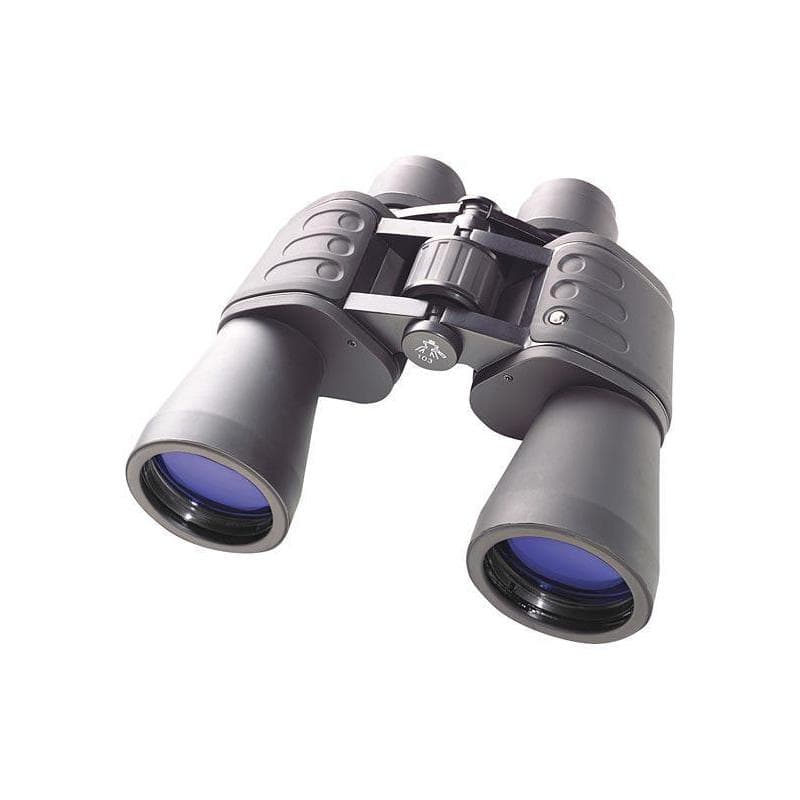
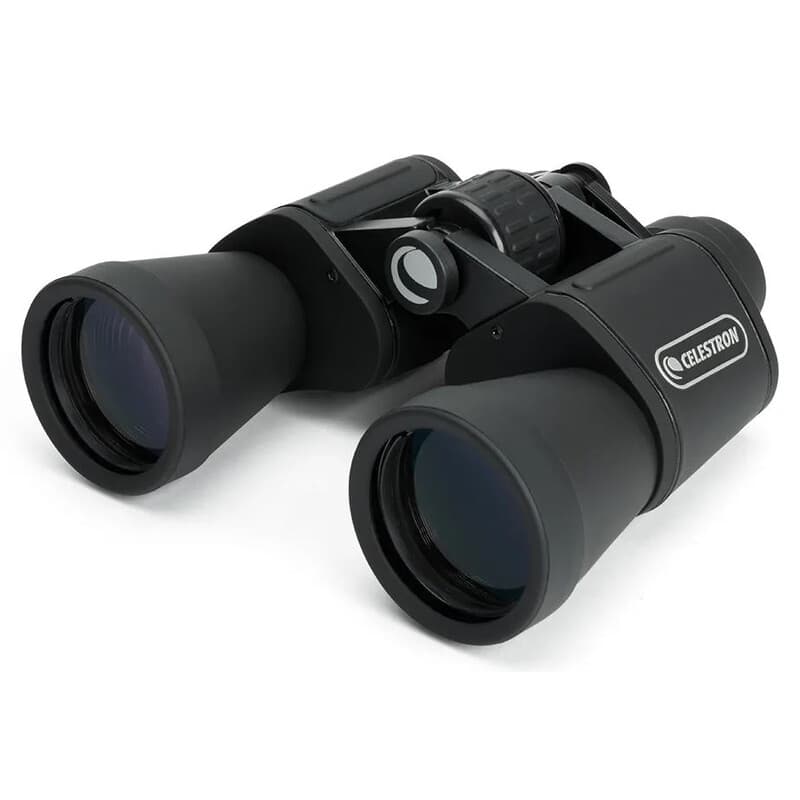
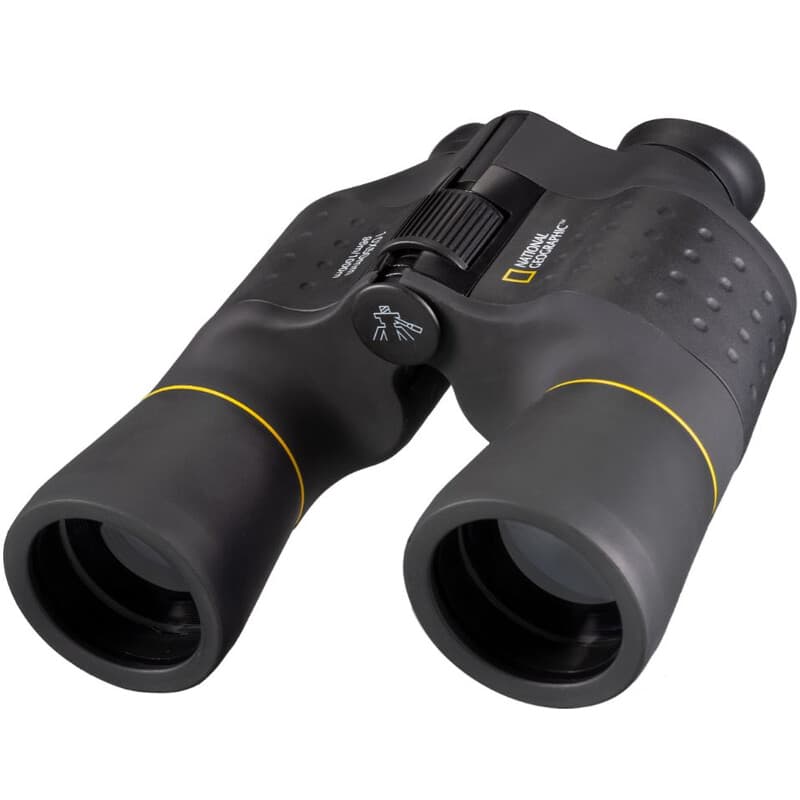
Three Porro-prism pairs, 780 to 870 g per their spec tables. The Celestrons have the widest field (6.5°); the Bresser and the National Geographic are the lightest (780 g).
The Pleiades, suburban sky (Bortle 6). Computed, not photographed.
One price per model — the cheapest observed offer, with its date — and the button goes to that offer, never to the one that pays. Cards in price order. Links marked paid link earn us a commission and cost you nothing extra. Every seller is listed on the model's page.
Their 5 mm exit pupil suits almost every dark-adapted eye, and they can still be held by hand. Decent pairs cost under €100.
7×50 or 10×50?10×50 for most adults.
A 7×50's 7.1 mm exit pupil is used in full only by an eye that opens to 7 mm, which becomes rare with age; otherwise part of its light is lost.
Can you see Saturn's rings with binoculars?No.
At 10× (50 mm, an exit pupil of 5 mm), Saturn stays a point, at best elongated. To see the ring stand clear of the globe, you need a telescope.
Do astronomy binoculars need a tripod?Not 10×50s: a tripod helps, but you can do without.
Beyond a magnification of 10, and for a 15×70, yes.
Binoculars or a telescope to start with?Binoculars if you do not yet know what you like in the sky, or if the budget is under €150.
A telescope if it is the planets and the Moon's detail you want.
What is the exit pupil of binoculars?The objective diameter divided by the magnification: 50 ÷ 10 = 5 mm for 10×50s.
It should stay below your dark-adapted pupil, or part of the light is lost.
Photo credits
These thumbnails are built from real photographs, scaled and darkened by the same arithmetic as the large view.
The Pleiades: Wikimedia Commons, Plejades (M45).jpg, CC0
The Hercules Cluster: Wikimedia Commons, Messier_13.jpg, CC BY-SA
Method and changes
What this page rests on and when it changed, computed from the catalogue — no date below is typed by hand. There is no price history yet, so this log says what was read and when, never whether it went up or down.
First published
5 prices read at Astroshop
One price per model: the cheapest observed offer, with its date. Models are ordered by that price, never by what a link pays. How we choose.