A child of 6–7, or travel
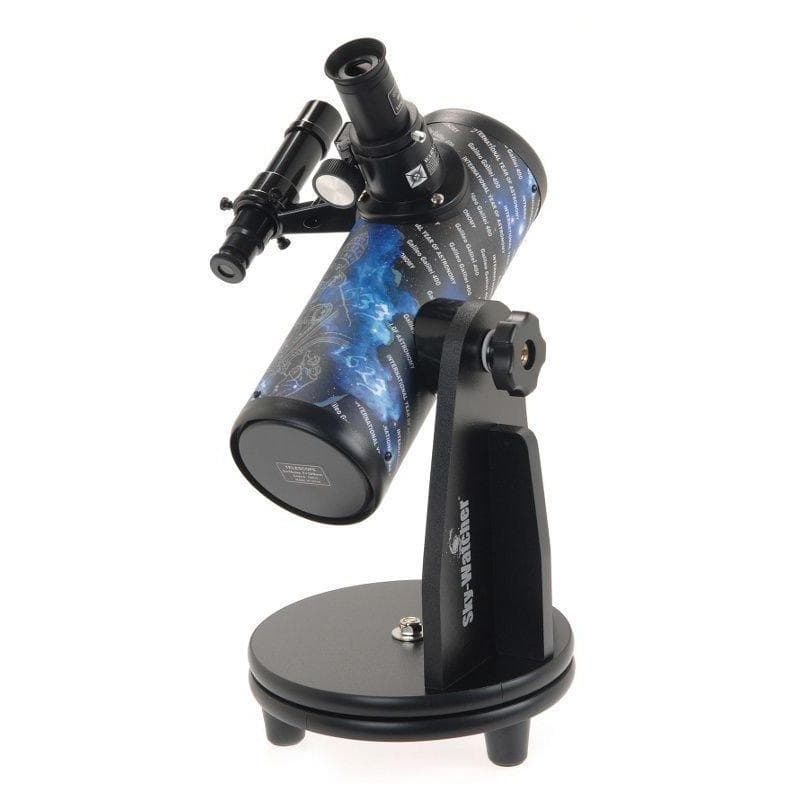
76 mm tabletop Newtonian
The Moon in detail, Saturn's ring, Jupiter's moons. Fits in a rucksack; frustrates an adult within a year.
€94seen 7 Oct 2026 at Astroshop
See it at Astroshoppaid link?
A tabletop telescope is a 76 to 150 mm Newtonian on a shrunken Dobsonian base, with no tripod. It sits on a garden table, a wall, a car bonnet.
The class first, then the cheapest observed model in it. Every view is computed: same eyepiece rule, same suburban sky.
A child of 6–7, or travel
The Moon in detail, Saturn's ring, Jupiter's moons. Fits in a rucksack; frustrates an adult within a year.
€94seen 7 Oct 2026 at Astroshop
See it at Astroshoppaid link?
The cheapest that sufficesThe lowest observed price among these picks that will show Jupiter's belts and clusters resolved into stars.
The centre of gravity
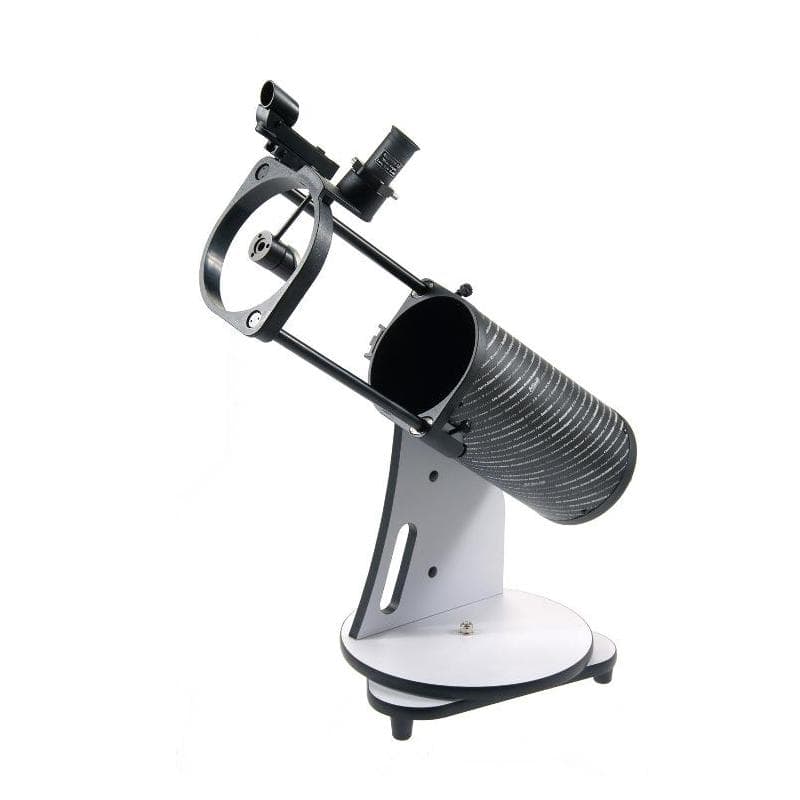
Sky-Watcher Heritage 130P FlexTube
A parabolic mirror, 130 mm: one notch below a 150 Dobsonian, in a cupboard.
€197seen 7 Oct 2026 at Astroshop
See it at Astroshoppaid link?
If you have somewhere to keep it
Sky-Watcher Skyliner 150P Classic
Rather than the 150 tabletop: the Dobsonian on the ground shows the same, stands on its own and does not shake.
€357seen 7 Oct 2026 at Astroshop
See it at Astroshoppaid link?
For a beginner short on space, a child, or a budget of €100–300, it is the category that gives the most aperture per euro and per centimetre of cupboard. The 130/650 is its centre of gravity.
The models, at their observed price
The 76, the two 130s and the 150 tabletop, in price order.
Jupiter, suburban sky (Bortle 6). Computed, not photographed.
One price per model — the cheapest observed offer, with its date — and the button goes to that offer, never to the one that pays. Cards in price order. Links marked paid link earn us a commission and cost you nothing extra. Every seller is listed on the model's page.
The family's strengths
The family's limits
€94seen 7 Oct 2026 at Astroshop
 See it at Astroshoppaid link
The first telescope, under €300
130 mm · f/5.0 · 6.2 kg · set up in 3 min
The family's strengths
The family's limits
€197seen 7 Oct 2026 at Astroshop
 See it at Astroshoppaid link
The first telescope, under €300
130 mm · f/5.0 · 7.5 kg · set up in 3 min
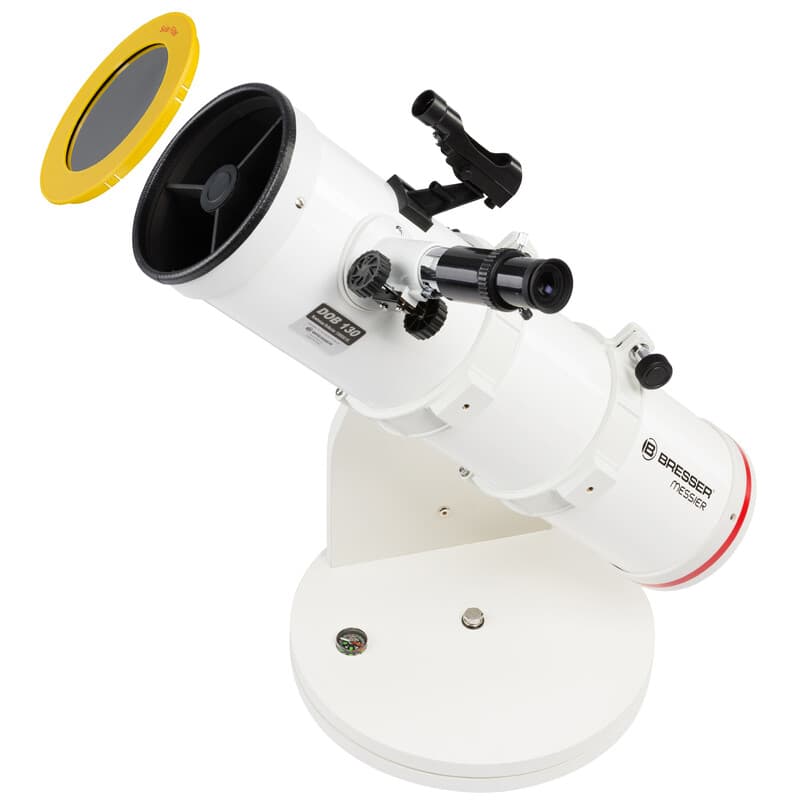
€219seen 7 Oct 2026 at Astroshop
 See it at Astroshoppaid link
Rarely: the ground Dobsonian does better
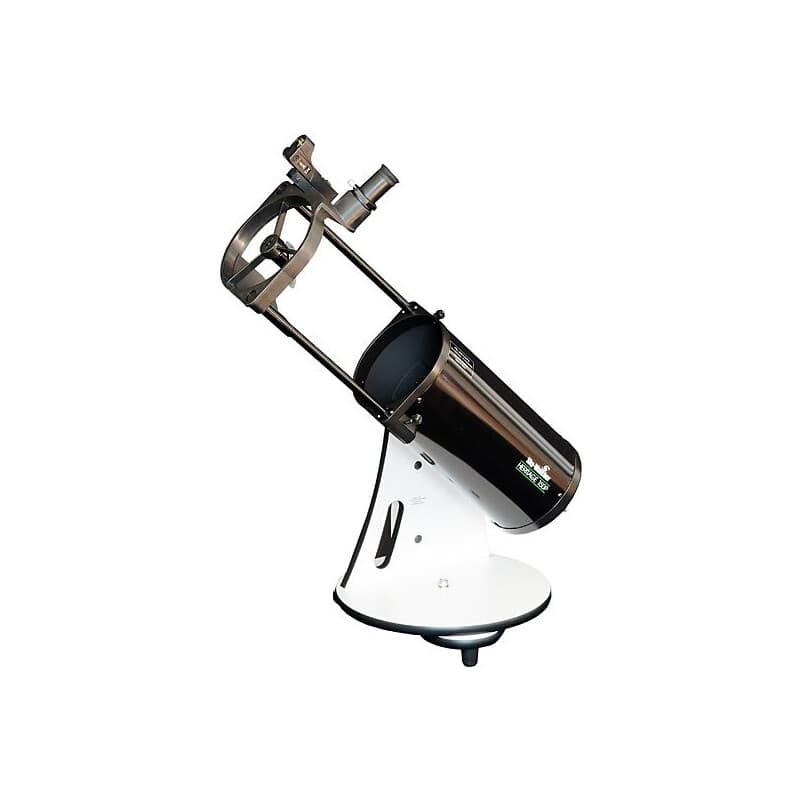
150 mm · f/5.0 · 7.5 kg · set up in 3 min
€345seen 7 Oct 2026 at Astroshop
 See it at Astroshoppaid link
The price of a telescope under €300 goes mostly into what carries it. A tripod that does not shake costs more than the tube it holds, and the manufacturers know it: that is why €119 refractors have good lenses on unusable tripods. The tabletop base removes the tripod. What remains is a board that turns, a fork that tilts, and a tube; the whole thing is low, heavy for its size, and does not vibrate. The money saved goes into the mirror. That is how a 130 mm tabletop costs barely more than a 70 mm refractor on a tripod.
This is the question nobody asks before buying and everybody asks on the first night. A garden table works, provided it does not move when you lean on it. A wall, a terrace ledge, a car bonnet, an upturned wooden crate do just as well. A bar stool is too narrow; a coffee table too low, unless you sit on the ground, which is a good position for a child anyway.
Without a table, a solid photo tripod with a 3/8" screw or an adapter carries the 76 without trouble and the 130 with care: above 100× on 130 mm (an exit pupil of 1.3 mm) it shakes. The right answer for the 130 is a wooden stool or a €20 trestle cut to height. Sitting behind it, the eyepiece lands at eye level, and that is the position you observe longest in.
The 76/300 (f/4) is a low-power instrument. Its 300 mm of focal length gives 30× with the 10 mm eyepiece, on 76 mm an exit pupil of 2.5 mm; that is the whole Moon in the field, the Pleiades, the big clusters, and Saturn small but with its ring. Its short mirrors limit sharpness at high power, at a point that differs by model: for the FirstScope 76, Telescopic Watch reports about 40× at most (an exit pupil of 1.9 mm); you will not go looking for the Cassini division. For a six- or seven-year-old, or as a travel telescope, it is perfect. As a curious adult's only instrument, it frustrates after a year.
The 130/650 (f/5) is another world. Parabolic mirror, 130 mm: in practice you see what a 150 mm Dobsonian shows, one notch down. Jupiter with its belts, Saturn with the Cassini division in good air, the Hercules cluster as an anthill, the Orion nebula with its wings, a dozen galaxies under a decent sky. It needs collimating now and then (five minutes, once you know how) and takes a 6 mm eyepiece, 108× on 130 mm (an exit pupil of 1.2 mm), for the planets. The collapsible tube of the FlexTube models stores in a cupboard 40 cm high.
The 130 tabletop is the telescope people keep. Many who go on to buy a 200 or 250 mm Dobsonian hold onto the 130 as a travel or balcony instrument, because it fits in a boot next to the suitcases. The 76 gets handed down to someone younger. Neither resells well, and that does not matter: at that price you do not replace, you add.
Cheapest first. Each view is the Hercules Cluster through the model, at the same exit pupil, under the same suburban sky.
| Model | Aperture | Weight | Setup | What it shows | Price |
|---|---|---|---|---|---|
| Sky-Watcher Heritage 76For whom: Age 6–7, or travel | 76 mm · f/3.9 | 1.8 kg | 2 min | €947 Oct 2026 · Astroshop | |
| Sky-Watcher Heritage 130P FlexTubeFor whom: The first telescope, under €300 | 130 mm · f/5.0 | 6.2 kg | 3 min | €1977 Oct 2026 · Astroshop | |
| Bresser Messier 130/650 DobsonFor whom: The first telescope, under €300 | 130 mm · f/5.0 | 7.5 kg | 3 min | €2197 Oct 2026 · Astroshop | |
| Sky-Watcher Heritage 150P FlexTubeFor whom: Rarely: the ground Dobsonian does better | 150 mm · f/5.0 | 7.5 kg | 3 min | €3457 Oct 2026 · Astroshop | |
| Sky-Watcher Skyliner 150P ClassicFor whom: If there is room | 150 mm · f/8.0 | 18.0 kg | 8 min | €3577 Oct 2026 · Astroshop |
The base costs less than a tripod and does not shake; the money goes into the mirror.
The observed prices are on this page, dated. Not the 76/700 or 114/900 on a plastic table tripod.
In grey, except the Moon, the planets and the stars.
A solid photo tripod carries the 76; with the 130 it shakes above 100× (an exit pupil of 1.3 mm on 130 mm).
The 130 tabletop stores anywhere and travels. If the space exists, the Dobsonian; if not, the 130 with no regret.
These thumbnails are built from real photographs, scaled and darkened by the same arithmetic as the large view.
What this page rests on and when it changed, computed from the catalogue — no date below is typed by hand. There is no price history yet, so this log says what was read and when, never whether it went up or down.
One price per model: the cheapest observed offer, with its date. Models are ordered by that price, never by what a link pays. How we choose.
Read next
Written and maintained by the person behind About.