What it shows
Through the family's typical instrument: 76 mm at f/3.9, with the eyepiece a beginner would use for each target. Computed, then darkened by the sky — never a photograph.
- The MoonDetailed38× (8 mm eyepiece) · 76 mm · 2.0 mm exit pupil
- SaturnRecognisable75× (4 mm eyepiece) · 76 mm · 1.0 mm exit pupil
- The Hercules ClusterDetectable50× (6 mm eyepiece) · 76 mm · 1.5 mm exit pupil
- The Whirlpool GalaxyDetectable30× (10 mm eyepiece) · 76 mm · 2.5 mm exit pupil
Photo credits
These thumbnails are built from real photographs, scaled and darkened by the same arithmetic as the large view.
Which level of detail a target reaches is a rule of thumb from observers; the magnification, field and exit pupil are arithmetic.
What it is for, goal by goal
Every score with the sentence behind it, highest first.
- With a child4/5 GoodA child can carry it to the table and move it themselves; an adult focuses and finds the first targets. From experience, a child who stays interested outgrows it within a year or two.
- Travel4/5 GoodUnder 2 kg and rucksack-sized. The table it needs is the part that does not travel: a wall or a picnic table will do.
- Sun4/5 GoodIn white light: sunspots with their penumbra, faculae near the edge, and granulation on a steady morning. Dawes' limit on the Sun: 1.5″ (116 ÷ 76 mm, arithmetic). The cell has to hold each model's own outside diameter, so it depends on the model: from €55 to €69 for 76 mm. Each model's page names its own. Every time: certified filter over the front · finder capped · never an eyepiece filter · an adult with children · never without the filter · measure first.
- Learn the sky3/5 FairAbout 4° of sky at 12× on 76 mm (an exit pupil of 6.3 mm) makes star-hopping easy. The view is upside down, like every reflector's, and the telescope needs something to stand on wherever you learn.
- Moon & planets2/5 WeakThe Moon in detail; Saturn's ring and Jupiter's four moons. Dawes' limit is 1.5″ (116 ÷ 76, arithmetic). How much power these short mirrors take before the image goes soft is experience, and differs by model: where a named source reports a ceiling, the model's page gives it.
- Deep sky2/5 WeakThe bright showpieces — the Orion Nebula, the Pleiades, the Double Cluster — at 12× on 76 mm (an exit pupil of 6.3 mm) and about 4° of field. Galaxies beyond Andromeda's core are out of reach: a third of a 130's light is arithmetic, and faint objects are where it shows.
Not for this
- Serious photo0/5 NoNo. No tracking, no camera connection, no mount to grow into.
- Photo0/5 NoNot an imaging instrument. The base does not track, so beyond a phone held to the eyepiece on the Moon there is nothing to photograph.
What it does well
- Under 2 kg with its base: a child can carry it, and it fits in a rucksack
- A 25 mm eyepiece on its 300 mm focal length gives 12× on 76 mm — an exit pupil of 6.3 mm and about 4° of sky, so finding things is easy
- Nothing to align, nothing to power, nothing to break
What it costs you
- About a third of the light of a 130 mm — (76 ÷ 130)² ≈ 0.34, arithmetic. Faint things stay out of reach
- The usual rule — twice the aperture in millimetres — allows about 150× on 76 mm (an exit pupil of 0.5 mm); these short f/4 mirrors go soft far below that, at a power that differs by model — where a named source reports one, the model's page gives it (experience)
- Needs a table, a wall or a crate. On the ground you are lying down
The Sun, safely
The Sun with this family
The cell has to hold each model's own outside diameter, so it depends on the model: from €55 to €69 for 76 mm. Each model's page names its own.
In white light: sunspots with their penumbra, faculae near the edge, and granulation on a steady morning. Dawes' limit on the Sun: 1.5″ (116 ÷ 76 mm, arithmetic).
- 76 mm: outside diameter not sourced — once measured, one of: Omegon Helievo 72 (64–88 mm), Omegon Helievo 92 (84–108 mm), Omegon Helievo 112 (104–128 mm) (€55–€69).
The listing names no standard; no international standard exists for filters on telescopes, binoculars or lenses (AAS).
Counted against this family: €69, the filter for its smallest model — its cheapest route, where its price band starts.
Every time
- A certified solar filter over the FRONT of the instrument, fastened so it cannot slip or blow off.
- Cap or remove the finder. It is a second telescope, and it has no filter.
- Never a filter at the eyepiece end: the concentrated sunlight there can crack it in an instant.
- With children, an adult is there every time.
- Never look, or point, without the filter on. Check it before each use; a scratched or torn filter goes in the bin.
- Measure before ordering. A cell that sits loose can fall off.
Sources for the Sun
- American Astronomical Society — How to View a Solar Eclipse Safely — filters on optics go on the front; eclipse glasses never with optics; children supervised
- American Astronomical Society — Solar Filters for Optics — eyepiece filters are dangerous; the finder capped, removed or filtered; the filter attached securely
- American Astronomical Society — About the ISO 12312-2 Standard — EN ISO 12312-2:2015 covers naked-eye viewers only; no international standard covers filters on telescopes, binoculars or lenses
- Société astronomique de France — Guide des observations solaires — a filter at the front, never one screwed into the eyepiece, the finder capped
- NASA — Keep Your Eclipse Glasses to See the Sun's ‘Freckles’ — a large enough sunspot shows through eclipse glasses
- AAVSO — Le Guide d'Observation Solaire de l'AAVSO, v1.1 (2017), p. 6 — archived copy — “Les ouvertures plus grandes que 100 à 125 mm sont généralement limitées par les effets de turbulence atmosphérique”; 50 to 80 mm is enough to count sunspots
Next to it
Smaller
10×50 binoculars- −23 mm
- −1.1 kg
- −€10 at entry level
Recognisable targets (of 14): countryside 10 → 9, city 7 → 6.
Bigger
130 mm tabletop Dobsonian- +64 mm
- +4 kg
- +€70 at entry level
Recognisable targets (of 14): countryside 10 → 14, city 7 → 10.
Rule of thumb from observers, at each family's typical aperture.
The models
Each price is the cheapest one observed, with its date. Links marked paid link earn us a commission and cost you nothing extra; the list is ordered by price, then by name — never by what pays. How this site is funded
| Model | Aperture | Focal length | Weight | Eyepieces supplied | Cheapest observed | Buy |
|---|---|---|---|---|---|---|
| Celestron FirstScope 76 | 76 mm | 300 mm | 1.9 kg | 20 mm and 4 mm | €85seen 7 Oct 2026 at Astroshop | At Astroshoppaid link4 other sellers
|
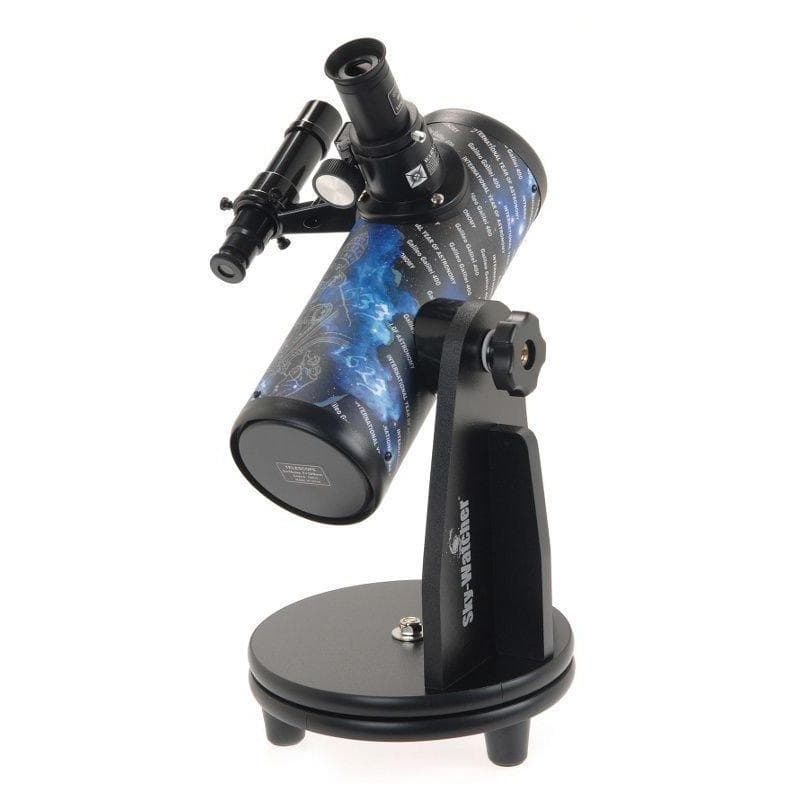 Sky-Watcher Heritage 76 Sky-Watcher Heritage 76 | 76 mm | 300 mm | 1.8 kg | 25 mm and 10 mm | €94seen 7 Oct 2026 at Astroshop | At Astroshoppaid link4 other sellers
|
Questions people ask
Does a 76 mm show Saturn's rings?
Yes, from about 30× — an exit pupil of 2.5 mm on 76 mm, with a 10 mm eyepiece. The ring stands clear of the globe, small. Jupiter shows its four moons and, on a steady night, its two main belts faintly. The usual rule — twice the aperture in millimetres — would give about 150×; these short mirrors go soft well before that, at a power that differs by model (for the FirstScope 76, about 40× per Telescopic Watch, an exit pupil of 1.9 mm), and that part is experience.
A 76 mm or a 130 mm tabletop?
The 130 gathers (130 ÷ 76)² ≈ 2.9 times the light and resolves 0.9″ against 1.5″ (Dawes' limit, 116 ÷ D). The 76 weighs under 2 kg and goes in a rucksack. For an adult, the 130; for a young child who will carry it themselves, or for travel, the 76.
What sets it apart from a small telescope for children?
The base: a small rocker box that holds still on a table. The optics are simple — a short f/4 mirror — and they are what limits sharpness at high power, at a point that differs by model.
From what age?
From about six, with an adult to set it up and focus; a child of eight or nine can use it alone. That is experience, not a rule: patience decides more than age.
Read next
- Which telescope for a child?Age by age: who sets the instrument up, what they will see on the first night, and what not to buy.Updated 24 Sept 2026
- Tabletop telescopes: which one, and for whomThe 76, the 130, where to put them, and what a tabletop telescope does not do.Updated 24 Sept 2026
- Telescopes under €200: what is worth itTwo good buys, one honest one, and the number that rules out the rest — with what each really shows.Updated 24 Sept 2026