The answer does not depend on a brand but on three numbers you can work out yourself: the magnification, the exit pupil and the true field. This page works them out for three common instruments, and says which to buy first.
Three numbers, and that is all
- Magnification: the telescope's focal length divided by the eyepiece's. A 10 mm eyepiece on a telescope of 650 mm focal length gives 650 ÷ 10 = 65×, on 130 mm of aperture, an exit pupil of 2 mm.
- Exit pupil: the width of the beam leaving the eyepiece, which is the telescope's aperture divided by the magnification. It says how bright the image is. Shortcut: it is also the eyepiece focal length divided by the telescope's focal ratio, so a 10 mm gives a 2 mm exit pupil on any f/5 telescope.
- True field: the eyepiece's apparent field (engraved on it or given by the maker, in degrees) divided by the magnification. It is the patch of sky you see; the full Moon is half a degree across.
Magnification on its own says nothing: it is the number that sells, and the number that misleads. What decides whether an image is useful is the exit pupil it leaves. Too large, larger than your eye's pupil, and some of the light lands beside it. Too small, under 0.5 mm, and the image gets bigger without showing one more detail, only dimmer and softer.
At the other end, the dark-adapted eye's pupil opens to about 7 mm in a young adult, and less with age, often 5 to 6 mm past fifty. Beyond that, the extra light falls on the iris. That is why a 'very low power' eyepiece is not always a gain.
What each exit pupil is for
- About 5 to 7 mm: the widest field, for finding things, large clusters, the whole Pleiades, extended nebulae under a dark sky.
- About 2 to 3 mm: the all-round deep-sky exit pupil, for galaxies, globular clusters, small nebulae.
- About 1 mm: the Moon in detail, planets, double stars, when the air is steady.
- Below 1 mm, down to 0.5 mm: only on nights of very steady air, for planets and close doubles.
Three telescopes, worked out
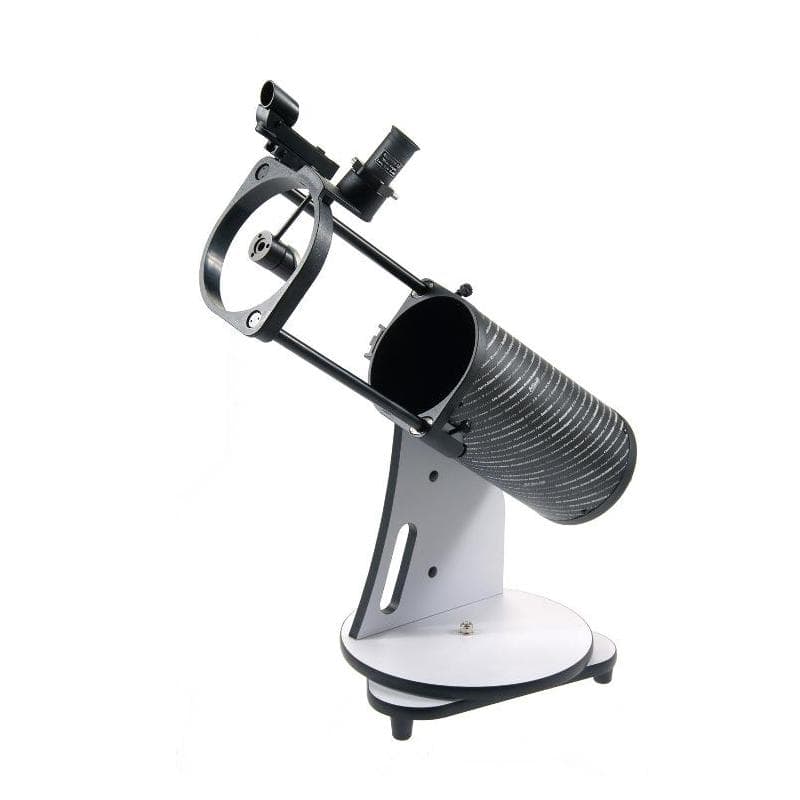
A 130/650 tabletop Dobsonian (f/5), with the 25 mm and 10 mm from the box. The 25 mm gives 26× on 130 mm, an exit pupil of 5 mm, and with a 50° apparent field a true field of 1.9°, nearly four full Moons. The 10 mm gives 65× on 130 mm, an exit pupil of 2 mm. The gap is near 1 mm: a 6 mm gives 108× on 130 mm, an exit pupil of 1.2 mm, and a 5 mm gives 130× on 130 mm, an exit pupil of 1 mm.
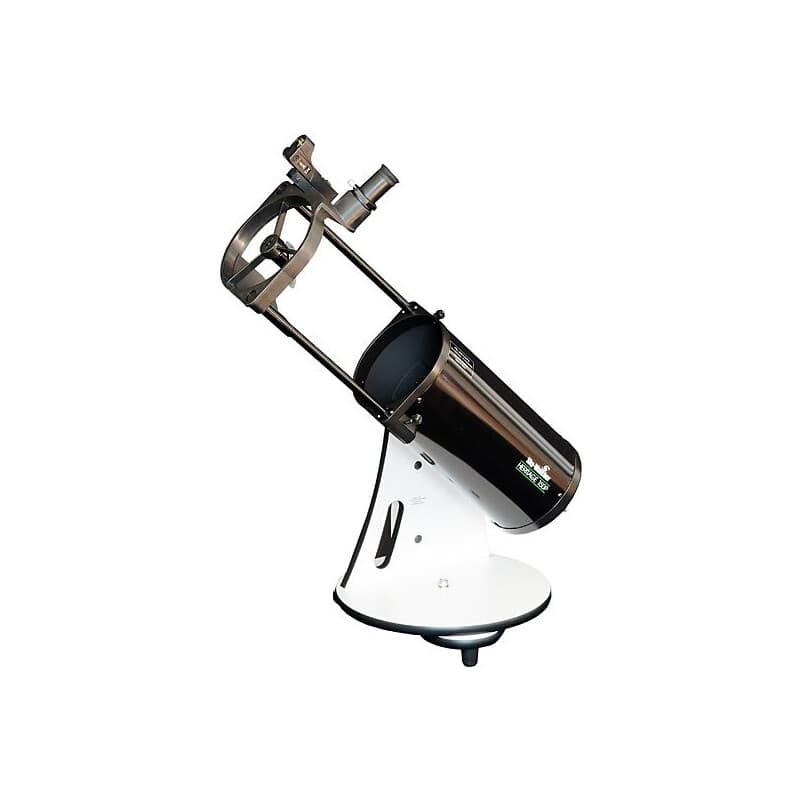
A 150/750 tabletop Dobsonian (f/5), with the same 25 mm and 10 mm. The 25 mm gives 30× on 150 mm, an exit pupil of 5 mm; the 10 mm gives 75× on 150 mm, an exit pupil of 2 mm. Same focal ratio, so the same exit pupils: a 5 mm gives 150× on 150 mm, an exit pupil of 1 mm, and a 6 mm gives 125× on 150 mm, an exit pupil of 1.2 mm.
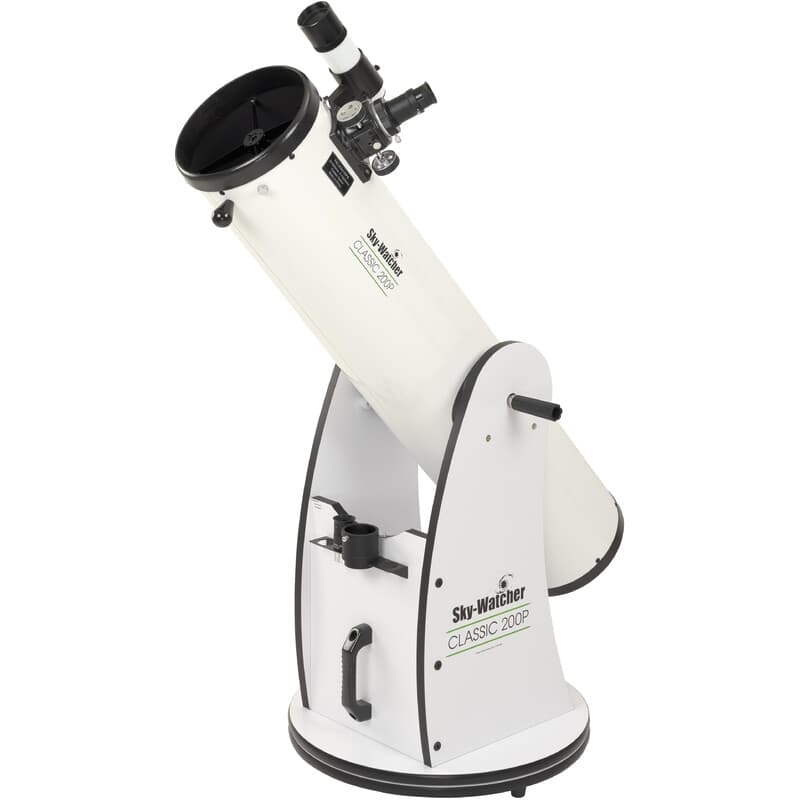
A 200/1200 Dobsonian (f/6), with a 25 mm and a 10 mm. The 25 mm gives 48× on 200 mm, an exit pupil of 4.2 mm; the 10 mm gives 120× on 200 mm, an exit pupil of 1.7 mm. A 6 mm gives 200× on 200 mm, an exit pupil of 1 mm. At the low end, a 32 mm gives 38× on 200 mm, an exit pupil of 5.3 mm, and a wider true field than the 25 mm.
The three instruments in the examples
A 130/650, a 150/750 and a 200/1200, each supplied with a 25 mm and a 10 mm: the arithmetic above is theirs.
One price per model — the cheapest observed offer, with its date — and the button goes to that offer, never to the one that pays. Cards in price order. Links marked paid link earn us a commission and cost you nothing extra. Every seller is listed on the model's page.
Sky-Watcher Heritage 130P FlexTube
130 mm · f/5.0 · 6.2 kg · set up in 3 min
The family's strengths
- Real aperture — several hundred times the light of an unaided eye — at a price that does not need justifying
- Carried outside in one hand, set up in a couple of minutes
The family's limits
- Needs a table or a wall. On the ground you are lying down
- Needs collimating occasionally — five minutes with a €20 cap
€197seen 8 Oct 2026 at Astroshop
 See it at Astroshoppaid link
4 other sellers
- First Light Opticssearches; neither price nor stock checked
- Optique Unterlindensearches; neither price nor stock checked
- Pierro Astrosearches; neither price nor stock checked
- Teleskop-Expresssearches; neither price nor stock checked
Sky-Watcher Heritage 150P FlexTube
150 mm · f/5.0 · 7.5 kg · set up in 3 min
€345seen 8 Oct 2026 at Astroshop
 See it at Astroshoppaid link
4 other sellers
- First Light Opticssearches; neither price nor stock checked
- Optique Unterlindensearches; neither price nor stock checked
- Pierro Astrosearches; neither price nor stock checked
- Teleskop-Expresssearches; neither price nor stock checked
The family's strengths
- Enough aperture that globular clusters resolve into stars rather than staying fuzz
- No mount to align: push it, and it stays where you left it
The family's limits
- Two trips outside, or one heavy one. This is what decides whether it gets used
- The base is bulky in a way the tube is not — storage is the real constraint
€449seen 8 Oct 2026 at Astroshop
 See it at Astroshoppaid link
4 other sellers
- First Light Opticssearches; neither price nor stock checked
- Optique Unterlindensearches; neither price nor stock checked
- Pierro Astrosearches; neither price nor stock checked
- Teleskop-Expresssearches; neither price nor stock checked
Which to buy first
- First purchase: an eyepiece giving about 1 to 1.2 mm of exit pupil, so a focal length of 5 to 6 mm on an f/5, 6 to 7 mm on an f/6. It is the one that shows Jupiter's belts, the Cassini division, the craters along the terminator.
- Choose it with comfortable eye relief (how far from the glass your eye sits): short focal lengths in older designs make you press your eye to the lens, which is tiring, and impossible with glasses on.
- A wider apparent field, around 60° or more, helps on a Dobsonian without tracking: the planet crosses the field more slowly, and you nudge it back less often.
- Second purchase, later: a wide field at low power, if the 25 mm feels narrow. In a 1.25-inch focuser the true field tops out around a 32 mm at 50° or a 24 mm at 68°; beyond that you need a 2-inch focuser.
The Barlow, honestly
A Barlow lens slides in ahead of the eyepiece and multiplies the telescope's focal length, most often by two. It adds neither light nor resolution: it only gives each eyepiece one more magnification. Well chosen, it doubles the range. On a 130/650, a 2× Barlow turns the 10 mm into the equivalent of a 5 mm, 130× on 130 mm, an exit pupil of 1 mm, and the 25 mm into the equivalent of a 12.5 mm, 52× on 130 mm, an exit pupil of 2.5 mm.
Badly chosen, it only serves to overshoot the maximum useful power. On a 200/1200, the same 2× Barlow turns the 10 mm into the equivalent of a 5 mm, 240× on 200 mm, an exit pupil of 0.8 mm: useful only on very steady nights. And the 3× Barlow in cheap kits, with its 4 mm, mostly serves to print a big number on the box.
What not to buy
ExperienceOpinion, not physics — shared by nearly everyone who has helped a beginner.
A case of eyepieces and filters
Five compromises instead of one good choice, overlapping focal lengths, and colour filters almost nobody keeps using after the first month.
- Instead
- One eyepiece, chosen for the exit pupil you are missing.
- What changes
- A case costs in the order of 100 to 250 €; one well-chosen eyepiece, often less.
The shortest eyepiece you can find, 'to magnify more'
Below an exit pupil of 0.5 mm the image grows without one more detail, and on most nights the atmosphere stops you well before.
- Instead
- An eyepiece giving about a 1 mm exit pupil.
A zoom or a premium wide-field before a month of observing
You do not yet know which exit pupil you use; an expensive eyepiece at the wrong power stays at the bottom of the bag.
- Instead
- A month with the eyepieces in the box, then the purchase that fills the gap.
Every model in this guide
Cheapest first. Each view is the Hercules Cluster through the model, at the same exit pupil, under the same suburban sky.
| Model | Aperture | Weight | Setup | What it shows | Price |
|---|---|---|---|---|---|
| Sky-Watcher Heritage 130P FlexTube | 130 mm · f/5.0 | 6.2 kg | 3 min | €1978 Oct 2026 · Astroshop | |
| Sky-Watcher Heritage 150P FlexTube | 150 mm · f/5.0 | 7.5 kg | 3 min | €3458 Oct 2026 · Astroshop | |
| Sky-Watcher Skyliner 200P | 200 mm · f/6.0 | 25.0 kg | 8 min | €4498 Oct 2026 · Astroshop |
Questions people ask
Which eyepiece should I buy to see the planets?The one giving an exit pupil of about 1 mm: a focal length equal to the telescope's focal ratio.
On a 130/650 (f/5), a 5 mm gives 130× on 130 mm, an exit pupil of 1 mm.
How do I work out an eyepiece's magnification?Divide the telescope's focal length by the eyepiece's.
Then divide the aperture by that magnification to get the exit pupil: a 10 mm on a 200/1200 gives 120× on 200 mm, an exit pupil of 1.7 mm.
What is my telescope's maximum magnification?About twice the aperture in millimetres, where the exit pupil falls to 0.5 mm: 260× on 130 mm, an exit pupil of 0.5 mm.
On most nights the turbulence stops you well before.
Is a Barlow lens worth it?Sometimes.
A 2× Barlow gives each eyepiece one more magnification; it is useful if it lands on the exit pupil you are missing, useless if it takes you past the maximum useful power.
What is an eyepiece's apparent field?The angle the image covers in your eye, in degrees: about 50° for a simple eyepiece, 60 to 70° for a wide-field one.
Divided by the magnification, it gives the true field, the patch of sky you see.
Should I buy a case of eyepieces?No.
The focal lengths overlap and the colour filters see little use. One eyepiece, chosen for the exit pupil you are missing, does more.
Photo credits
These thumbnails are built from real photographs, scaled and darkened by the same arithmetic as the large view.
- The Hercules Cluster: Wikimedia Commons, Messier_13.jpg, CC BY-SA
Method and changes
What this page rests on and when it changed, computed from the catalogue — no date below is typed by hand. There is no price history yet, so this log says what was read and when, never whether it went up or down.
- 3 prices read at Astroshop
- First published
One price per model: the cheapest observed offer, with its date. Models are ordered by that price, never by what a link pays. How we choose.
Read next
- Tabletop telescopes: which one, and for whomThe 76, the 130, where to put them, and what a tabletop telescope does not do.Updated 24 Sept 2026
- Giving a telescopeWhich one to give to whom, at what price, and when the best present is not a telescope.Updated 29 Sept 2026
- Buying a second-hand telescopeA Dobsonian at 55–65% of new that has been out ten times: where to find it, what to check, what not to buy used.Updated 30 Aug 2026
Written and maintained by the person behind About.