Nothing is broken: it is geometry. This page works it out in arcseconds for four common telescopes, and says what makes the image bigger and what stops it.
Saturn in arcseconds
Sizes in the sky are angles. A degree is 60 minutes of arc (60′), a minute is 60 seconds of arc (60″). The full Moon averages 31′, or 1,860″. Saturn, when it is closest, is about 44″ from one edge of the ring to the other, and its globe about 19″: the ring is roughly 2.27 times the planet's equatorial width (273,000 km against 120,500 km).
These values shift a little through the year with the distance between Earth and Saturn; 44″ is the one the site's simulator uses. It sets everything else: a telescope does not make Saturn bigger, it multiplies that angle.
What magnification does
Magnification multiplies the apparent angle. Multiplied by 42, the ring looks as wide as the full Moon does to the naked eye: on a 130/650 that is an eyepiece of about 15 mm, 43× on 130 mm, an exit pupil of 3 mm.
And the full Moon does not look big to the naked eye: half a degree in a sky that spans 180 from horizon to horizon. In the eyepiece, the ring is surrounded by the eyepiece's apparent field, about 50° for the ones in the box. Even enlarged to 1.6°, it fills only a thirtieth of that width. That small thing in a big black circle is what the eye remembers.
The Saturn photographs you see online are made differently: a camera records thousands of short frames, software keeps the sharpest and stacks them, and the result is enlarged on a screen. They show neither the size nor the sharpness the eye sees at the eyepiece.
Four telescopes, worked out
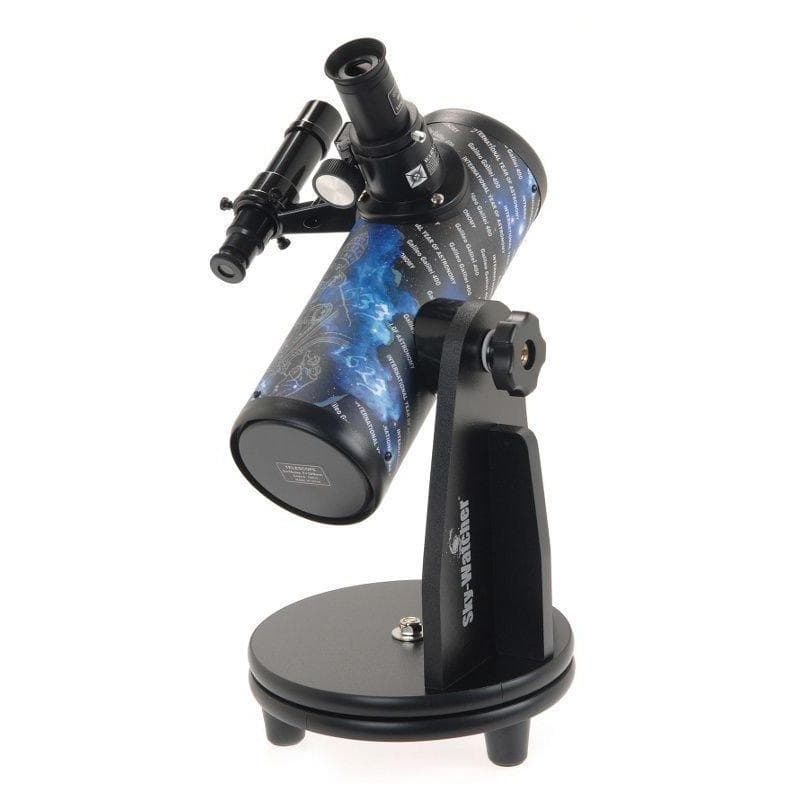
A 76/300 tabletop Newtonian (f/3.9), sold with a 25 mm and a 10 mm. The 10 mm gives 30× on 76 mm, an exit pupil of 2.5 mm: the ring spans 0.36°, less than the full Moon to the naked eye. A 4 mm would give 75× on 76 mm, an exit pupil of 1 mm, and 0.9° of ring.
A 70/900 refractor (f/12.9), sold with a 20 mm and a 10 mm. The 10 mm gives 90× on 70 mm, an exit pupil of 0.8 mm, and 1.1° of ring. The useful maximum, 140× on 70 mm (an exit pupil of 0.5 mm), is only one and a half times further.
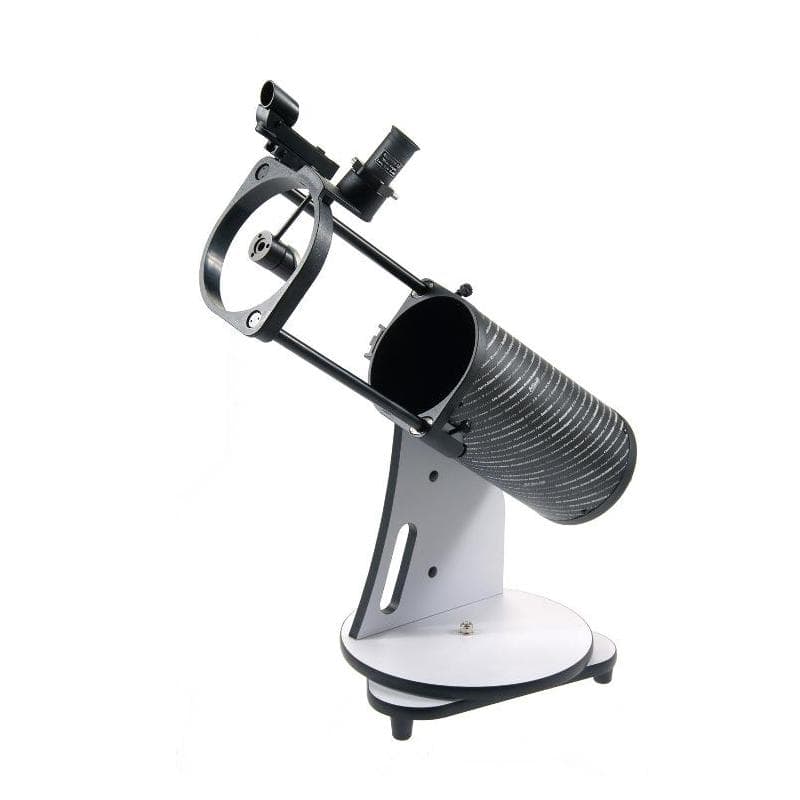
A 130/650 tabletop Dobsonian (f/5), sold with a 25 mm and a 10 mm. The 10 mm gives 65× on 130 mm, an exit pupil of 2 mm, and 0.8° of ring. A 5 mm gives 130× on 130 mm, an exit pupil of 1 mm, and 1.6° of ring.
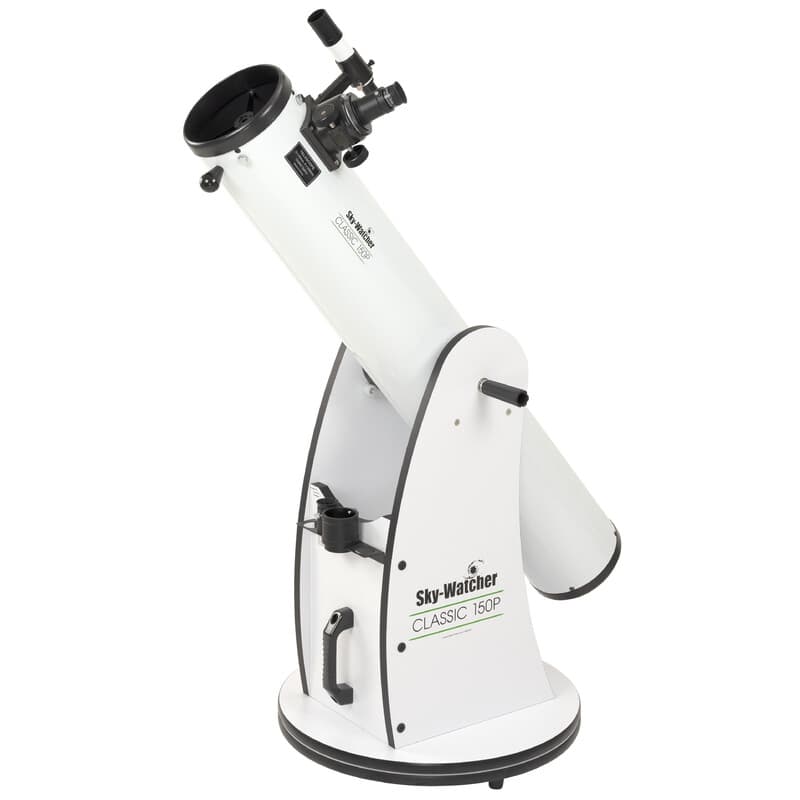
A 150/1200 Dobsonian (f/8), sold with a 25 mm and a 10 mm. The 10 mm already gives 120× on 150 mm, an exit pupil of 1.25 mm, and 1.5° of ring. A 6 mm gives 200× on 150 mm, an exit pupil of 0.75 mm, and 2.4° of ring: a power for steady nights.
The four instruments in the examples
A 76/300, a 70/900, a 130/650 and a 150/1200, with the eyepieces in their boxes: the arithmetic above is theirs.
One price per model — the cheapest observed offer, with its date — and the button goes to that offer, never to the one that pays. Cards in price order. Links marked paid link earn us a commission and cost you nothing extra. Every seller is listed on the model's page.
The family's strengths
- Under 2 kg with its base: a child can carry it, and it fits in a rucksack
- A 25 mm eyepiece on its 300 mm focal length gives 12× on 76 mm — an exit pupil of 6.3 mm and about 4° of sky, so finding things is easy
The family's limits
- About a third of the light of a 130 mm — (76 ÷ 130)² ≈ 0.34, arithmetic. Faint things stay out of reach
- The usual rule — twice the aperture in millimetres — allows about 150× on 76 mm (an exit pupil of 0.5 mm); these short f/4 mirrors go soft far below that, at a power that differs by model — where a named source reports one, the model's page gives it (experience)
€94seen 8 Oct 2026 at Astroshop
 See it at Astroshoppaid link
4 other sellers
- First Light Opticssearches; neither price nor stock checked
- Optique Unterlindensearches; neither price nor stock checked
- Pierro Astrosearches; neither price nor stock checked
- Teleskop-Expresssearches; neither price nor stock checked
Celestron AstroMaster 70AZ
70–90 mm refractor on an alt-az mount
70 mm · f/12.9 · 4.5 kg · set up in 5 min
The family's strengths
- Point it and look. No collimation, ever
- The eyepiece stays at a comfortable height wherever you aim
The family's limits
- 70–90 mm is not much light. Deep sky is a short list
- Cheap achromats show a violet fringe on the Moon and bright planets
€189seen 8 Oct 2026 at Astroshop
See it at Astroshoppaid link
4 other sellers
- First Light Opticssearches; neither price nor stock checked
- Optique Unterlindensearches; neither price nor stock checked
- Pierro Astrosearches; neither price nor stock checked
- Teleskop-Expresssearches; neither price nor stock checked
Sky-Watcher Heritage 130P FlexTube
130 mm · f/5.0 · 6.2 kg · set up in 3 min
The family's strengths
- Real aperture — several hundred times the light of an unaided eye — at a price that does not need justifying
- Carried outside in one hand, set up in a couple of minutes
The family's limits
- Needs a table or a wall. On the ground you are lying down
- Needs collimating occasionally — five minutes with a €20 cap
€197seen 8 Oct 2026 at Astroshop
 See it at Astroshoppaid link
4 other sellers
- First Light Opticssearches; neither price nor stock checked
- Optique Unterlindensearches; neither price nor stock checked
- Pierro Astrosearches; neither price nor stock checked
- Teleskop-Expresssearches; neither price nor stock checked
The family's strengths
- Enough aperture that globular clusters resolve into stars rather than staying fuzz
- No mount to align: push it, and it stays where you left it
The family's limits
- Two trips outside, or one heavy one. This is what decides whether it gets used
- The base is bulky in a way the tube is not — storage is the real constraint
€357seen 8 Oct 2026 at Astroshop
 See it at Astroshoppaid link
4 other sellers
- First Light Opticssearches; neither price nor stock checked
- Optique Unterlindensearches; neither price nor stock checked
- Pierro Astrosearches; neither price nor stock checked
- Teleskop-Expresssearches; neither price nor stock checked
What stops the magnification
- Aperture. Beyond about twice the aperture in millimetres, the exit pupil drops under 0.5 mm: the image grows without one more detail, dimmer and softer.
- Resolution. Dawes' limit, 116 ÷ aperture in millimetres, is 1.5″ on 76 mm, 0.89″ on 130 mm and 0.77″ on 150 mm: magnifying past what the aperture resolves enlarges the blur.
- The atmosphere. Turbulent air makes the image shimmer and boil, and it sets the limit on most nights.
In 2026 the ring is nearly edge-on
The ring passed edge-on as seen from Earth on 23 March 2025. At the 4 October 2026 opposition it is tilted only about 7.5°: it draws an ellipse 44″ long and less than 6″ tall, thinner than the globe. It opens to about 27° in 2032, when the ellipse will be nearly 20″ tall, and closes again around 2038–2039.
What not to buy for a bigger Saturn
ExperienceOpinion, not physics — shared by nearly everyone who has helped a beginner.
A 4 mm eyepiece and a 3× Barlow
On a 130/650 a 4 mm gives 163× on 130 mm, an exit pupil of 0.8 mm, already a steady-night power; with the 3× Barlow, 488× on 130 mm, an exit pupil of 0.27 mm: bigger, darker, and without one more detail.
- Instead
- An eyepiece giving about a 1 mm exit pupil: a focal length equal to the focal ratio, 5 mm on an f/5, 8 mm on an f/8.
A bigger telescope to see Saturn bigger
At the same magnification Saturn is the same size in every telescope. A bigger one shows it sharper and brighter, and takes a little more power on good nights, but the atmosphere stays the same.
- Instead
- A suitable eyepiece, a steady night, and the patience to wait for the moments when the air settles.
Every model in this guide
Cheapest first. Each view is the Hercules Cluster through the model, at the same exit pupil, under the same suburban sky.
| Model | Aperture | Weight | Setup | What it shows | Price |
|---|---|---|---|---|---|
| Sky-Watcher Heritage 76 | 76 mm · f/3.9 | 1.8 kg | 2 min | €948 Oct 2026 · Astroshop | |
| Celestron AstroMaster 70AZ | 70 mm · f/12.9 | 4.5 kg | 5 min | €1898 Oct 2026 · Astroshop | |
| Sky-Watcher Heritage 130P FlexTube | 130 mm · f/5.0 | 6.2 kg | 3 min | €1978 Oct 2026 · Astroshop | |
| Sky-Watcher Skyliner 150P Classic | 150 mm · f/8.0 | 18.0 kg | 8 min | €3578 Oct 2026 · Astroshop |
Questions people ask
Why is Saturn so small in my telescope?Because it is only 44″ across.
Even at 130× on a 130 mm, an exit pupil of 1 mm, the ring fills only a thirtieth of the eyepiece's field. That is normal, and it is what everyone sees.
What magnification to see Saturn's rings?The ring shows at low power: with the 10 mm of a 130/650, 65× on 130 mm, an exit pupil of 2 mm.
Comfort comes at about a 1 mm exit pupil, 130× on 130 mm.
Do I need a Barlow to see Saturn bigger?Only if it lands on an exit pupil around 1 mm.
Past the useful maximum, twice the aperture in millimetres, the image grows without one more detail.
Can a small telescope show the Cassini division?With 75 to 100 mm, a steady night and the ring well open, yes.
In 2026 and 2027 the ring is nearly edge-on and it is much harder.
Will Saturn look better in a few years?Yes.
The ring, tilted about 7.5° in autumn 2026, opens to about 27° in 2032: it will look three and a half times taller.
Photo credits
These thumbnails are built from real photographs, scaled and darkened by the same arithmetic as the large view.
- The Hercules Cluster: Wikimedia Commons, Messier_13.jpg, CC BY-SA
Method and changes
What this page rests on and when it changed, computed from the catalogue — no date below is typed by hand. There is no price history yet, so this log says what was read and when, never whether it went up or down.
- First published
- 4 prices read at Astroshop
One price per model: the cheapest observed offer, with its date. Models are ordered by that price, never by what a link pays. How we choose.
Read next
- Which telescope for a child?Age by age: who sets the instrument up, what they will see on the first night, and what not to buy.Updated 24 Sept 2026
- Tabletop telescopes: which one, and for whomThe 76, the 130, where to put them, and what a tabletop telescope does not do.Updated 24 Sept 2026
- Telescopes under €200: what is worth itTwo good buys, one honest one, and the number that rules out the rest — with what each really shows.Updated 24 Sept 2026
Written and maintained by the person behind About.