This page rebuilds it from the parts in the box, shows what that magnification gives on 60 or 70 mm of aperture, and says which number to read instead.
Where the number comes from
Two examples the site has recorded. Lidl's French listing for the Bresser Skylux 60/700 refractor stated, on 26 September 2026, “Grossissement max. utile 525x” (maximum useful magnification 525x). Celestron's manual for the PowerSeeker 70EQ (70/700, 2009 edition) also gives 525 in its magnification table, on page 10, and a highest useful magnification of 165, on page 30. In both cases the figure comes from the same parts: a 4 mm eyepiece and a 3× Barlow.
What “525×” gives on 60 mm
- Exit pupil: 525× on 60 mm leaves an exit pupil of 60 ÷ 525 = 0.11 mm; on 70 mm, 0.13 mm. The usual limit is 0.5 mm.
- Useful maximum: twice the aperture in millimetres, so 120× on 60 mm and 140× on 70 mm, an exit pupil of 0.5 mm. “525×” is 4.4 times the first and 3.75 times the second.
- Brightness: from a 0.5 mm to a 0.11 mm exit pupil, surface brightness is divided by (0.5 ÷ 0.11)², about 20. The Moon turns dull, a planet a pale smudge.
- Detail: Dawes' limit for a 60 mm is 116 ÷ 60 = 1.9″. Multiplied by 525 it becomes 17′, more than half the Moon's width; at 120× on 60 mm, an exit pupil of 0.5 mm, it is 3.9′, already big enough for the eye. Magnifying beyond that enlarges the blur, not the object.
- Tracking: with a 50° apparent field, the true field at that power is 50 ÷ 525 ≈ 0.1°. A star near the celestial equator crosses it in under half a minute, and every touch on a light tripod knocks it out of view.
The same myth, in general
The site files this number among the myths, in its “675×” form: it is the only number on the box that can be made as big as you like without spending a cent more, with a shorter eyepiece and a stronger Barlow. Aperture costs glass and aluminium.
The number to read instead
- The aperture, in millimetres: it sets the light, the detail and the useful magnification. It is the first number of a '130/650'.
- The mount: a tripod that shakes for five seconds after every touch makes any magnification useless, low or high.
- The eyepieces in the box, set against twice the aperture: a kit whose shortest eyepiece, Barlow included, goes far beyond that ceiling is advertising a number it cannot deliver.
Instead, at the observed price
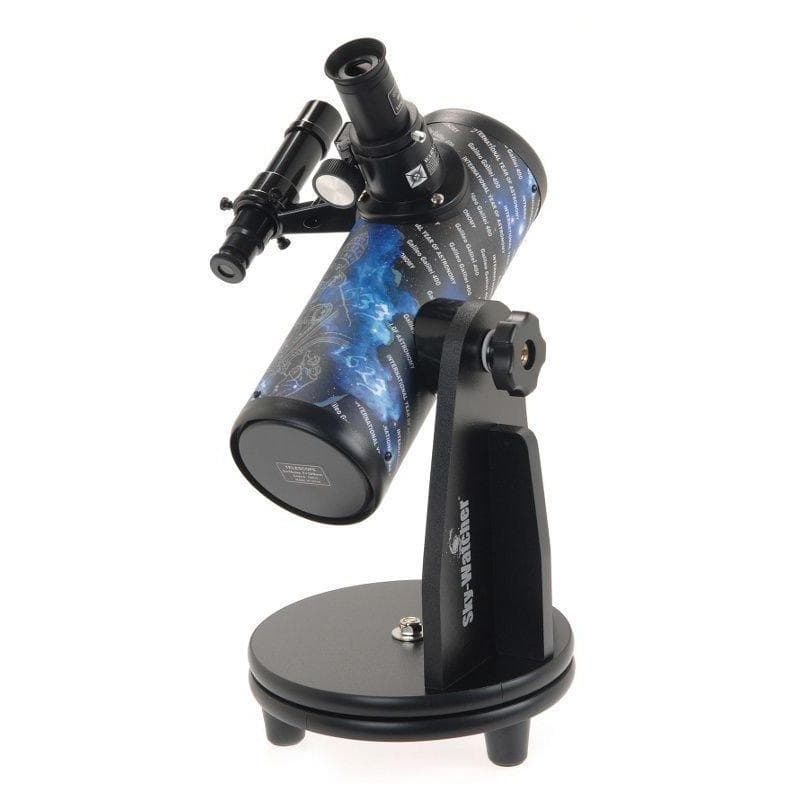
Two tabletop Newtonians, sold with a 25 mm and a 10 mm. The 10 mm gives 30× on 76 mm (an exit pupil of 2.5 mm) and 65× on 130 mm (an exit pupil of 2 mm): far from box numbers, and useful every night.
One price per model — the cheapest observed offer, with its date — and the button goes to that offer, never to the one that pays. Cards in price order. Links marked paid link earn us a commission and cost you nothing extra. Every seller is listed on the model's page.
The family's strengths
- Under 2 kg with its base: a child can carry it, and it fits in a rucksack
- A 25 mm eyepiece on its 300 mm focal length gives 12× on 76 mm — an exit pupil of 6.3 mm and about 4° of sky, so finding things is easy
The family's limits
- About a third of the light of a 130 mm — (76 ÷ 130)² ≈ 0.34, arithmetic. Faint things stay out of reach
- The usual rule — twice the aperture in millimetres — allows about 150× on 76 mm (an exit pupil of 0.5 mm); these short f/4 mirrors go soft far below that, at a power that differs by model — where a named source reports one, the model's page gives it (experience)
€94seen 8 Oct 2026 at Astroshop
 See it at Astroshoppaid link
4 other sellers
- First Light Opticssearches; neither price nor stock checked
- Optique Unterlindensearches; neither price nor stock checked
- Pierro Astrosearches; neither price nor stock checked
- Teleskop-Expresssearches; neither price nor stock checked
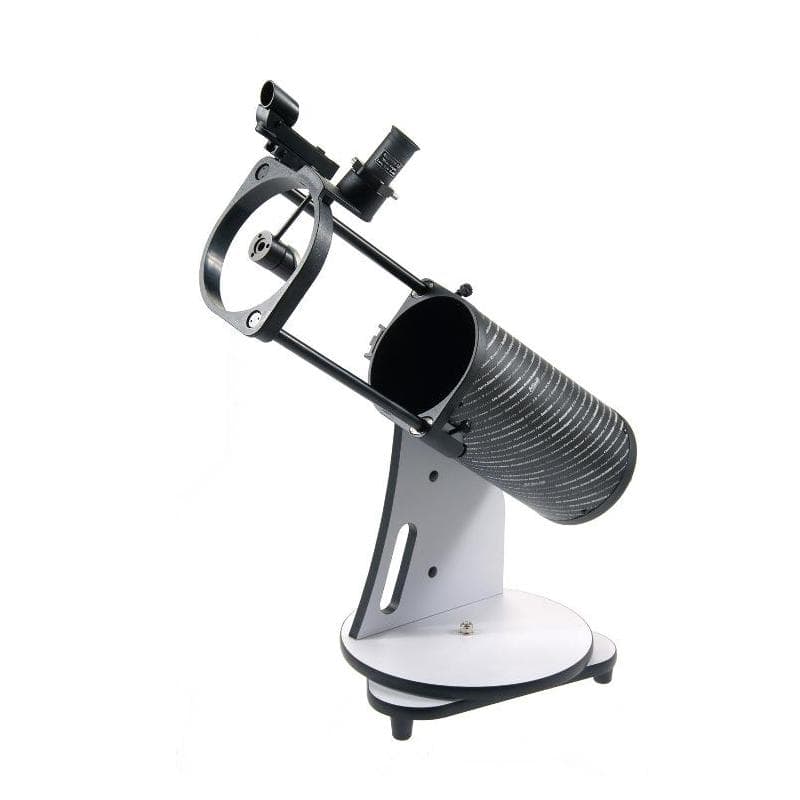
Sky-Watcher Heritage 130P FlexTube
130 mm · f/5.0 · 6.2 kg · set up in 3 min
The family's strengths
- Real aperture — several hundred times the light of an unaided eye — at a price that does not need justifying
- Carried outside in one hand, set up in a couple of minutes
The family's limits
- Needs a table or a wall. On the ground you are lying down
- Needs collimating occasionally — five minutes with a €20 cap
€197seen 8 Oct 2026 at Astroshop
 See it at Astroshoppaid link
4 other sellers
- First Light Opticssearches; neither price nor stock checked
- Optique Unterlindensearches; neither price nor stock checked
- Pierro Astrosearches; neither price nor stock checked
- Teleskop-Expresssearches; neither price nor stock checked
What not to buy
ExperienceOpinion, not physics — shared by nearly everyone who has helped a beginner.
A telescope chosen for the magnification printed on the box
That number depends on the accessories, not the instrument: with a 4 mm eyepiece and a 3× Barlow, any tube of 700 mm focal length reaches it.
- Instead
- An instrument chosen for its aperture and its mount.
A stronger Barlow or a shorter eyepiece 'to go further'
Past an exit pupil of 0.5 mm the image grows without one more detail, and darkens.
- Instead
- An eyepiece giving about a 1 mm exit pupil, the practical limit on good nights.
Every model in this guide
Cheapest first. Each view is the Hercules Cluster through the model, at the same exit pupil, under the same suburban sky.
| Model | Aperture | Weight | Setup | What it shows | Price |
|---|---|---|---|---|---|
| Sky-Watcher Heritage 76 | 76 mm · f/3.9 | 1.8 kg | 2 min | €948 Oct 2026 · Astroshop | |
| Sky-Watcher Heritage 130P FlexTube | 130 mm · f/5.0 | 6.2 kg | 3 min | €1978 Oct 2026 · Astroshop |
Questions people ask
What does “525× magnification” on a telescope mean?The magnification the shortest eyepiece in the box gives with the Barlow: 700 mm ÷ 4 mm × 3 = 525.
On 60 mm that leaves an exit pupil of 0.11 mm, which is unusable.
What is the real maximum magnification of a 60 mm telescope?About 120× on 60 mm, an exit pupil of 0.5 mm.
On most nights turbulence stops things a little before.
Does magnification matter when choosing a telescope?No.
It depends on the eyepieces, which are bought separately. Aperture and the mount matter; magnification follows from them.
Why do makers print such high magnifications?
The number is right as arithmetic, and it is the only one that can be raised without spending anything: a shorter eyepiece and a stronger Barlow are enough.
Is a 3× Barlow lens useful?Rarely on a small telescope: it mostly serves to reach a box number.
A Barlow is judged by the exit pupil it gives, not by the magnification.
Photo credits
These thumbnails are built from real photographs, scaled and darkened by the same arithmetic as the large view.
- The Hercules Cluster: Wikimedia Commons, Messier_13.jpg, CC BY-SA
Method and changes
What this page rests on and when it changed, computed from the catalogue — no date below is typed by hand. There is no price history yet, so this log says what was read and when, never whether it went up or down.
- First published
- 2 prices read at Astroshop
One price per model: the cheapest observed offer, with its date. Models are ordered by that price, never by what a link pays. How we choose.
Read next
- Which telescope for a child?Age by age: who sets the instrument up, what they will see on the first night, and what not to buy.Updated 24 Sept 2026
- Tabletop telescopes: which one, and for whomThe 76, the 130, where to put them, and what a tabletop telescope does not do.Updated 24 Sept 2026
- Telescopes under €200: what is worth itTwo good buys, one honest one, and the number that rules out the rest — with what each really shows.Updated 24 Sept 2026
Written and maintained by the person behind About.