First telescope
150–200 mm Dobsonian
Cheaper, and at f/6 more forgiving. It shows M57; by the site's rules of thumb, detail in the ring needs 240 mm under this sky.
€449seen 7 Oct 2026 at Astroshop
See it at Astroshoppaid link?
A 300 mm Dobsonian gathers 44% more light than a 250. 2 m. What that light shows depends mostly on your sky; the weight has to be carried every time you go out.
The class first, then the cheapest observed model in it. Every view is computed: same eyepiece rule, same suburban sky.
First telescope
Cheaper, and at f/6 more forgiving. It shows M57; by the site's rules of thumb, detail in the ring needs 240 mm under this sky.
€449seen 7 Oct 2026 at Astroshop
See it at Astroshoppaid link?
The cheapest that sufficesThe lowest observed price among these picks that will a crisp ring in M57, under a bright suburban sky.
The default
The largest mirror whose tube, 12 to 16 kg, one person can still carry.
€622seen 7 Oct 2026 at Astroshop
See it at Astroshoppaid link?
Small car
Sky-Watcher Skyliner 250P FlexTube
The same 250, with a tube that collapses and two eyepieces in the box.
€818seen 7 Oct 2026 at Astroshop
See it at Astroshoppaid link?
Dark sky, big car, and a helper
44% more light, for a tube of 19 to 21 kg and 1.5 m.
€899seen 7 Oct 2026 at Astroshop
See it at Astroshoppaid link?
The solid-tube 250s, at the observed price
In price order. The FlexTubes and the GoTo are further down.
The Ring Nebula, suburban sky (Bortle 6). Computed, not photographed.
One price per model — the cheapest observed offer, with its date — and the button goes to that offer, never to the one that pays. Cards in price order. Links marked paid link earn us a commission and cost you nothing extra. Every seller is listed on the model's page.
For
Against
€622seen 7 Oct 2026 at Astroshop
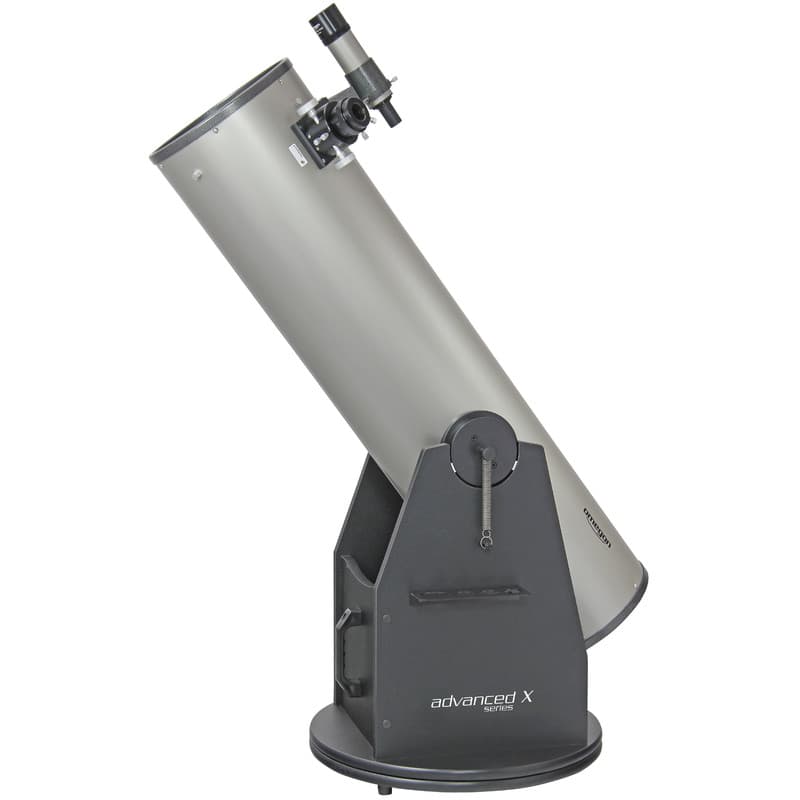 See it at Astroshoppaid link
For
Against
€693seen 7 Oct 2026 at Astroshop
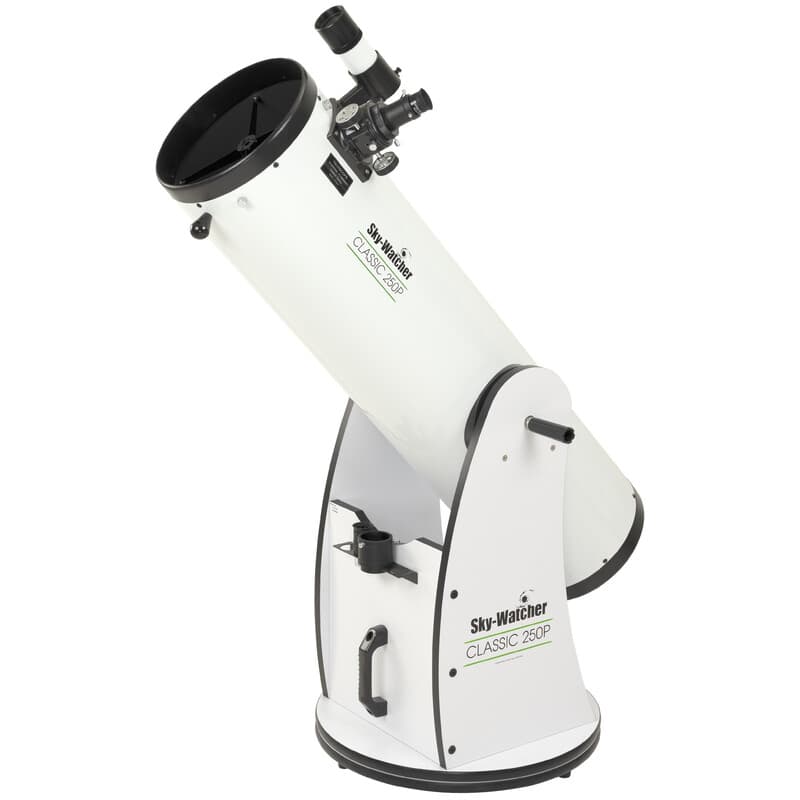 See it at Astroshoppaid link
Against
€829seen 7 Oct 2026 at Astroshop
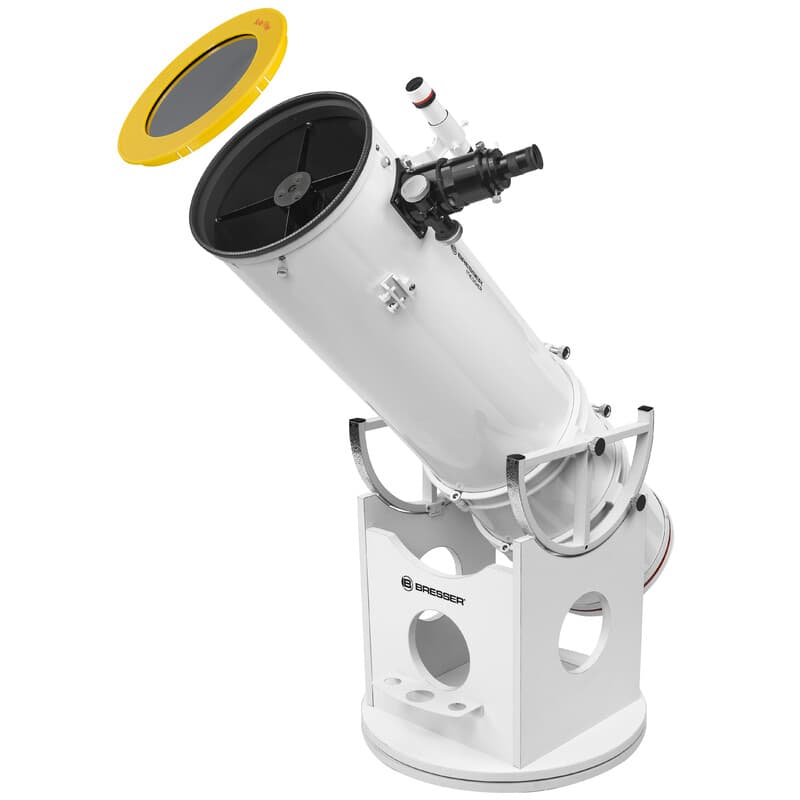 See it at Astroshoppaid link
Against
€829seen 7 Oct 2026 at Astroshop
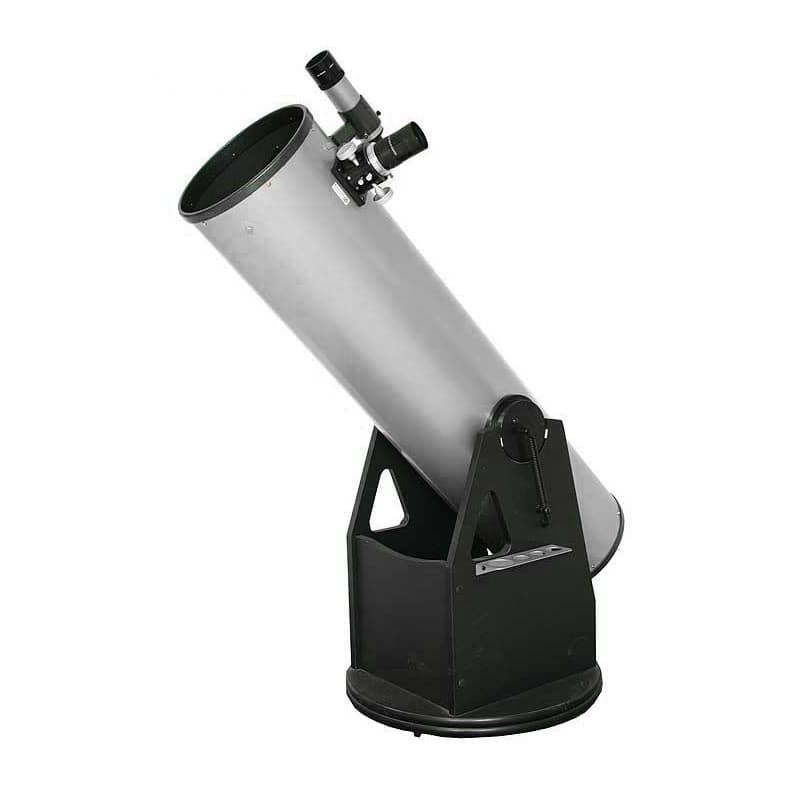 See it at Astroshoppaid link
The solid-tube 300s, at the observed price
In price order.
The Ring Nebula, suburban sky (Bortle 6). Computed, not photographed.
Against
€899seen 7 Oct 2026 at Astroshop
 See it at Astroshoppaid link?
Against
€899seen 7 Oct 2026 at Astroshop
 See it at Astroshoppaid link?
Against
€1,265seen 7 Oct 2026 at Astroshop
 See it at Astroshoppaid link?
More light makes faint objects easier and brings out structure in the ones you could already see. For each object, the site keeps three apertures: the one that shows it, the one that makes it recognisable, and the one that shows its detail. They are set for a Bortle 4 sky and raised for each brighter class. They are observers' rules of thumb, not optics, and they give a clear answer for the galaxy everyone wants to see.
Small bright objects stay within reach longer. By the same rules of thumb, detail in the ring of M57 needs 240 mm under Bortle 6, and both get there; under Bortle 7 it needs 300, and only the 300 shows it crisply; under Bortle 8, neither. For someone observing from a garden on the edge of town, that is the best argument for the 300, provided it gets carried out.
On paper, the 300 separates finer detail: 0.38 arcseconds against 0.46 for a 254 mm (Dawes' limit, 116 divided by the aperture in millimetres).
A practical point. The Omegon, Bresser and GSO models come with one eyepiece, a 25 mm, which gives 50× on a 254/1250 (an exit pupil of 5.1 mm) and 60× on a 300/1500 (an exit pupil of 5 mm). The planets need a second one: a 10 mm gives 125× on the 254/1250 and 150× on the 300/1500, an exit pupil of 2 mm in both. Sky-Watcher's FlexTubes come with a 25 and a 10 mm, the Skyliner 250PX with a 20 and a 12.5 mm.
Measure the boot before ordering, with the seats folded if need be. And pointing straight up, the eyepiece of a 300/1500 is 1.6 m off the ground (the Messier 305/1525 listing): an adult observes near the zenith standing up, a child needs a step.
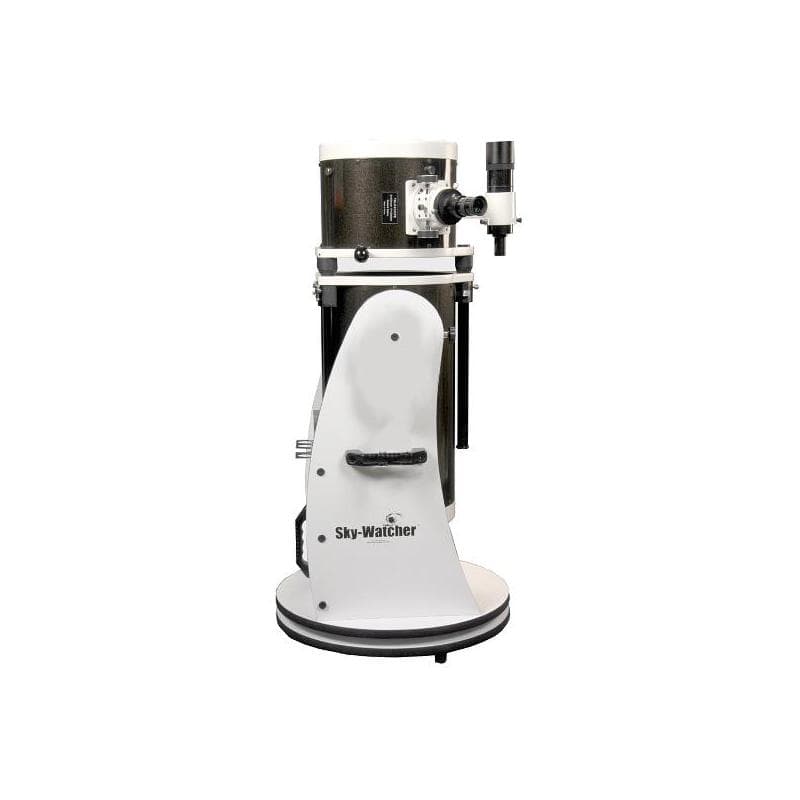
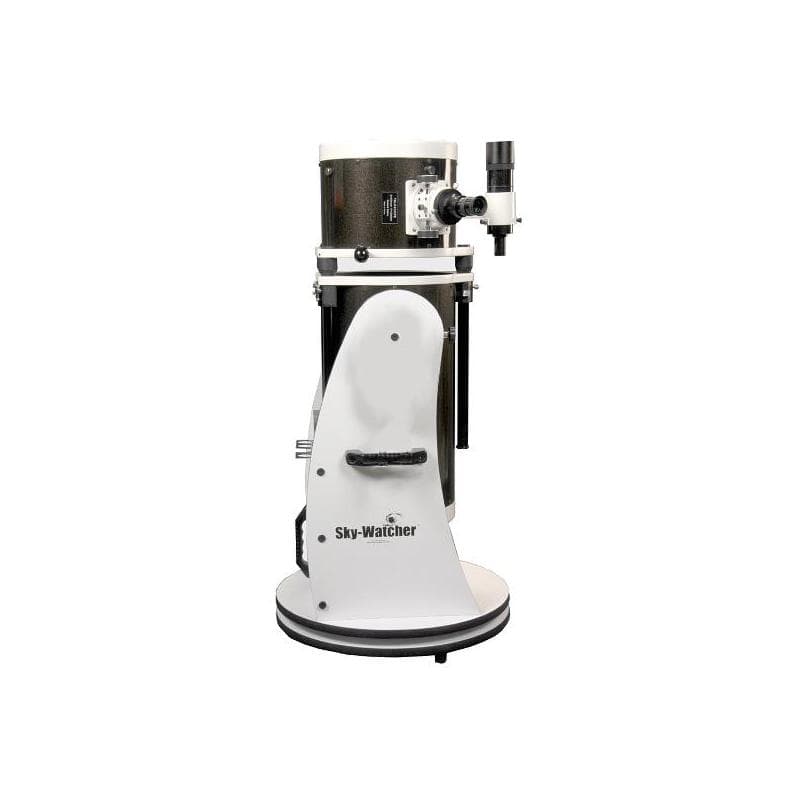
The solid tube is the simplest and the bulkiest. Sky-Watcher's FlexTube slides on three rods and shortens for the car; between the rods it is open, and the shroud that keeps out stray light is sold separately.
The FlexTubes, at the observed price
The Ring Nebula, suburban sky (Bortle 6). Computed, not photographed.
Small car: the tube collapses
254 mm · f/4.7 · 25.8 kg · set up in 15 min
For
Against
€818seen 7 Oct 2026 at Astroshop
 See it at Astroshoppaid link?
For
Against
€1,299seen 7 Oct 2026 at Astroshop
 See it at Astroshoppaid link?
The Skyliner 250P FlexTube GoTo has motors on both axes and a SynScan hand controller. Once aligned on stars at the start of the evening, it finds objects and follows them. It needs 12 V (1.7 A per the listing), and the listed contents name no battery or mains supply. Under a city sky, where too few stars show to find your way, it is a real help; under a dark sky, a chart does the job.
The 250 GoTo, at the observed price
The Ring Nebula, suburban sky (Bortle 6). Computed, not photographed.
Finding objects without a chart
254 mm · f/4.7 · set up in 15 min
For
Against
€1,557seen 7 Oct 2026 at Astroshop
See it at Astroshoppaid link?
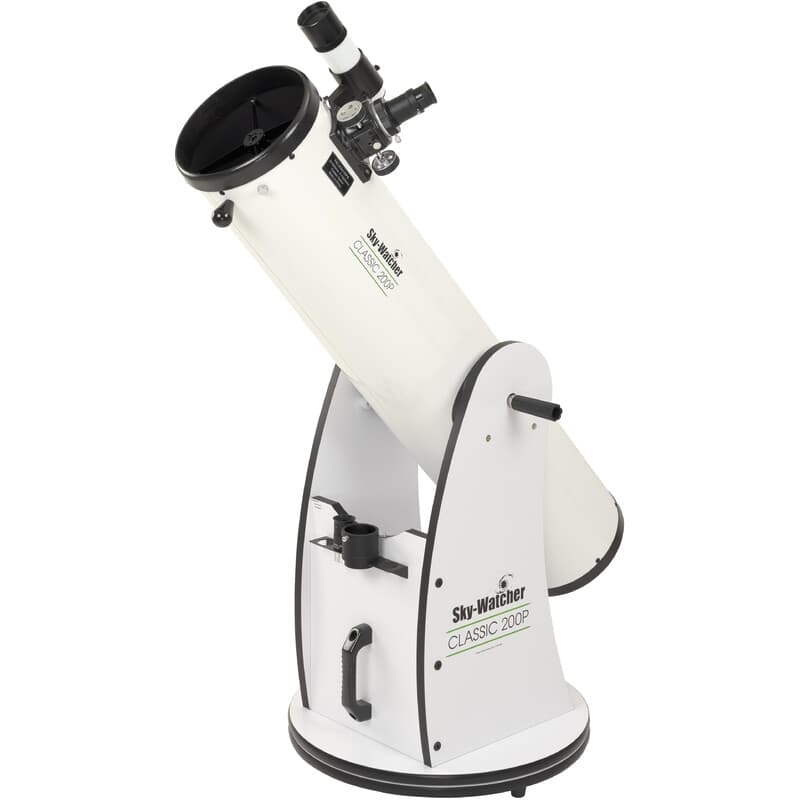
If this Dobsonian is your first telescope, the 200/1200 deserves a look. It gathers less light than a 250, but at f/6 it is more forgiving of collimation and of cheap eyepieces, and it costs less. Under a bright suburban sky it shows M51 the way the other two do: two patches, no arms.
The 200/1200, at the observed price
The Ring Nebula, suburban sky (Bortle 6). Computed, not photographed.
First telescope: f/6, more forgiving
200 mm · f/6.0 · 25.0 kg · set up in 8 min
The family's strengths
The family's limits
€449seen 7 Oct 2026 at Astroshop
 See it at Astroshoppaid link?
The site's advisor runs this reasoning with your sky and your home as inputs. It may land on the 200, or on something else, and it also tells you what not to buy with it.
Cheapest first. Each view is the Hercules Cluster through the model, at the same exit pupil, under the same suburban sky.
| Model | Aperture | Weight | Setup | What it shows | Price |
|---|---|---|---|---|---|
| Sky-Watcher Skyliner 200PFor whom: First telescope: f/6, more forgiving | 200 mm · f/6.0 | 25.0 kg | 8 min | €4497 Oct 2026 · Astroshop | |
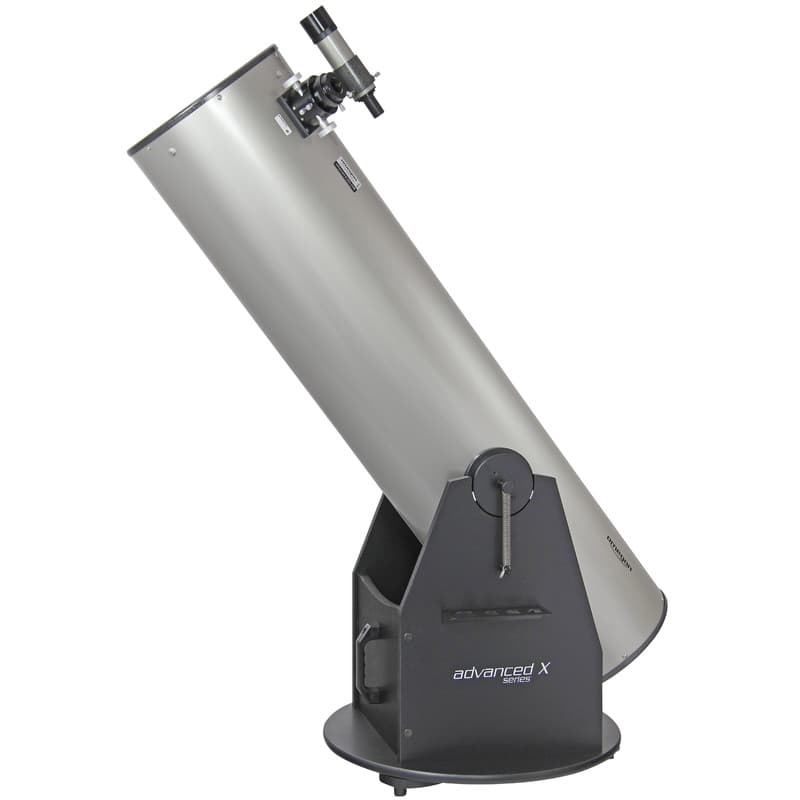
| Omegon Advanced X N 254/1250For whom: A solid-tube 250 with a fan | 254 mm · f/4.9 | 24.4 kg | 15 min | €6227 Oct 2026 · Astroshop | |
| Sky-Watcher Skyliner 250PXFor whom: The lightest 250 tube (12 kg) | 254 mm · f/4.7 | 32.0 kg | 15 min | €6937 Oct 2026 · Astroshop | |
| Sky-Watcher Skyliner 250P FlexTubeFor whom: Small car: the tube collapses | 254 mm · f/4.7 | 25.8 kg | 15 min | €8187 Oct 2026 · Astroshop | |
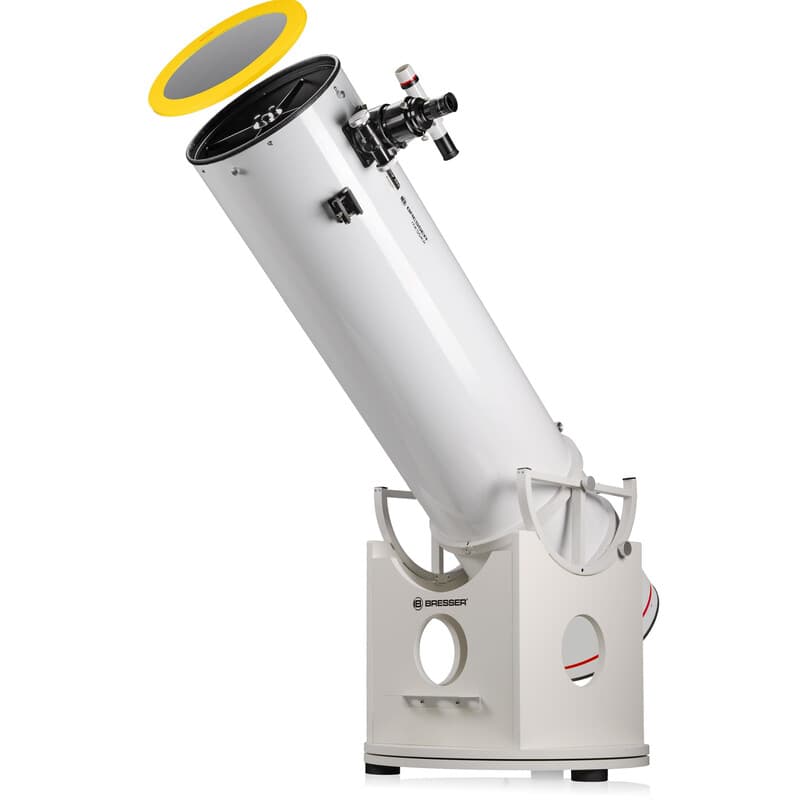
| Bresser Messier 254/1270 DobsonFor whom: A solid-tube 250 | 254 mm · f/5.0 | 27.6 kg | 15 min | €8297 Oct 2026 · Astroshop | |
| GSO Dobson 250/1250For whom: A solid-tube 250, nothing electronic | 250 mm · f/5.0 | 27.7 kg | 15 min | €8297 Oct 2026 · Astroshop | |
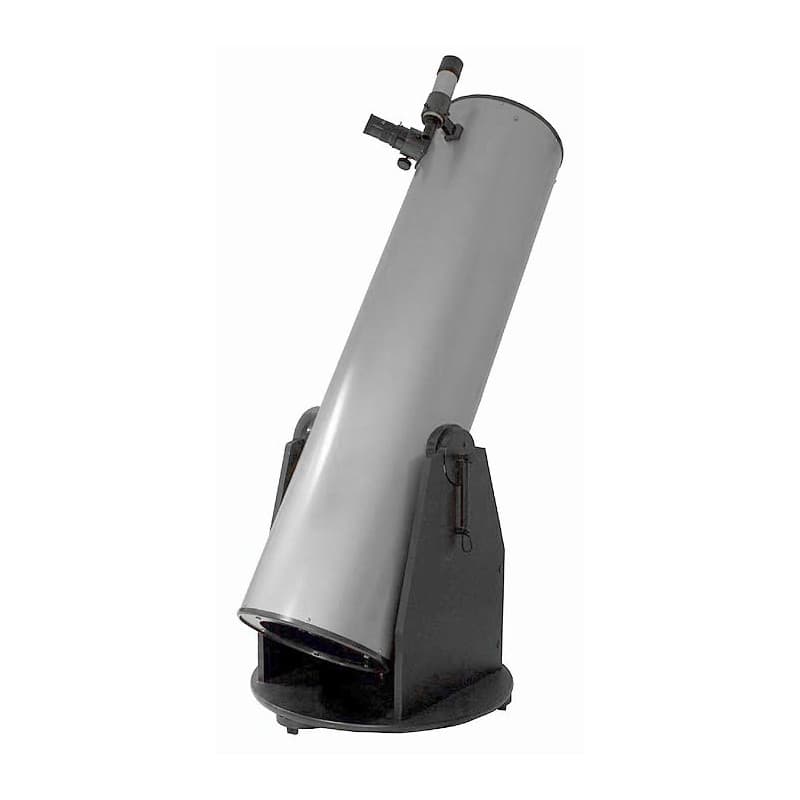
| GSO Dobson 300/1500For whom: The plainest 300, nothing electronic | 300 mm · f/5.0 | 33.0 kg | 15 min | €8997 Oct 2026 · Astroshop | |
| Omegon Advanced X N 304/1500For whom: A solid-tube 300 with a fan | 304 mm · f/4.9 | 33.0 kg | 15 min | €8997 Oct 2026 · Astroshop | |
| Bresser Messier 305/1525 DobsonFor whom: A solid-tube 300 | 305 mm · f/5.0 | 31.0 kg | 15 min | €1,2657 Oct 2026 · Astroshop | |
| Sky-Watcher Skyliner 300P FlexTubeFor whom: A 300 that collapses | 305 mm · f/4.9 | — | 15 min | €1,2997 Oct 2026 · Astroshop | |
| Sky-Watcher Skyliner 250P FlexTube SynScan GoToFor whom: Finding objects without a chart | 254 mm · f/4.7 | — | 15 min | €1,5577 Oct 2026 · Astroshop |
Under a rural sky, galaxies gain structure in it; under a bright suburban sky, the difference shows mostly on small bright objects such as planetary nebulae.
Both come in two pieces, the base and the tube.
FlexTubes collapse and shorten the tube; they do not make it lighter.
In practice, the turbulence of the air limits both first nearly every night, and the 300 takes longer to cool down.
Elsewhere a chart or an app does the job, and the price difference buys several eyepieces. It also needs a 12 V supply, which is not in the listed contents.
For a first telescope the 200 is the safer choice; if you already know what you are looking for and your sky is dark, the 250.
These thumbnails are built from real photographs, scaled and darkened by the same arithmetic as the large view.
What this page rests on and when it changed, computed from the catalogue — no date below is typed by hand. There is no price history yet, so this log says what was read and when, never whether it went up or down.
One price per model: the cheapest observed offer, with its date. Models are ordered by that price, never by what a link pays. How we choose.
Read next
Written and maintained by the person behind About.