70–90 mm refractor on an alt-az mount
Celestron Inspire 70AZ
The shape most people picture when they picture a telescope. Sealed tube, nothing to collimate, and a standing eyepiece height that suits sharing.
€259seen 7 Oct 2026 at Astroshop
- 70 mmAperture
- f/10.0Focal ratio
- 12–140×Useful magnification
Should you buy it?
- Yes if what you mainly want is sharing it with children: that is what this family does best.
- No if your priority is nebulae, clusters and galaxies, by eye: other families do better for the same money.
Computed from its family's per-goal scores and its own numbers — not a rating, not one evening's opinion.
Where to buy
Also search at First Light Optics · Optique Unterlinden · Pierro Astro · Teleskop-Express (searches; neither price nor stock checked)
1 of these 5 links earn us a commission, marked above. Sorted by price, never by what pays. How this site is funded.
Prices are observed on the date shown, never live. Links marked paid link earn us a commission and cost you nothing extra.
What it shows, really
These circles are simulations, computed from the aperture, the magnification and the sky — indicative, not exact. A real night also depends on the turbulence, your eyes and your experience. Closer to the truth than the photo on the box; still not a promise.
Under a suburban sky (Bortle 6), through a common 25 mm eyepiece for wide targets and a 10 mm for planets. Every circle is the true field — nothing is enlarged.
Photo credits
These thumbnails are built from real photographs, scaled and darkened by the same arithmetic as the large view.
The numbers
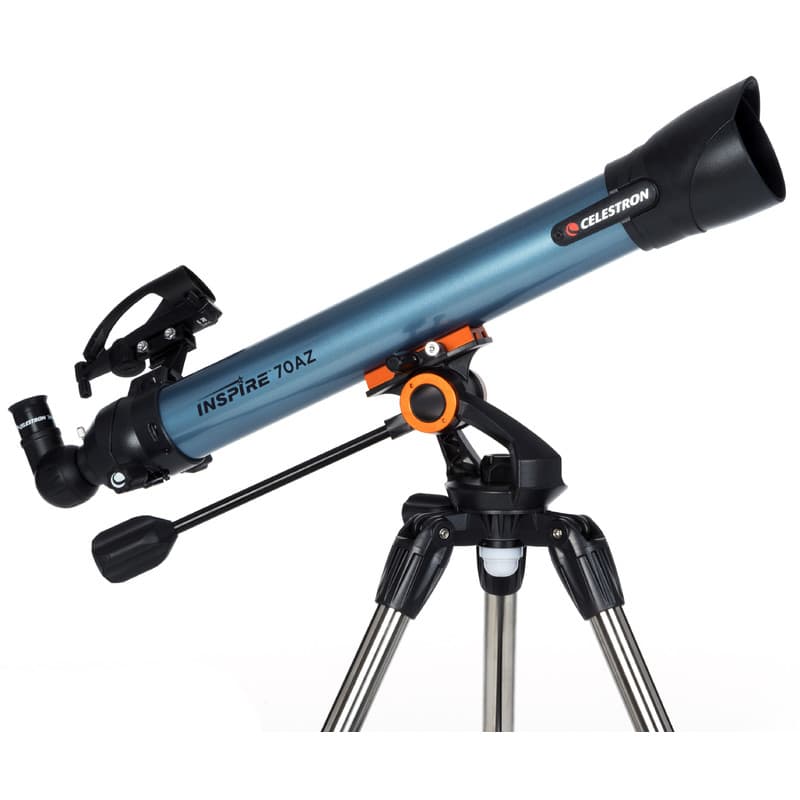 Photo: Astroshop
| Aperture | 70 mm |
|---|---|
| Focal ratio | 700 mm · f/10.0 |
| Mount | Alt-az on a steel tripod, smartphone adapter |
| Eyepieces | 20 mm and 10 mm |
| Useful magnification | 12× to 140× at 70 mm |
| Resolution (Dawes) | 1.7″ — the tightest double star this aperture can split |
| Faintest star, suburban sky | around magnitude 10.5 |
| Observed price | €259 seen 7 Oct 2026 at Astroshop |
Made for
- Sharing it with children
Standing height, sealed tube, and no mirror to knock out of line.
- The Sun
In white light: sunspots with their penumbra, faculae near the edge, and granulation on a steady morning. Dawes' limit on the Sun: 1.7″ (116 ÷ 70 mm, arithmetic). Measure the outside diameter first, then one of: euro EMC SF100 (57–71 mm), Omegon Helievo 72 (64–88 mm), Omegon Helievo 92 (84–108 mm), Omegon Helievo 112 (104–128 mm) (€50–€69). Every time: certified filter over the front · finder capped · never an eyepiece filter · an adult with children · never without the filter · measure first.
Not made for
- Nebulae, clusters and galaxies, by eye
Bright clusters and the Orion Nebula. Galaxies are mostly out of reach.
The Sun, safely
No solar filter in the box
The Sun with this model
No source we have states the outside diameter of its tube or dew shield. Measure it at the front, then take the cell whose range holds it. For 70 mm of aperture, one of these:
In white light: sunspots with their penumbra, faculae near the edge, and granulation on a steady morning. Dawes' limit on the Sun: 1.7″ (116 ÷ 70 mm, arithmetic).
- euro EMC SF100 (57–71 mm): holds 57–71 mm, €50 (seen 26 Sept 2026) Astroshoppaid link
- Omegon Helievo 72 (64–88 mm): holds 64–88 mm, €55 (seen 26 Sept 2026) Astroshoppaid link
- Omegon Helievo 92 (84–108 mm): holds 84–108 mm, €59 (seen 26 Sept 2026) Astroshoppaid link
- Omegon Helievo 112 (104–128 mm): holds 104–128 mm, €69 (seen 26 Sept 2026) Astroshoppaid link
The listing names no standard; no international standard exists for filters on telescopes, binoculars or lenses (AAS).
Every time
- A certified solar filter over the FRONT of the instrument, fastened so it cannot slip or blow off.
- Cap or remove the finder. It is a second telescope, and it has no filter.
- Never a filter at the eyepiece end: the concentrated sunlight there can crack it in an instant.
- With children, an adult is there every time.
- Never look, or point, without the filter on. Check it before each use; a scratched or torn filter goes in the bin.
- Measure before ordering. A cell that sits loose can fall off.
Sources for the Sun
- American Astronomical Society — How to View a Solar Eclipse Safely — filters on optics go on the front; eclipse glasses never with optics; children supervised
- American Astronomical Society — Solar Filters for Optics — eyepiece filters are dangerous; the finder capped, removed or filtered; the filter attached securely
- American Astronomical Society — About the ISO 12312-2 Standard — EN ISO 12312-2:2015 covers naked-eye viewers only; no international standard covers filters on telescopes, binoculars or lenses
- Société astronomique de France — Guide des observations solaires — a filter at the front, never one screwed into the eyepiece, the finder capped
- NASA — Keep Your Eclipse Glasses to See the Sun's ‘Freckles’ — a large enough sunspot shows through eclipse glasses
- AAVSO — Le Guide d'Observation Solaire de l'AAVSO, v1.1 (2017), p. 6 — archived copy — “Les ouvertures plus grandes que 100 à 125 mm sont généralement limitées par les effets de turbulence atmosphérique”; 50 to 80 mm is enough to count sunspots
The family it belongs to: 70–90 mm refractor on an alt-az mount
What it does well
- Point it and look. No collimation, ever
- The eyepiece stays at a comfortable height wherever you aim
- Doubles as a daytime spotting scope
What it costs you
- 70–90 mm is not much light. Deep sky is a short list
- Cheap achromats show a violet fringe on the Moon and bright planets
- The bundled tripod is usually the weak part — a wobbly tripod ruins a good tube
Worth knowing about this model
The 10 mm eyepiece in the box gives 70× on 70 mm, an exit pupil of 1 mm. The usual rule allows about 140× on 70 mm (twice the aperture in millimetres, an exit pupil of 0.5 mm); anything past 70× on 70 mm (an exit pupil of 1 mm) needs a shorter eyepiece or a Barlow, and the spec table lists neither.
Same family, other sizes
Read next
- Refractor or reflector for a first telescope?For the same money a reflector gives two to three times the aperture. When that decides, and the two cases where it does not.Updated 30 Aug 2026
- Telescopes under €200: what is worth itTwo good buys, one honest one, and the number that rules out the rest — with what each really shows.Updated 24 Sept 2026
€259seen 7 Oct 2026 at Astroshop
Where to buy