Smart telescope (30–80 mm, integrated camera)
ZWO Seestar S50 Pro
A small telescope with a camera where the eyepiece would be, driven from a phone. It finds the target, tracks it, stacks exposures, and hands you an image in a few minutes.
€999seen 23 Oct 2026 at Astroshop
Price alert
One email when the price we observe for the ZWO Seestar S50 Pro falls at least 5% below the lowest we observed in the previous 30 days. At most one a week.
- 50 mmAperture
- f/5.2Focal ratio
- 2.8 kgTypical weight
- 8–100×Useful magnification
Should you buy it?
- Yes if what you mainly want is first astrophotography, sharing it with children, taking it with me: that is what this family does best.
- No if your priority is nebulae, clusters and galaxies, by eye, the moon and the planets: other families do better for the same money.
- It is a camera driven from a phone, not an eyepiece: you look at a screen. A good choice if the image is the goal; a poor one if seeing is.
Computed from its family's per-goal scores and its own numbers — not a rating, not one evening's opinion.
Where to buy
Also search at First Light Optics · Optique Unterlinden · Pierro Astro · Teleskop-Express (searches; neither price nor stock checked)
1 of these 5 links earn us a commission, marked above. Sorted by price, never by what pays. How this site is funded.
Prices are observed on the date shown, never live. Links marked paid link earn us a commission and cost you nothing extra.
Observed price history
Unchanged at Astroshop: €999 at each of the 25 readings from 29 Sept 2026 to 23 Oct 2026.
Only prices actually read on the retailer’s page, one per day at most; a day without a reading is a gap, not a guess.
What it shows, really
No eyepiece to simulate: a smart telescope stacks photographs and shows the result on your phone. Its views are not comparable with visual telescopes — the guide below is the honest comparison.
The numbers
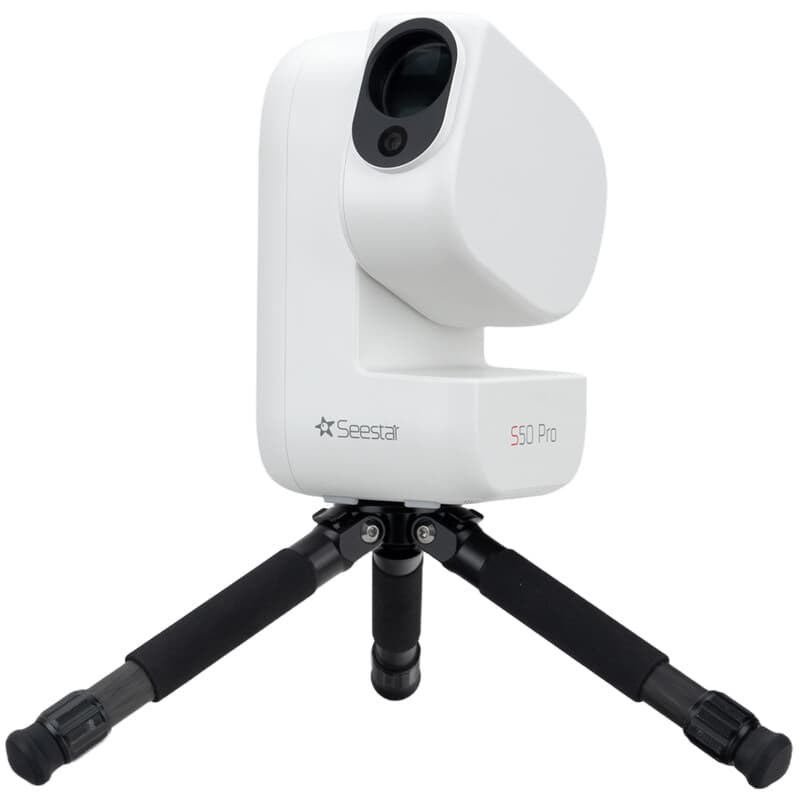 Photo: Astroshop
| Aperture | 50 mm |
|---|---|
| Focal ratio | 260 mm · f/5.2 |
| Mount | Integrated alt-az tracking, phone app |
| Typical weight | 2.8 kg |
| Useful magnification | 8× to 100× at 50 mm |
| Resolution (Dawes) | 2.3″ — the tightest double star this aperture can split |
| Faintest star, suburban sky | around magnitude 9.8 |
| Observed price | €999 seen 23 Oct 2026 at Astroshop |
Made for
- First astrophotography
The shortest path from nothing to a recognisable image of a nebula.
- Sharing it with children
A picture on a phone holds attention that a grey smudge in an eyepiece does not.
- Taking it with me
Small, self-contained, battery powered.
Not made for
- Nebulae, clusters and galaxies, by eye
It shows you deep sky, but not by eye. Score depends entirely on whether that distinction matters to you.
- The Moon and the planets
Small aperture and short focal length. The Moon works; the planets are underwhelming.
The Sun, safely
Solar filter in the box (read on the listing)
The Sun with this model
The maker's solar filter is in the box and made for this instrument: nothing to buy, nothing to measure.
In white light: the larger sunspots and their groups. Dawes' limit on the Sun: 2.3″ (116 ÷ 50 mm, arithmetic).
Every time
- A certified solar filter over the FRONT of the instrument, fastened so it cannot slip or blow off.
- Cap or remove the finder. It is a second telescope, and it has no filter.
- Never a filter at the eyepiece end: the concentrated sunlight there can crack it in an instant.
- With children, an adult is there every time.
- Never look, or point, without the filter on. Check it before each use; a scratched or torn filter goes in the bin.
Sources for the Sun
- American Astronomical Society — How to View a Solar Eclipse Safely — filters on optics go on the front; eclipse glasses never with optics; children supervised
- American Astronomical Society — Solar Filters for Optics — eyepiece filters are dangerous; the finder capped, removed or filtered; the filter attached securely
- American Astronomical Society — About the ISO 12312-2 Standard — EN ISO 12312-2:2015 covers naked-eye viewers only; no international standard covers filters on telescopes, binoculars or lenses
- Société astronomique de France — Guide des observations solaires — a filter at the front, never one screwed into the eyepiece, the finder capped
- NASA — Keep Your Eclipse Glasses to See the Sun's ‘Freckles’ — a large enough sunspot shows through eclipse glasses
- AAVSO — Le Guide d'Observation Solaire de l'AAVSO, v1.1 (2017), p. 6 — archived copy — “Les ouvertures plus grandes que 100 à 125 mm sont généralement limitées par les effets de turbulence atmosphérique”; 50 to 80 mm is enough to count sunspots
The family it belongs to: Smart telescope (30–80 mm, integrated camera)
What it does well
- Shows colour and structure in nebulae that no eyepiece at this aperture ever will
- Works under a city sky far better than visual observing does
- Set up in minutes, operated from indoors if it is cold
What it costs you
- There is nothing to look through. If the appeal is photons hitting your own retina, this is the wrong category
- The image is the instrument's, not yours — limited control over how it is made
- A fast-moving product category; anything written about it dates within a year
Worth knowing about this model
Announced 25 August 2026, shipping from September: the S50 rebuilt around a four-element objective and two 4K sensors, with an EQ mode for 60-second exposures. It launched below its list price, and the launch price did not last. Still a camera driven from a phone, still no eyepiece — the aperture is the same 50 mm as the original.
Everything about Smart telescope (30–80 mm, integrated camera) →
Same family, other sizes
Compare it
Other reviews to compare
Read next
- Seestar, Dwarf or a real telescope?Two activities, not two levels: which one is yours, before the box decides.Updated 24 Sept 2026
- Which telescope should a beginner buy?The short answer, the three things the box does not say, then the detail by budget and by situation.Updated 24 Sept 2026
- Giving a telescopeWhich one to give to whom, at what price, and when the best present is not a telescope.Updated 29 Sept 2026
€999seen 23 Oct 2026 at Astroshop
Where to buy