Smart telescope (30–80 mm, integrated camera)
Vaonis Vespera II
A small telescope with a camera where the eyepiece would be, driven from a phone. It finds the target, tracks it, stacks exposures, and hands you an image in a few minutes.
€1,577seen 7 Oct 2026 at Astroshop
- 50 mmAperture
- f/5.0Focal ratio
- 5 kgTypical weight
- 8–100×Useful magnification
Should you buy it?
- Yes if what you mainly want is first astrophotography, sharing it with children, taking it with me: that is what this family does best.
- No if your priority is nebulae, clusters and galaxies, by eye, the moon and the planets: other families do better for the same money.
- It is a camera driven from a phone, not an eyepiece: you look at a screen. A good choice if the image is the goal; a poor one if seeing is.
Computed from its family's per-goal scores and its own numbers — not a rating, not one evening's opinion.
Where to buy
Also search at First Light Optics · Optique Unterlinden · Pierro Astro · Teleskop-Express (searches; neither price nor stock checked)
1 of these 5 links earn us a commission, marked above. Sorted by price, never by what pays. How this site is funded.
Prices are observed on the date shown, never live. Links marked paid link earn us a commission and cost you nothing extra.
What it shows, really
No eyepiece to simulate: a smart telescope stacks photographs and shows the result on your phone. Its views are not comparable with visual telescopes — the guide below is the honest comparison.
The numbers
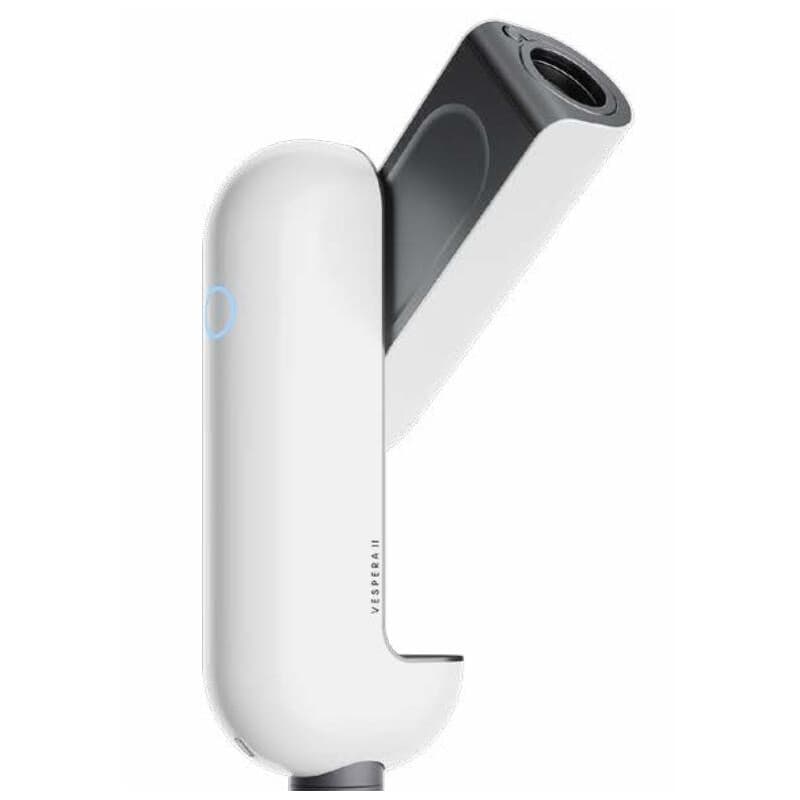 Photo: Astroshop
| Aperture | 50 mm |
|---|---|
| Focal ratio | 250 mm · f/5.0 |
| Mount | Integrated alt-az tracking, phone app |
| Typical weight | 5 kg |
| Useful magnification | 8× to 100× at 50 mm |
| Resolution (Dawes) | 2.3″ — the tightest double star this aperture can split |
| Faintest star, suburban sky | around magnitude 9.8 |
| Observed price | €1,577 seen 7 Oct 2026 at Astroshop |
Made for
- First astrophotography
The shortest path from nothing to a recognisable image of a nebula.
- Sharing it with children
A picture on a phone holds attention that a grey smudge in an eyepiece does not.
- Taking it with me
Small, self-contained, battery powered.
Not made for
- Nebulae, clusters and galaxies, by eye
It shows you deep sky, but not by eye. Score depends entirely on whether that distinction matters to you.
- The Moon and the planets
Small aperture and short focal length. The Moon works; the planets are underwhelming.
The Sun, safely
No solar filter in the box
The Sun with this model
It needs its maker's own solar filter (Vaonis Vespera): €149, seen 26 Sept 2026. A generic cell does not fit this body.
In white light: the larger sunspots and their groups. Dawes' limit on the Sun: 2.3″ (116 ÷ 50 mm, arithmetic).
The listing names no standard; no international standard exists for filters on telescopes, binoculars or lenses (AAS).
Where to buy
1 of these 1 links earn us a commission, marked above. Sorted by price, never by what pays. How this site is funded.
Every time
- A certified solar filter over the FRONT of the instrument, fastened so it cannot slip or blow off.
- Cap or remove the finder. It is a second telescope, and it has no filter.
- Never a filter at the eyepiece end: the concentrated sunlight there can crack it in an instant.
- With children, an adult is there every time.
- Never look, or point, without the filter on. Check it before each use; a scratched or torn filter goes in the bin.
Sources for the Sun
- American Astronomical Society — How to View a Solar Eclipse Safely — filters on optics go on the front; eclipse glasses never with optics; children supervised
- American Astronomical Society — Solar Filters for Optics — eyepiece filters are dangerous; the finder capped, removed or filtered; the filter attached securely
- American Astronomical Society — About the ISO 12312-2 Standard — EN ISO 12312-2:2015 covers naked-eye viewers only; no international standard covers filters on telescopes, binoculars or lenses
- Société astronomique de France — Guide des observations solaires — a filter at the front, never one screwed into the eyepiece, the finder capped
- NASA — Keep Your Eclipse Glasses to See the Sun's ‘Freckles’ — a large enough sunspot shows through eclipse glasses
- AAVSO — Le Guide d'Observation Solaire de l'AAVSO, v1.1 (2017), p. 6 — archived copy — “Les ouvertures plus grandes que 100 à 125 mm sont généralement limitées par les effets de turbulence atmosphérique”; 50 to 80 mm is enough to count sunspots
The family it belongs to: Smart telescope (30–80 mm, integrated camera)
What it does well
- Shows colour and structure in nebulae that no eyepiece at this aperture ever will
- Works under a city sky far better than visual observing does
- Set up in minutes, operated from indoors if it is cold
What it costs you
- There is nothing to look through. If the appeal is photons hitting your own retina, this is the wrong category
- The image is the instrument's, not yours — limited control over how it is made
- A fast-moving product category; anything written about it dates within a year
Worth knowing about this model
No eyepiece and no way to fit one: a camera driven from a phone app. 50 mm of aperture, the same as the Seestar S50's; 5 kg, and about 4 hours of battery per the spec table.
Everything about Smart telescope (30–80 mm, integrated camera) →
Same family, other sizes
Read next
- Seestar, Dwarf or a real telescope?Two activities, not two levels: which one is yours, before the box decides.Updated 24 Sept 2026
- Which telescope should a beginner buy?The short answer, the three things the box does not say, then the detail by budget and by situation.Updated 24 Sept 2026
- Giving a telescopeWhich one to give to whom, at what price, and when the best present is not a telescope.Updated 29 Sept 2026
€1,577seen 7 Oct 2026 at Astroshop
Where to buy