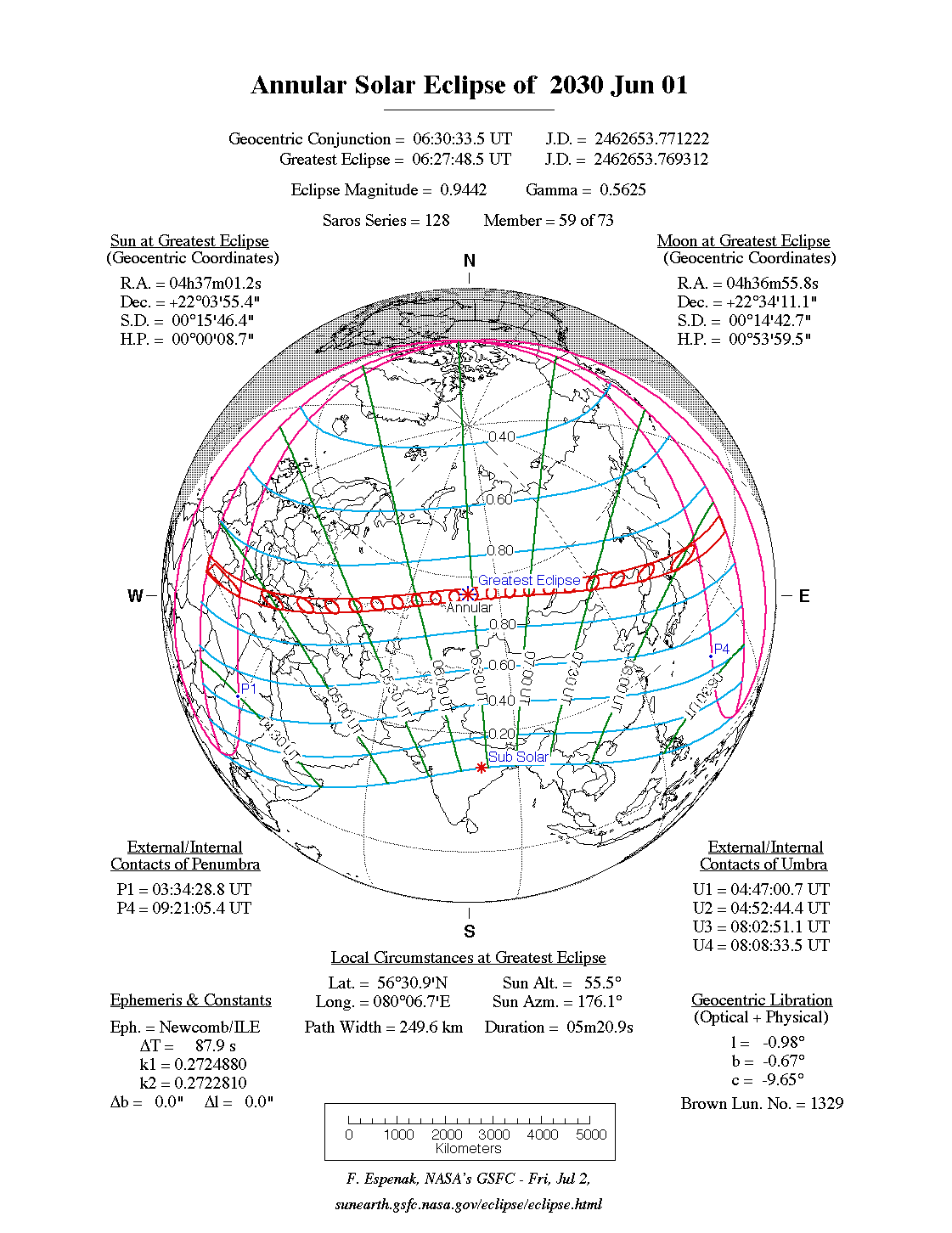
Annular solar eclipse of 1 June 2030
The Moon is too far from Earth to cover the whole Sun: along a narrow path a ring of Sun stays round it, and that ring is still dazzling. Partial everywhere else.
Where it is visible
Europe, North Africa, the Middle East, Asia, the Arctic, Alaska. Annular in Algeria, Tunisia, Greece, Turkey, Russia, northern China and Japan. Greatest eclipse at 6:28 UT.
From your city
London, United Kingdom · the largest city of your country, as a starting point
Any town of 1,000 people or more, anywhere in the world.
Partial, 48% at 6:22, Sun at 12°
Saturday 1 June 2030 · Local time in London (UTC+1)
Sun covered at greatest 48%
Timeline
What it looks like from London
Begins5:25 · 4°0% covered Partial5:54 · 8°27% covered Greatest6:22 · 12°48% covered Partial6:52 · 16°25% covered Ends7:22 · 21°0% covered
Zenith at the top, facing the Sun, as through eclipse glasses or filtered binoculars.
How these drawings are made
Each drawing is computed for this city and the minute under it: the positions of the Sun and the Moon seen from here (Astronomy Engine), their true apparent sizes, and the share of the Sun's area the Moon covers, the same figure as in the table.
The Sun is drawn as it looks through eclipse glasses: a pale disc on black, the Moon invisible except where it covers the Sun. Never look without them.
Up is the zenith as you face the Sun. An astronomical telescope turns the view upside down, or mirrors it if it has a diagonal.
At totality the drawing shows the black Moon and a faint hint of the corona: a schematic impression, not a picture. The real corona is larger, finer and brighter than any drawing, and no photograph is shown here because none looks like what the eye sees.
Details
| Moment | Time | Sun's altitude |
|---|---|---|
| Begins | 5:25 | 4° |
| Greatest | 6:22 | 12° |
| Ends | 7:22 | 21° |
Cities: GeoNames (CC BY 4.0).
What you will actually see, and with what
Never look at the Sun without protection, not even at 90%: the part left uncovered still burns the retina, without pain.
- With the naked eye: eclipse glasses or a viewer meeting ISO 12312-2, from a named maker, for every person.
- Binoculars or a telescope: only with a solar filter made for it, fixed firmly over the FRONT of the instrument. Never eclipse glasses behind an eyepiece.
Annular solar eclipse
An annular eclipse is never total: the ring of Sun that remains is dazzling. Glasses on from start to finish, even at the ring.
Eclipse glasses meeting ISO 12312-2
Eclipse glasses, single pair Bresser · SoFi
“Conforms to EN ISO 12312-2:2015”, per the product sheet. One pair per person.
Where to buy
1 of these 1 links earn us a commission, marked above. Sorted by price, never by what pays. How this site is funded.
Eclipse glasses, pack of 10 Omegon · SoFi Solar Safe, pack of 10
“Conforms to ISO 12312-2”, per the product sheet. For a family or a group.
Where to buy
1 of these 1 links earn us a commission, marked above. Sorted by price, never by what pays. How this site is funded.
City by city
Computed when this page was built, in each city's local time. Your own city, any city, is in the box above.
| City | What it sees |
|---|---|
| Lisbon | Partial at sunrise: the Sun rises at 6:14, after the maximum |
| Madrid | Partial, 63% at 7:07, Sun at 3°, the Sun rises already eclipsed at 6:47, very low: you need a clear horizon |
| Paris | Partial, 53% at 7:17, Sun at 12° |
| Lyon | Partial, 60% at 7:11, Sun at 11° |
| Marseille | Partial, 65% at 7:08, Sun at 10° |
| Brussels | Partial, 52% at 7:20, Sun at 14° |
| Geneva | Partial, 61% at 7:12, Sun at 12° |
| Zurich | Partial, 61% at 7:13, Sun at 14° |
| Luxembourg | Partial, 55% at 7:17, Sun at 14° |
| London | Partial, 48% at 6:22, Sun at 12° |
| Edinburgh | Partial, 40% at 6:30, Sun at 13° |
| Dublin | Partial, 41% at 6:26, Sun at 10° |
| Amsterdam | Partial, 50% at 7:22, Sun at 15° |
| Berlin | Partial, 57% at 7:22, Sun at 20° |
| Rome | Partial, 75% at 7:04, Sun at 14° |
| Athens | Annular, 7:56–8:00 (3 min 59 s), Sun at 20° |
| Bucharest | Partial, 83% at 8:09, Sun at 25° |
| Warsaw | Partial, 64% at 7:22, Sun at 25° |
| Helsinki | Partial, 54% at 8:38, Sun at 29° |
| Montreal | Not visible: the Sun is below the horizon throughout |
| New York | Not visible: the Sun is below the horizon throughout |
NASA's map