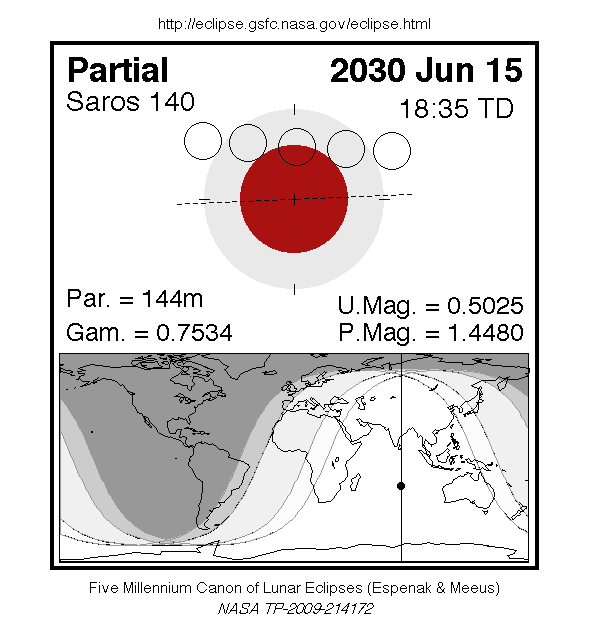
Partial lunar eclipse of 15 June 2030
Part of the Moon passes through the Earth's shadow: a dark bite out of the full Moon. Seen from everywhere the Moon is up.
Where it is visible
Europe, Africa, Asia, Australia. Greatest eclipse at 18:33 UT.
From your city
London, United Kingdom · the largest city of your country, as a starting point
Any town of 1,000 people or more, anywhere in the world.
Not visible: the Moon is below the horizon throughout
Saturday 15 June 2030 · Local time in London (UTC+1)
Timeline
What it looks like from London
- Below the horizon: nothing to see
Shadow begins18:21 - Below the horizon: nothing to see
Partial18:57 - Below the horizon: nothing to see
Greatest19:33 - Below the horizon: nothing to see
Partial20:10 - Below the horizon: nothing to see
Shadow ends20:46
Zenith at the top, facing the Moon, as with the naked eye or binoculars.
How these drawings are made
Each drawing is computed for this city and the minute under it: where the Earth's shadow falls on the Moon (Astronomy Engine's model: the Earth's radius plus 88 km of atmosphere, the convention that matches NASA's contact times), turned as the Moon stands in this city's sky.
The penumbra is drawn as the faint shading it is: the eye notices it only in its deepest part, next to the umbra. While part of the Moon is still lit, the umbra looks dark grey.
At totality the Moon is drawn a dark red-brown. The real colour changes from one eclipse to the next, from bright copper to almost black (the Danjon scale, L0 to L4), and cannot be predicted: it depends on the dust and clouds in the Earth's atmosphere that night.
Up is the zenith as you face the Moon. An astronomical telescope turns the view upside down, or mirrors it if it has a diagonal.
Details
| Moment | Time | Moon's altitude |
|---|---|---|
| Penumbra begins | 17:14 | below the horizon |
| Partial phase begins | 18:21 | below the horizon |
| Greatest | 19:33 | below the horizon |
| Partial phase ends | 20:46 | below the horizon |
| Penumbra ends | 21:53 | 4° |
The penumbral phases are invisible to the eye; only the partial phase and totality show.
Cities: GeoNames (CC BY 4.0).
What you will actually see, and with what
A lunar eclipse is safe to look at with the naked eye, from start to finish: it is the full Moon, dimmed.
10×50 binoculars: what they show, and what they cost
Binoculars show the colour and the edge of the shadow better than the eye. A 10×50 pair magnifies 10 times, with 50 mm lenses and a 5 mm exit pupil: steady enough to hand-hold, bright enough for a darkened Moon.
During totality the Moon turns copper, brick or brown, never the same twice: how dark depends on the dust and clouds in the Earth's atmosphere.
City by city
Computed when this page was built, in each city's local time. Your own city, any city, is in the box above.
| City | What it sees |
|---|---|
| Lisbon | Not visible: the Moon is below the horizon throughout |
| Madrid | Partial lunar, 21:42–21:46, Moon at 0° at most, the Moon rises at 21:42, during the eclipse, the Sun is still up: a pale Moon in a bright sky |
| Paris | Not visible: the Moon is below the horizon throughout |
| Lyon | Partial lunar, 21:25–21:46, Moon at 2° at most, the Moon rises at 21:25, during the eclipse, the Sun is still up: a pale Moon in a bright sky |
| Marseille | Partial lunar, 21:14–21:46, Moon at 4° at most, the Moon rises at 21:14, during the eclipse, the Sun is still up: a pale Moon in a bright sky |
| Brussels | Not visible: the Moon is below the horizon throughout |
| Geneva | Partial lunar, 21:22–21:46, Moon at 3° at most, the Moon rises at 21:22, during the eclipse, the Sun is still up: a pale Moon in a bright sky |
| Zurich | Partial lunar, 21:16–21:46, Moon at 3° at most, the Moon rises at 21:16, during the eclipse, the Sun is still up: a pale Moon in a bright sky |
| Luxembourg | Partial lunar, 21:37–21:46, Moon at 1° at most, the Moon rises at 21:37, during the eclipse, the Sun is still up: a pale Moon in a bright sky |
| London | Not visible: the Moon is below the horizon throughout |
| Edinburgh | Not visible: the Moon is below the horizon throughout |
| Dublin | Not visible: the Moon is below the horizon throughout |
| Amsterdam | Not visible: the Moon is below the horizon throughout |
| Berlin | Partial lunar, 21:21–21:46, Moon at 2° at most, the Moon rises at 21:21, during the eclipse, the Sun is still up: a pale Moon in a bright sky |
| Rome | Partial lunar, 20:39–21:46, Moon at 9° at most, the Moon rises at 20:39, during the eclipse, the Sun is still up: a pale Moon in a bright sky |
| Athens | Partial lunar, 20:40–22:46, Moon at 8°, the Moon rises at 20:40, during the eclipse, the Sun is still up: a pale Moon in a bright sky |
| Bucharest | Partial lunar, 20:52–22:46, Moon at 5°, the Moon rises at 20:52, during the eclipse, the Sun is still up: a pale Moon in a bright sky |
| Warsaw | Partial lunar, 20:48–21:46, Moon at 5° at most, the Moon rises at 20:48, during the eclipse, the Sun is still up: a pale Moon in a bright sky |
| Helsinki | Partial lunar, 22:31–22:46, Moon at 1° at most, the Moon rises at 22:31, during the eclipse, the Sun is still up: a pale Moon in a bright sky |
| Montreal | Not visible: the Moon is below the horizon throughout |
| New York | Not visible: the Moon is below the horizon throughout |
NASA's map