60 mm refractor on a light mountReviewed, not suggested by the advisor
Celestron PowerSeeker 60EQ
With the 4 mm eyepiece and the 3× Barlow in the box, this 60 mm reaches 675× — an exit pupil of 0.09 mm. The retailer's own spec table gives 120× as the maximum useful magnification, an exit pupil of 0.5 mm.
Before you buy it: what the advisor suggests for a similar price
Chosen by a rule, not by hand: catalogue models at 1.2 times its price or less (€166 at most, for €139), with at least 60 mm of aperture, in families the advisor scores at least 3 out of 5 for the Moon and the planets, in the order it ranks them at that budget — two models per family, three families at most. The advisor never suggests the model on this page. Everything else is the questionnaire's default: a first instrument, a garden, carried out by hand, a suburban sky.
Why this family, in the advisor's wordsGood on the Moon and adequate on Saturn. A long focal ratio keeps the colour fringing down.
- 70 mmMeade Infinity 70AZ€119 · seen 7 Oct 2026 at Astroshop→
70 mm against 60 mm: 1.4 times the light, and doubles split down to 1.66″ against 1.93″ (arithmetic); an alt-az mount, with nothing to point at the celestial pole; €20 cheaper.
Every price is the one the model's own page leads with, and that is the price the rule compares with the threshold. Whether a shop pays us plays no part.
What the listing says, and what the numbers say
| The listing | Eyepieces and Barlow: 20 mm and 4 mm, 3× Barlow, 1.5× erecting lens. Maximum useful magnification: 120. |
|---|---|
| The maker's manual | Celestron PowerSeeker manual, p. 10, table “3x Barlow Lens Magnification”, column 60EQ, row “w/4mm Eyepiece”: 675x. |
| The same manual | The same manual (2009), p. 30, “Highest Useful Magnification”: 142x; p. 10: the Barlow powers “should only be used under ideal conditions”. |
| The most the box reachesarithmetic | 900 ÷ 4 × 3 = 675× — an exit pupil of 0.09 mm |
| The useful maximum (usual rule)usual rule | 2 × 60 = 120× — an exit pupil of 0.5 mm |
| Against the usual rulearithmetic | 5.6 times the usual rule's maximum |
| Why the advisor does not suggest itarithmetic | Its box reaches 5.6 times the usual rule — more than the 2 times that makes a model “reviewed, not suggested” on this site. |
| Finest double star (Dawes)arithmetic | 116 ÷ 60 = 1.93″ |
| Light, against a 130 mmarithmetic | A 130 mm collects 4.7 times as much ((130 ÷ 60)²) |
The same Saturn, at both powers
Computed, not photographed: the same renderer as everywhere on this site, which darkens and blurs the view as the exit pupil shrinks. A suburban sky, a steady night.
What a tester of the PowerSeeker 70EQ and PowerSeeker 114EQ reports
- Experience
Zane Landers tested the PowerSeeker 70EQ. He writes that every PowerSeeker refractor comes with the same 20 mm and 4 mm eyepieces, that he could see nothing through the 4 mm, and that the all-plastic 3× Barlow cannot give a decent image. The 20 mm, he writes, is usable and of decent quality.
- Experience
Every equatorial PowerSeeker comes on the same EQ1 mount, he writes. He finds it adequate for a small, light tube, but notes that almost every part of it tends to work loose.
Zane Landers, Telescopic Watch — hands-on review of the Celestron PowerSeeker 114EQ, read on 26 Sept 2026 · Zane Landers, Telescopic Watch — hands-on review of the Celestron PowerSeeker 70EQ, read on 26 Sept 2026
The numbers
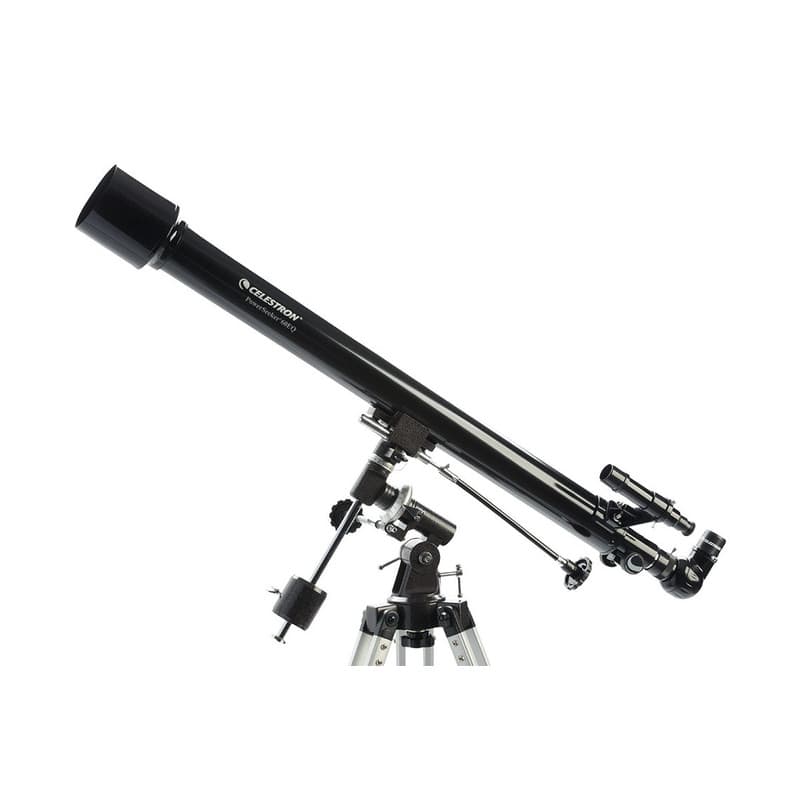 Photo: Astroshop
| Aperture | 60 mm |
|---|---|
| Focal ratio | 900 mm · f/15 |
| Mount | CG-1 manual equatorial on an aluminium tripod |
| Typical weight | 4.5 kg |
| Eyepieces | 20 mm and 4 mm, 3× Barlow, 1.5× erecting lens |
| Useful magnification | 10× to 120× at 60 mm |
| Faintest star, suburban sky | around magnitude 10.2 |
| Observed price | €139 seen 7 Oct 2026 at Astroshop |
Worth knowing about this model
The 4 mm eyepiece gives 225× on 60 mm, an exit pupil of 0.27 mm; with the 3× Barlow in the box, 675× and 0.09 mm. The spec table gives 120× as the maximum useful magnification: on 60 mm, an exit pupil of 0.5 mm. 900 mm of focal length, f/15, on a CG-1 equatorial head.
Where to buy
Also search at First Light Optics · Optique Unterlinden · Pierro Astro · Teleskop-Express (searches; neither price nor stock checked)
1 of these 5 links earn us a commission, marked above. Sorted by price, never by what pays. How this site is funded.
In price order, as for every model on this site.
Prices are observed on the date shown, never live. Links marked paid link earn us a commission and cost you nothing extra.
Sources
- The listing at Astroshop, read on 26 Sept 2026
- Celestron — PowerSeeker series instruction manual, linked as a download from the retailer's PowerSeeker 114EQ page (table “3x Barlow Lens Magnification”), read on 26 Sept 2026
- Zane Landers, Telescopic Watch — hands-on review of the Celestron PowerSeeker 70EQ, read on 26 Sept 2026
- Zane Landers, Telescopic Watch — hands-on review of the Celestron PowerSeeker 114EQ, read on 26 Sept 2026