114–127 mm Bird-Jones reflectorReviewed, not suggested by the advisor
Family as Telescopic Watch identifies it; the retailer's listing does not name it so.
Celestron StarSense Explorer LT 114AZ
The listing gives 1000 mm of focal length for a tube 607 mm long, focuser included. With the eyepieces and Barlow in the box it reaches 200× on 114 mm (an exit pupil of 0.57 mm), under the 228× of the usual rule. From experience, Telescopic Watch (Zane Landers) reports that it takes no more than about 100× (an exit pupil of 1.1 mm).
Before you buy it: what the advisor suggests for a similar price
Chosen by a rule, not by hand: catalogue models at 1.2 times its price or less (€310 at most, for €259), with at least 114 mm of aperture, in families the advisor scores at least 3 out of 5 for the Moon and the planets, in the order it ranks them at that budget — two models per family, three families at most. The advisor never suggests the model on this page. Everything else is the questionnaire's default: a first instrument, a garden, carried out by hand, a suburban sky.
Why this family, in the advisor's wordsSharp on the Moon, and Saturn's rings are unmistakable at 130× on 130 mm (an exit pupil of 1 mm). Jupiter shows two belts and four moons.
- 130 mmSky-Watcher Heritage 130P FlexTube€197 · seen 7 Oct 2026 at Astroshop→
130 mm against 114 mm: 1.3 times the light, and doubles split down to 0.89″ against 1.02″ (arithmetic); €62 cheaper.
- 130 mmBresser Messier 130/650 Dobson€219 · seen 7 Oct 2026 at Astroshop→
130 mm against 114 mm: 1.3 times the light, and doubles split down to 0.89″ against 1.02″ (arithmetic); €40 cheaper.
Why this family, in the advisor's wordsThe same light as a 130 mm tabletop, and once the mount is aligned on the pole one knob keeps a planet centred. Saturn's ring at 100× on 130 mm is an exit pupil of 1.3 mm; the aperture allows about 260× (twice the aperture in millimetres, by the usual rule), the seeing rarely does. From experience, a light head takes a second or two to settle after each touch.
- 130 mmCelestron AstroMaster 130EQ€309 · seen 7 Oct 2026 at Astroshop→
130 mm against 114 mm: 1.3 times the light, and doubles split down to 0.89″ against 1.02″ (arithmetic); €50 more.
- 130 mmSky-Watcher Explorer 130/900 EQ-2€309 · seen 7 Oct 2026 at Astroshop→
130 mm against 114 mm: 1.3 times the light, and doubles split down to 0.89″ against 1.02″ (arithmetic); €50 more.
Every price is the one the model's own page leads with, and that is the price the rule compares with the threshold. Whether a shop pays us plays no part.
What the listing says, and what the numbers say
| The listing | Eyepieces and Barlow: 25 mm and 10 mm, 2× Barlow. Maximum useful magnification: 228. |
|---|---|
| Focal lengthlisting | 1000 mm |
| Tube lengthlisting | 607 mm (“Avec porte-oculaire, mais sans pare-buée.”) |
| The most the box reachesarithmetic | 1000 ÷ 10 × 2 = 200× — an exit pupil of 0.57 mm |
| The useful maximum (usual rule)usual rule | 2 × 114 = 228× — an exit pupil of 0.5 mm |
| Practical ceilingexperience | About 100× on 114 mm (an exit pupil of 1.1 mm) (experience: Telescopic Watch (Zane Landers)) |
| Why the advisor does not suggest itarithmetic | Its focal length (1000 mm) is 1.65 times its tube length (607 mm) — more than the 1.3 times that makes a reflector “reviewed, not suggested” on this site. |
| Finest double star (Dawes)arithmetic | 116 ÷ 114 = 1.02″ |
| Light, against a 130 mmarithmetic | A 130 mm collects 1.3 times as much ((130 ÷ 114)²) |
What people who used it report
- Experience
Zane Landers, who tested this model, writes that it is a Bird-Jones: a corrector lens at the end of the focuser drawtube roughly doubles the focal length, which is why the tube is shorter than the focal length on the listing.
- Experience
Well collimated, he writes, it gives images of acceptable quality, less sharp towards the edge of the field; he finds the two eyepieces supplied decent, and the plastic 2× Barlow poor.
- Experience
For an accurate collimation he describes taking the focuser apart with a screwdriver, removing that lens, and putting it back without touching it; the primary mirror's screws, by contrast, turn without tools.
- Experience
In his experience it cannot take more than about 100× even when well collimated — on 114 mm, an exit pupil of 1.1 mm.
- Experience
The mount has neither slow-motion controls nor locks, and the short tube with its long focal length makes small adjustments tricky, he writes.
- Experience
The StarSense finder, using a phone in its cradle, almost always puts the target in the field at low power; with a good alignment he measured it to better than a quarter of a degree.
The numbers
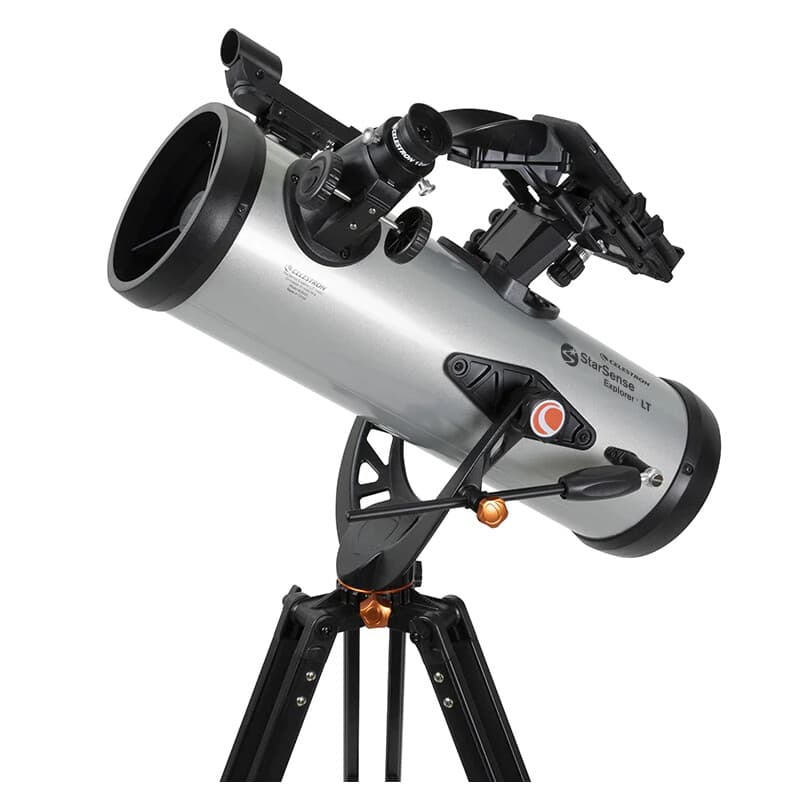 Photo: Astroshop
| Aperture | 114 mm |
|---|---|
| Focal ratio | 1000 mm · f/8.8 |
| Mount | Single-arm alt-az on an aluminium tripod, phone cradle for the StarSense app |
| Typical weight | 4.7 kg |
| Eyepieces | 25 mm and 10 mm, 2× Barlow |
| Useful magnification | 19× to 228× at 114 mm — from experience, about 100× at most (an exit pupil of 1.1 mm; Telescopic Watch (Zane Landers)) |
| Faintest star, suburban sky | around magnitude 11.6 |
| Observed price | €259 seen 7 Oct 2026 at Astroshop |
Worth knowing about this model
The spec table gives a tube 607 mm long with its focuser, for a focal length of 1000 mm. The 10 mm eyepiece gives 100× on 114 mm, an exit pupil of 1.1 mm; with the 2× Barlow in the box, 200× and 0.57 mm. The StarSense finding works through your own smartphone in the cradle.
Where to buy
Also search at First Light Optics · Optique Unterlinden · Pierro Astro · Teleskop-Express (searches; neither price nor stock checked)
1 of these 5 links earn us a commission, marked above. Sorted by price, never by what pays. How this site is funded.
In price order, as for every model on this site.
Prices are observed on the date shown, never live. Links marked paid link earn us a commission and cost you nothing extra.