Two models, the numbers decide
Sky-Watcher Skyliner 200P or Sky-Watcher Explorer 200P EQ5?
Sky-Watcher Skyliner 200P — 200 mm, €475. Sky-Watcher Explorer 200P EQ5 — 200 mm, €733. The same method as everywhere on this site: the numbers first, the verdict from them.
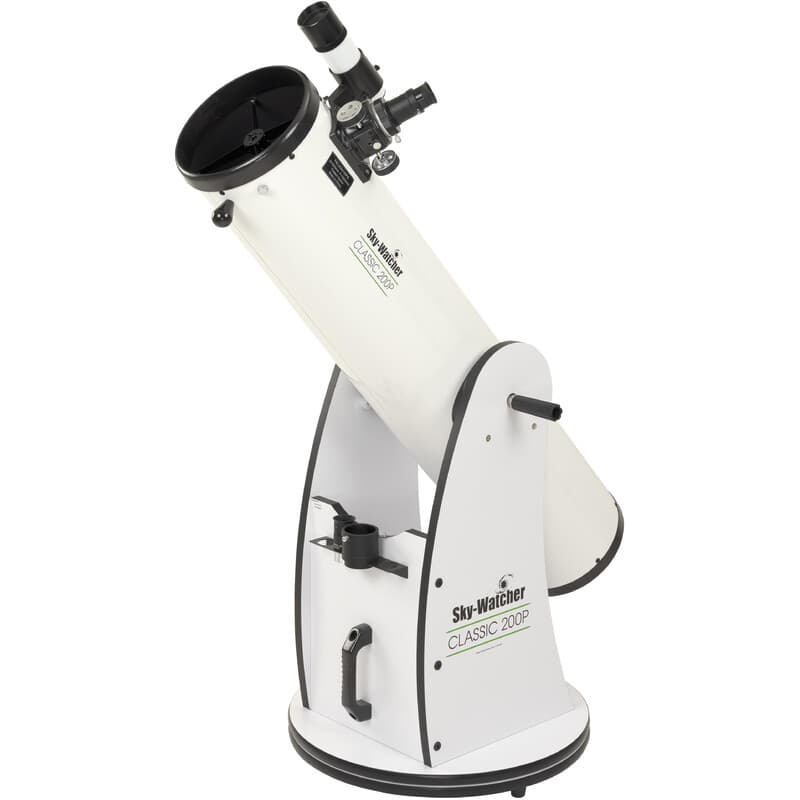
€475seen 19 Nov 2026 at Astroshop
114–130 mm Newtonian on a manual equatorial mount

€733seen 19 Nov 2026 at Astroshop
Side by side
| Sky-Watcher Skyliner 200P | Sky-Watcher Explorer 200P EQ5 | |
|---|---|---|
| Aperture | 200 mm | 200 mm |
| Focal ratio | 1200 mm · f/6.0 | 1000 mm · f/5.0 |
| Typical weight | 26 kg | — |
| Setup time | 8 minutes | 12 minutes |
| Learning curve | 2 out of 5 | 3 out of 5 |
| Useful magnification | ≤ 400× | ≤ 400× |
| Resolution (Dawes) | 0.6″ | 0.6″ |
| Observed price | €475seen 19 Nov 2026 at Astroshop | €733seen 19 Nov 2026 at Astroshop |
| Where to buy | See it at Astroshop paid link | See it at Astroshop paid link |
Choose the Sky-Watcher Skyliner 200P if…
- budget decides: €258 less
- the first nights should stay simple: gentler learning curve
Full page on the Skyliner 200P →
Where to buy
Also search at First Light Optics · Optique Unterlinden · Pierro Astro · Teleskop-Express (searches; neither price nor stock checked)
1 of these 5 links earn us a commission, marked above. Sorted by price, never by what pays. How this site is funded.
Price alert
Our price readings have been paused since 24 Oct 2026. Alerts will resume as soon as readings do.
One email when the price we observe for the Sky-Watcher Skyliner 200P falls at least 5% below the lowest we observed in the previous 30 days. At most one a week.
Choose the Sky-Watcher Explorer 200P EQ5 if…
The numbers give it few arguments — the other wins this one.
Full page on the Explorer 200P EQ5 →
Where to buy
Also search at First Light Optics · Optique Unterlinden · Pierro Astro · Teleskop-Express (searches; neither price nor stock checked)
1 of these 5 links earn us a commission, marked above. Sorted by price, never by what pays. How this site is funded.
Price alert
Our price readings have been paused since 24 Oct 2026. Alerts will resume as soon as readings do.
One email when the price we observe for the Sky-Watcher Explorer 200P EQ5 falls at least 5% below the lowest we observed in the previous 30 days. At most one a week.
Goal by goal
The family scores the advisor uses, out of 5 — a property of each family, not marketing.
- Nebulae, clusters and galaxies, by eye
Skyliner 200P — The classic answer. Aperture is what deep-sky observing is short of, and this is where it stops being expensive.
Explorer 200P EQ5 — The brighter half of the Messier list from a decent sky: the light of a 130 mm tabletop. Finding faint things is slower, because the mount moves along the sky's coordinates rather than the chart's up-down and left-right.
- The Moon and the planets
Skyliner 200P — Plenty of resolution. You will be nudging it along by hand every thirty seconds at high power.
Explorer 200P EQ5 — The same light as a 130 mm tabletop, and once the mount is aligned on the pole one knob keeps a planet centred. Saturn's ring at 100× on 130 mm is an exit pupil of 1.3 mm; the aperture allows about 260× (twice the aperture in millimetres, by the usual rule), the seeing rarely does. From experience, a light head takes a second or two to settle after each touch.
- The Sun
Skyliner 200P — In white light: sunspots with their penumbra, faculae near the edge, and granulation on a steady morning. Dawes' limit on the Sun: 0.6″ (116 ÷ 200 mm, arithmetic). Measure the outside diameter first, then one of: Omegon Helievo 192 (184–208 mm), euro EMC SF100 (187–221 mm), euro EMC SF100 (215–273 mm) (€109–€163). Every time: certified filter over the front · finder capped · never an eyepiece filter · an adult with children · never without the filter · measure first.
Explorer 200P EQ5 — In white light: sunspots with their penumbra, faculae near the edge, and granulation on a steady morning. Dawes' limit on the Sun: 0.6″ (116 ÷ 200 mm, arithmetic). Measure the outside diameter first, then one of: Omegon Helievo 192 (184–208 mm), euro EMC SF100 (187–221 mm), euro EMC SF100 (215–273 mm) (€109–€163). Every time: certified filter over the front · finder capped · never an eyepiece filter · an adult with children · never without the filter · measure first.
- Learn my way around the sky
Skyliner 200P — Star-hopping with a finder works well, but the field is narrower than binoculars.
Explorer 200P EQ5 — It teaches the celestial coordinates, which is a real skill, but star-hopping from a chart is slower than with a base you push where you look, and the finder swings to odd angles as the tube goes round the pole.
- Sharing it with children
Skyliner 200P — The eyepiece height wanders between standing and kneeling as you move around the sky.
Explorer 200P EQ5 — An adult aligns it and points it. The eyepiece height changes as the tube swings round, and in the dark the counterweight bar sits at a child's head height (experience).
- Taking it with me
Skyliner 200P — It goes in a car and nowhere else.
Explorer 200P EQ5 — A car, in three pieces: tripod, head with counterweight, tube. Hand luggage, no.
The same sky, through both
These circles are simulations, computed from the aperture, the magnification and the sky — indicative, not exact. A real night also depends on the turbulence, your eyes and your experience. Closer to the truth than the photo on the box; still not a promise.
The Moon
Saturn
The Orion Nebula
The Andromeda Galaxy
Photo credits
These thumbnails are built from real photographs, scaled and darkened by the same arithmetic as the large view.
Other duels with these models
- Sky-Watcher Skyliner 150P Classic or Sky-Watcher Skyliner 200P?
- Sky-Watcher Skyliner 200P or Sky-Watcher Skyliner 250PX?
- Bresser Messier 6" Dobson or Sky-Watcher Skyliner 200P?
- Sky-Watcher Skyliner 200P or Omegon Advanced X N 203/1200?
- Sky-Watcher Skyliner 200P or Bresser Messier 8" Dobson?
- Sky-Watcher Skyliner 200P or Celestron StarSense Explorer 8"?
- Sky-Watcher Skyliner 200P or Celestron NexStar 8SE?
Guides that discuss these models
Read next
- 130/900, 150/750 or a 150/1200 Dobsonian?The three forum favourites show almost the same thing. What separates them is what holds them up.Updated 23 Aug 2026
- Collimating a Dobsonian or Newtonian, with a laser or a capStars that are never sharp in a Newtonian: five minutes with a laser or a cap, in the right order.Updated 21 Nov 2026
- Buying a second-hand telescopeA Dobsonian at 55–65% of new that has been out ten times: where to find it, what to check, what not to buy used.Updated 30 Aug 2026