What it shows
Through the family's typical instrument: 80 mm at f/11.5, with the eyepiece a beginner would use for each target. Computed, then darkened by the sky — never a photograph.
- The MoonDetailed37× (25 mm eyepiece) · 80 mm · 2.2 mm exit pupil
- SaturnRecognisable92× (10 mm eyepiece) · 80 mm · 0.9 mm exit pupil
- The Hercules ClusterRecognisable61× (15 mm eyepiece) · 80 mm · 1.3 mm exit pupil
- The Whirlpool GalaxyDetectable29× (32 mm eyepiece) · 80 mm · 2.8 mm exit pupil
Photo credits
These thumbnails are built from real photographs, scaled and darkened by the same arithmetic as the large view.
Which level of detail a target reaches is a rule of thumb from observers; the magnification, field and exit pupil are arithmetic.
What it is for, goal by goal
Every score with the sentence behind it, highest first.
- Sun4/5 GoodIn white light: sunspots with their penumbra, faculae near the edge, and granulation on a steady morning. Dawes' limit on the Sun: 1.3″ (116 ÷ 90 mm, arithmetic). The cell has to hold each model's own outside diameter, so it depends on the model: from €59 to €79 for 90 mm. Each model's page names its own. Every time: certified filter over the front · finder capped · never an eyepiece filter · an adult with children · never without the filter · measure first.
- Moon & planets3/5 FairGood on the Moon and on Saturn: 90× on 90 mm is an exit pupil of 1 mm, and the aperture allows about 180× (twice the aperture in millimetres, by the usual rule). At f/10 the colour fringe is small. One knob keeps the planet in the field; from experience, a light head shakes for a moment after each touch.
- Deep sky2/5 WeakBright clusters and the Orion Nebula. Galaxies are mostly out of reach: 90 mm gathers about half the light of a 130 mm, arithmetic.
- Learn the sky2/5 WeakIt teaches the celestial coordinates, a real skill, but star-hopping from a chart is slower than on a mount that moves up-down and left-right.
- With a child2/5 WeakAn adult aligns it and points it. As a long tube swings round the pole the eyepiece climbs and drops, and the counterweight bar sits at a child's head height (experience).
- Travel2/5 WeakA 90 cm tube, a tripod and a head with its counterweight: a car, not a plane.
Not for this
- Photo1/5 PoorA phone at the eyepiece on the Moon. Not long exposures: the head is too light to carry a camera steadily (experience), and an f/10 achromat puts a violet halo round bright stars.
- Serious photo0/5 NoNo. A slow achromat on a light manual head is not an imaging instrument.
What it does well
- Sealed tube: no collimation, ever
- Once the mount is aligned roughly on the pole, one slow-motion knob follows a planet at high power
- At f/10 the violet fringe around the Moon and bright planets stays small for an achromat
What it costs you
- 70–90 mm is not much light: a 90 mm gathers (90 ÷ 130)² ≈ 0.48 of a 130 mm's, arithmetic. Deep sky is a short list
- Pointed high, a 90 cm tube on an equatorial head puts the eyepiece low, down among the tripod legs
- About 12 kg in three pieces, and a rough alignment on the pole every night
The Sun, safely
The Sun with this family
The cell has to hold each model's own outside diameter, so it depends on the model: from €59 to €79 for 90 mm. Each model's page names its own.
In white light: sunspots with their penumbra, faculae near the edge, and granulation on a steady morning. Dawes' limit on the Sun: 1.3″ (116 ÷ 90 mm, arithmetic).
- 90 mm: outside diameter not sourced — once measured, one of: Omegon Helievo 92 (84–108 mm), Omegon Helievo 112 (104–128 mm), Omegon Helievo 132 (124–148 mm) (€59–€79).
- 90 mm, 115 mm outside: Omegon Helievo 112 (104–128 mm), €69.
The listing names no standard; no international standard exists for filters on telescopes, binoculars or lenses (AAS).
Counted against this family: €79, the filter for its smallest model — its cheapest route, where its price band starts.
Later, and only on a refractor: a Herschel wedge with its ND3 filter (€139–339) gives more contrast. Never on a reflector, a Schmidt-Cassegrain or a Maksutov.
Every time
- A certified solar filter over the FRONT of the instrument, fastened so it cannot slip or blow off.
- Cap or remove the finder. It is a second telescope, and it has no filter.
- Never a filter at the eyepiece end: the concentrated sunlight there can crack it in an instant.
- With children, an adult is there every time.
- Never look, or point, without the filter on. Check it before each use; a scratched or torn filter goes in the bin.
- Measure before ordering. A cell that sits loose can fall off.
Sources for the Sun
- American Astronomical Society — How to View a Solar Eclipse Safely — filters on optics go on the front; eclipse glasses never with optics; children supervised
- American Astronomical Society — Solar Filters for Optics — eyepiece filters are dangerous; the finder capped, removed or filtered; the filter attached securely
- American Astronomical Society — About the ISO 12312-2 Standard — EN ISO 12312-2:2015 covers naked-eye viewers only; no international standard covers filters on telescopes, binoculars or lenses
- Société astronomique de France — Guide des observations solaires — a filter at the front, never one screwed into the eyepiece, the finder capped
- NASA — Keep Your Eclipse Glasses to See the Sun's ‘Freckles’ — a large enough sunspot shows through eclipse glasses
- AAVSO — Le Guide d'Observation Solaire de l'AAVSO, v1.1 (2017), p. 6 — archived copy — “Les ouvertures plus grandes que 100 à 125 mm sont généralement limitées par les effets de turbulence atmosphérique”; 50 to 80 mm is enough to count sunspots
Next to it
Smaller
72–80 mm ED refractor- −4 mm
- −7 kg
- +€130 at entry level
Recognisable targets (of 14): countryside 11 → 10, city 7 → 7.
Same budget, another way
150–200 mm Dobsonian- +95 mm
- +8 kg
- +€60 at entry level
Recognisable targets (of 14): countryside 11 → 14, city 7 → 10.
Bigger
114–130 mm Newtonian on a manual equatorial mount- +42 mm
- −2 kg
- +€30 at entry level
Recognisable targets (of 14): countryside 11 → 14, city 7 → 8.
Rule of thumb from observers, at each family's typical aperture.
The models
Each price is the cheapest one observed, with its date. Links marked paid link earn us a commission and cost you nothing extra; the list is ordered by price, then by name — never by what pays. How this site is funded
| Model | Aperture | Focal length | Weight | Eyepieces supplied | Cheapest observed | Buy |
|---|---|---|---|---|---|---|
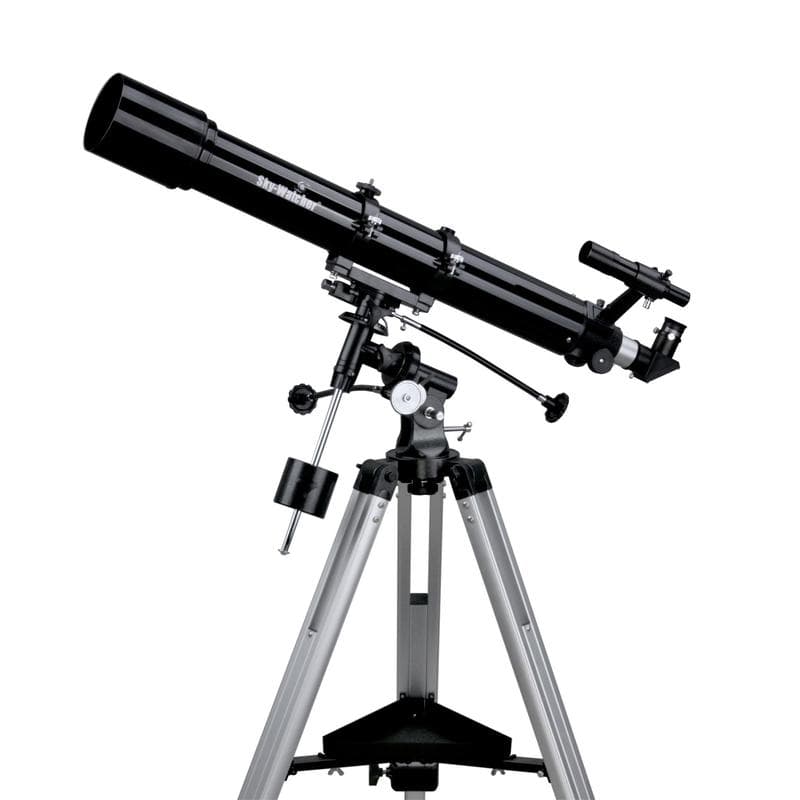 Sky-Watcher Evostar 90/900 EQ-2 Sky-Watcher Evostar 90/900 EQ-2 | 90 mm | 900 mm | — | 25 mm and 10 mm | €244seen 7 Oct 2026 at Astroshop | At Astroshoppaid link4 other sellers
|
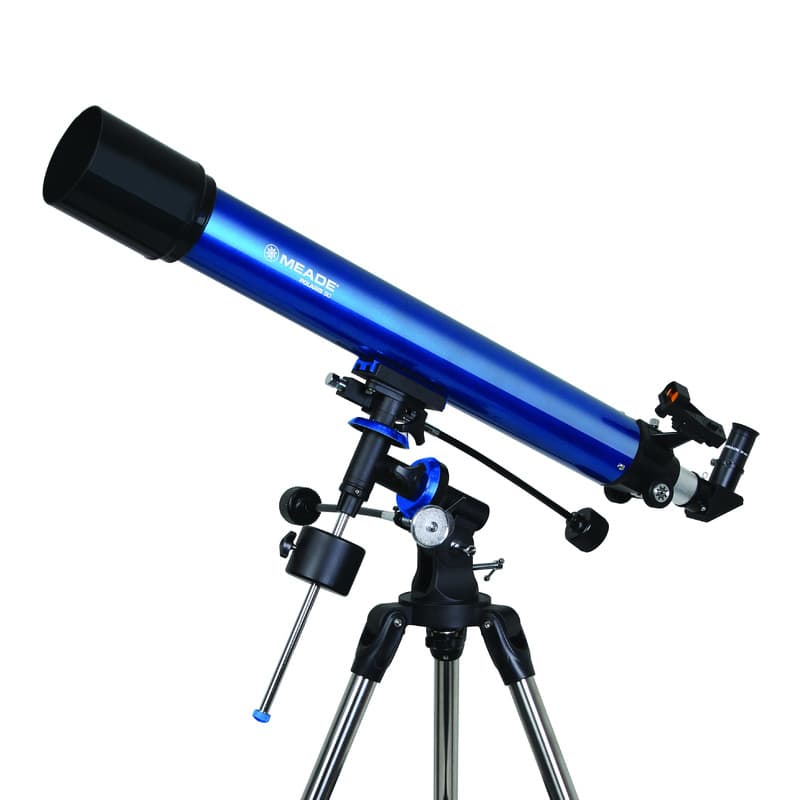 Meade Polaris 90 EQ Meade Polaris 90 EQ | 90 mm | 900 mm | 12 kg | 25 mm, 9 mm and 6.3 mm | €279seen 7 Oct 2026 at Astroshop | At Astroshoppaid link4 other sellers
|
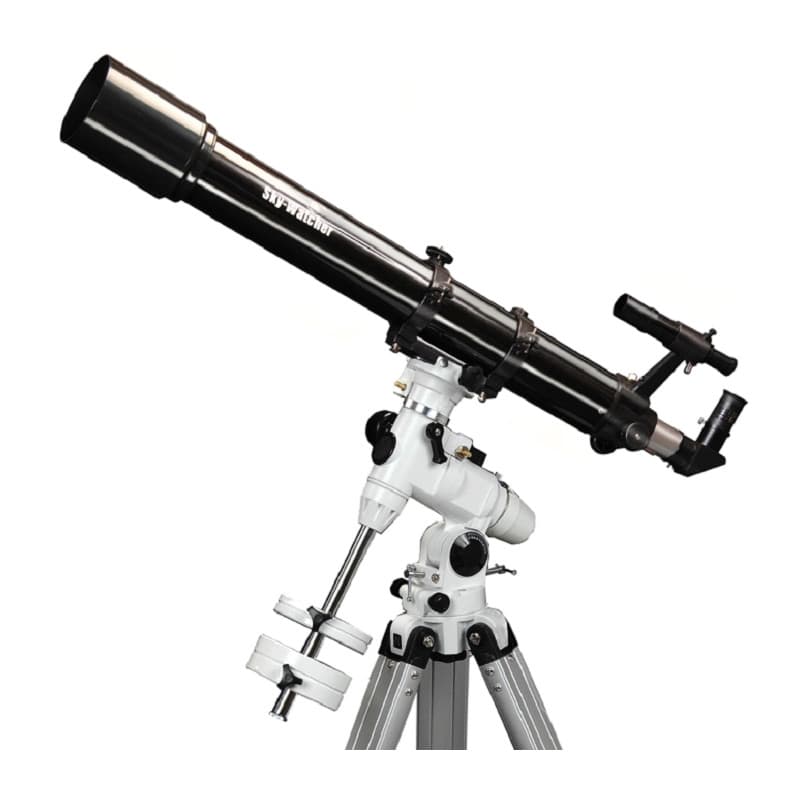 Sky-Watcher Evostar 90/900 EQ3-2 Sky-Watcher Evostar 90/900 EQ3-2 | 90 mm | 900 mm | — | 25 mm and 10 mm | €479seen 7 Oct 2026 at Astroshop | At Astroshoppaid link4 other sellers
|
Questions people ask
A refractor on an equatorial or on an alt-az?
Same tube, same image. The alt-az points the way you look — up, down, left, right — and is set up in a few minutes. The equatorial follows the sky with one knob once it points at the pole, which helps at high power, but it needs polar alignment, a counterweight and some learning.
What does a 90 mm refractor show?
The Moon in detail, Saturn and its rings, Jupiter's belts on a steady night, the bright clusters and the Orion Nebula. The aperture allows about 180× by the usual rule (twice the aperture in millimetres, an exit pupil of 0.5 mm). Galaxies stay hard: 90 mm gathers about half the light of a 130 mm.
Should I push it to the highest power?
Beyond about 180× on 90 mm the exit pupil drops below 0.5 mm: the image gets bigger without gaining detail. A 6 mm eyepiece on 900 mm of focal length already gives 150× on 90 mm (an exit pupil of 0.6 mm); with a 2× Barlow, 300× (0.3 mm), far beyond what 90 mm can show.
Read next
- Refractor or reflector for a first telescope?For the same money a reflector gives two to three times the aperture. When that decides, and the two cases where it does not.Updated 30 Aug 2026
- Which telescope should a beginner buy?The short answer, the three things the box does not say, then the detail by budget and by situation.Updated 24 Sept 2026